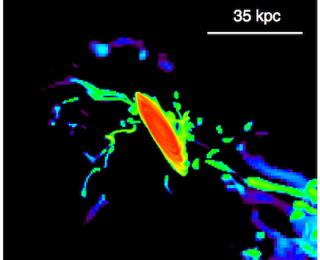
How does the Milky Way get its gas?
While the known gas in the Milky Way’s halo cannot supply enough gas to fuel star formation, what about the gas we haven’t observed yet?

While the known gas in the Milky Way’s halo cannot supply enough gas to fuel star formation, what about the gas we haven’t observed yet?
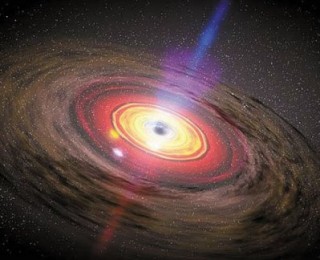
We know that supermassive black holes exist, but how did they get so big? In this paper, the authors seek to shed some light on their progenitors – rapidly accreting, intermediate-mass black holes.
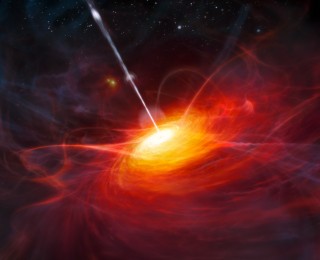
How does AGN activity influence star formation in active galaxies? Dai et al. combine multi-wavelength observations of 32 quasars to bring us closer to the answer.
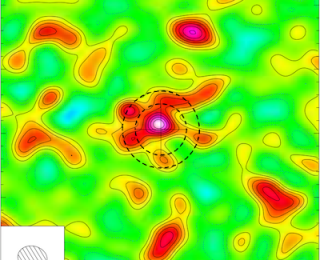
The idea of “negative feedback” on star formation in galaxies is ubiquitous, but the debate about what causes the massive outflows we see in galaxies is far from over. Now, Maiolino et al. have found evidence of a massive quasar-driven outflow at z > 6, making it the earliest instance yet of a central black hole affecting its host galaxy on a global scale.
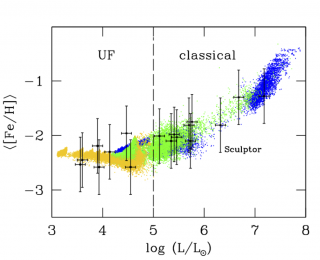
Living metal-poor stars represent the fossil records of the early cosmic star formation.
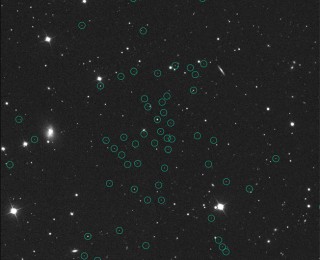
“A galaxy is a gravitationally bound collection of stars whose properties cannot be explained by a combination of baryons and Newton’s laws of gravity.” (Willman & Strader, http://arxiv.org/abs/1203.2608)