by Alice Olmstead | Mar 15, 2012 | Daily Paper Summaries
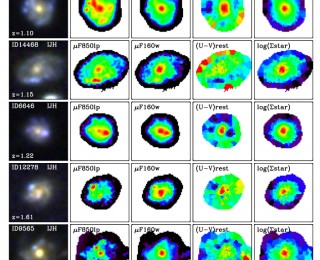
The lack of observed major mergers at high-redshift has prompted discussion of inside-out growth, that is, galaxies building up their stellar populations by cold gas accretion, starting in the inner regions and gradually moving outwards. This picture is far from settled, however, and so the authors of this paper set out to investigate whether or not the observations match the theory.

by Allison Strom | Mar 12, 2012 | Daily Paper Summaries
Researchers at Caltech have used data from the Keck Baryonic Structure Survey to place quantitative constraints on the circumgalactic medium around galaxies at z~2. Measurements like these help us fine-tune our understanding of the interplay between gas and galaxies and, ultimately, galaxy formation and evolution.
by Lucia Morganti | Mar 9, 2012 | Daily Paper Summaries
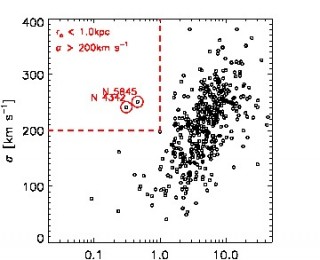
NGC 5845 is a nearby compact galaxy, more similar to the recently discovered high redshift z~2 compact galaxies than to its low-redshift mates. This makes it rare and interesting, as its structure and kinematics can be studied much better than is possible at high redshift. The analysis reveal a prominent rotating stellar disk, suggesting that similar structures could be present in high-redshift compact galaxies too.
by Alice Olmstead | Feb 16, 2012 | Daily Paper Summaries
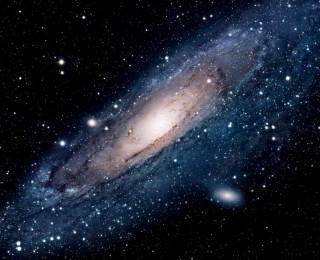
A specific class of elliptical galaxies called compact ellipticals, or cEs, are unusually compressed. Some speculate that these galaxies are petite because their outer layers have been stripped away by a neighboring galaxy; however, an alternative theory claims that these are regular elliptical galaxies that simply formed small and never contained stars in their outer regions. In order to differentiate between these two models, Howley et al. 2012 measured the dynamics of individual stars in one of our nearest neighbors, the compact elliptical M32.
by Courtney Dressing | Feb 16, 2012 | Daily Paper Summaries
This post has been removed. Please see the Astrobites Statement on Harassment Case at Leiden University for more details about this removal.
by Elisabeth Newton | Feb 15, 2012 | Daily Paper Summaries
The basis for something called the “G dwarf problem” is the comparison between observations and a simple model for chemical evolution in a galaxy. To cut to the chase, there are fewer very metal poor G dwarfs than are predicted by this basic understanding. This discrepancy has been shown to hold for the Milky Way as well as for other galaxies. It also holds for K dwarfs in the Milky Way – and now for M dwarfs as well.
