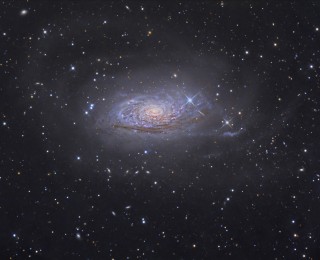
Growing Galaxies Inside-Out
A picture of galaxy construction emerges by comparing the relative sizes of star-formation and stellar continuum emission from 57 z=1 galaxies.

A picture of galaxy construction emerges by comparing the relative sizes of star-formation and stellar continuum emission from 57 z=1 galaxies.
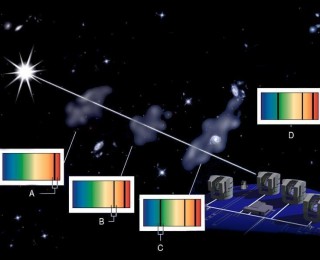
When the light from a distant quasar finally arrives at Earth, it often carries far more information than it did when it was emitted – the shadows of gas and galaxies that have intervened over the cosmic distances between us and the source. These features can tell us how the universe evolves in both space and time, by allowing us to sample both low and high redshifts for structures that would not otherwise be visible. This paper uses a new IR spectrograph, FIRE, deployed on the Magellan 6.5 m telescopes, to present the first high-redshift sample of Mg II absorption systems, including the most distant Mg II system yet found (z = 5.33). The authors show that the number of strong Mg II systems appears to peak and decline in number along with the star formation history of the universe, suggesting a correlation between the two, while weak Mg II systems stay mysteriously constant.
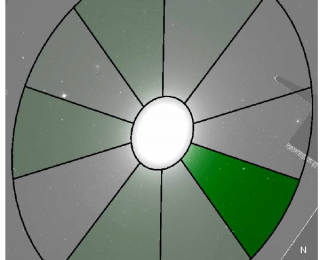
We think many galaxies we see today had mergers and interactions in their past, but how can we know for sure? Bonfini et al. look to evidence from a subtle pattern in the distribution of globular clusters in NGC 4261.
Lensing occurs when the mass of a foreground object distorts and magnifies the light from a background galaxy or quasar, sometimes even creating multiple images. It probably isn’t a stretch to say that the neatest thing about lensing is that you can typically see two to four images of the same galaxy. But something else that’s cool is that these distant background objects are magnified, making it possible to study them in detail when otherwise they might not be seen at all: in this way, gravitational lenses act as natural cosmic telescopes.
Modica et al. and the GOALS team use multiwavelength observations to investigate star formation and nuclear activity in a nearby luminous infrared galaxy.