by Allison Strom | Dec 16, 2012 | Daily Paper Summaries
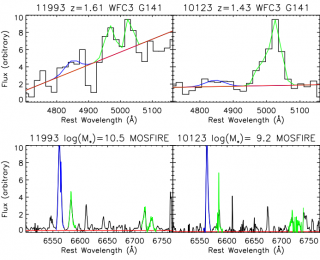
Using new data from the MOSFIRE spectrograph, the authors of this paper test the ability of classic emission line diagnostics to separate star formation activity from supermassive black hole accretion at high redshift. What they find may be important for understanding how the growth galaxies and black holes affect one another over cosmic time.
by Ryan Foltz | Dec 3, 2012 | Daily Paper Summaries
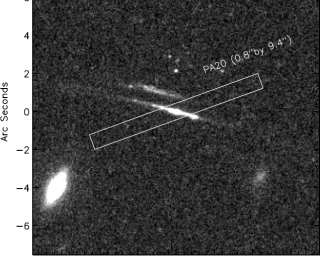
Using massive gravitational lenses can help us study the evolution of galaxies over unprecedented time scales.
by Elisabeth Newton | Nov 29, 2012 | Daily Paper Summaries
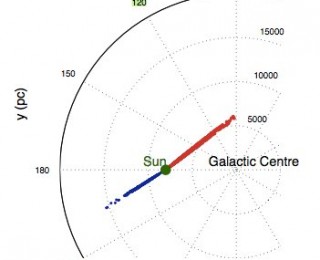
“Galactic archaeology” is the term that has come to refer to using the motions and chemical compositions of stars of different ages to learn about the history of the Milky Way. It seems to me that “galactic paleontology” might be a bit more accurate. I hope to see galactic archaeology v. galactic paleontology fought out in the comments!
by Nathan Sanders | Nov 26, 2012 | Daily Paper Summaries
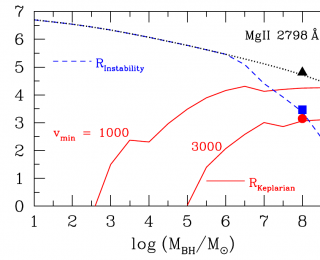
Observational surveys looking for the smallest super-massive black holes come up empty; could they be hiding in plain sight?
by Allison Strom | Oct 4, 2012 | Daily Paper Summaries
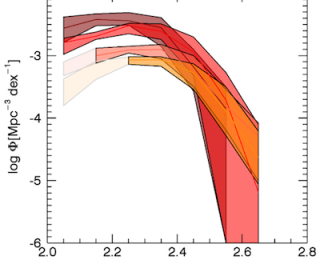
Astronomers at Yale investigate how the number of galaxies at fixed inferred velocity dispersion (a probe of the total gravitational potential) changes as a function of time. Their results support a picture where star-forming galaxies are somehow “quenched” and transition to the non-star-forming galaxy population, consistent with leading ideas of galaxy evolution.
by Shannon Hall | Sep 16, 2012 | Daily Paper Summaries
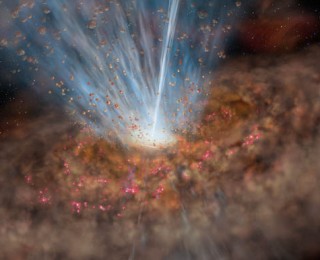
In the nearby Universe, massive galaxies contain very little interstellar gas and old stellar populations. But theoretical models predict that such galaxies should have much younger stellar populations. In order to solve this discrepancy models invoke quasar outflows in the early Universe. Such outflows would expel the gas from a galaxy and quench star formation. Presented here are the results from the first massive quasar outflow observer at z ~ 6.4189.
