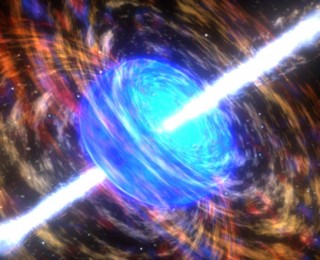
Are Short Gamma-Ray Bursts Jets?
Astronomers detect a jet break in the X-ray afterglow of short GRB 111020A.

Astronomers detect a jet break in the X-ray afterglow of short GRB 111020A.
Last year on Christmas day, scientists observed a unique gamma-ray burst, GRB 101225A. Two interesting and very different models have developed for the ‘Christmas burst:’ a tidal disruption of a comet by a neutron star somewhere in our Galaxy, or a neutron star consuming its companion star over 5 billion light years away.
Using a clever technique, the authors identify a sub-population of rotating Wolf-Rayet stars.
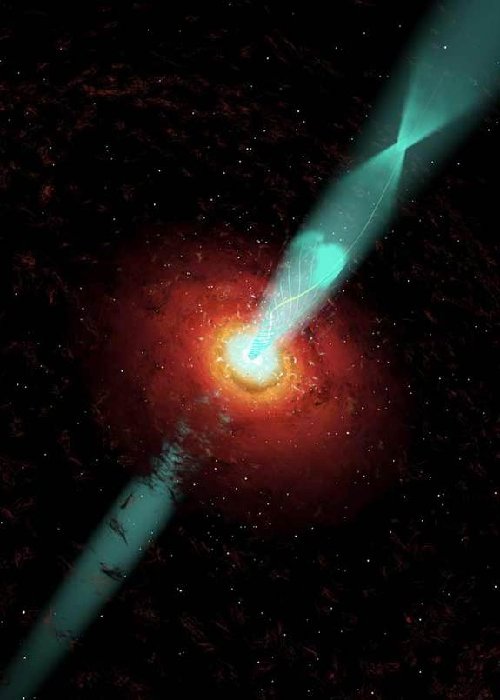
We think that blazars and gamma-ray bursts are both powered by extremely relativistic jets — but how is the kinetic energy of these jets transformed into the staggering amounts of radiation we observe?
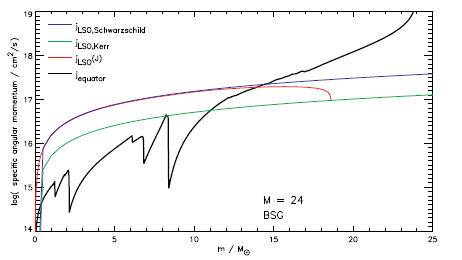
The collapsar model of gamma ray burst production posits that a black hole forms at the center of the star and sucks in the rest of the star’s mass, but that the inner regions have sufficient angular momentum to form an accretion disk which then radiates some fraction of its power in the form of a relativistic jet of matter beaming out of the star. But what if it were the outer, not the inner, layers of the star that had most of the angular momentum? The answer is a very different sort of gamma-ray transient.
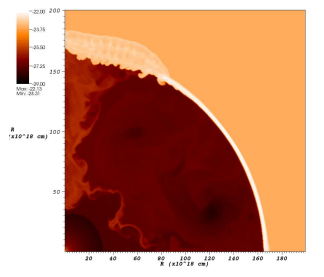
How can the medium immediately surrounding massive stars affect our observations of Gamma-Ray Bursts?