by Nick Ballering | Feb 3, 2014 | Daily Paper Summaries
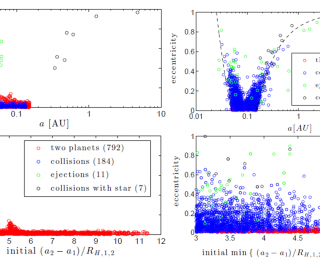
New dynamical simulations show that close-in planets on eccentric orbits can arise from planet-planet scattering — but only if the scattering occurs on larger orbits and is followed by inward migration.
by Lauren Weiss | Nov 10, 2012 | Daily Paper Summaries
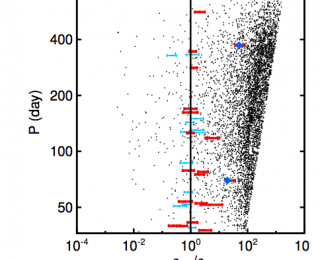
Title: A Paucity of Proto-Hot Jupiters on Super-Eccentric Orbits Authors: Rebekah I. Dawson, Ruth A. Murray-Clay, John Asher Johnson First Author’s Institution: Harvard-Smithsonian Center for Astrophysics Note: This post is based in part on a talk by Rebekah Dawson at the UC Berkeley Planet and Star Formation Seminar on Nov. 7, 2012.IntroductionHow do planets form, and after formation, how do they change their orbits (or “migrate”) to come to their present orbits? The increasing catalog of confirmed exoplanets (planets around other stars), in tandem with the also increasing list of exoplanet candidates discovered by the Kepler Mission, is making it possible to answer these questions through statistical tests of the exoplanet population.The authors investigate the formation history of a particular population of exoplanets called hot Jupiters, Jupiter-size planets in short orbits (in this study, 3-10 days) around their stars. The consensus among most scientists is that hot Jupiters are too big to have formed in their present location; they more likely formed oustide the “ice line,” or the radius at which water can freeze. This is because frozen water molecules can clump into tiny ice crystals, which could then aggregate into larger snowballs to form giant planets. Very few proposed mechanisms (such as core collapse, in which a clump of gas spontaneously collapses to form a planet) could form Jupiters inside the ice line, and these mechanisms are disfavored based on the current body of observations. Thus, theory says that hot Jupiters should have formed beyond the ice line and then migrated inward to their current, super-hot abodes. But how did they get there?There are two popular theories that could bring...
by Shannon Hall | Aug 19, 2012 | Daily Paper Summaries
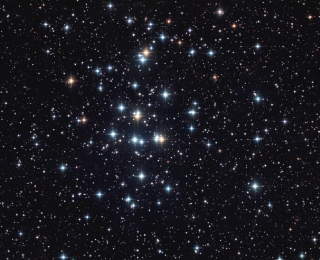
Presented here are the results from a recent survey of the Beehive cluster where two hot Jupiter planets were discovered. These are the first hot Jupiters to be discovered in an open cluster. Not only does this discovery prove that exoplanets do in fact exist in open clusters, but future studies will help provide more precise measurements of exoplanet characteristics.
by Justin Vasel | Jun 21, 2012 | Daily Paper Summaries
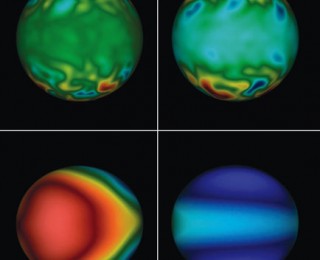
“Characterizing atmospheres beyond the Solar System is an endeavor no longer confined to the realm of science fiction.”
by Michelle Kislak | Apr 11, 2012 | Daily Paper Summaries
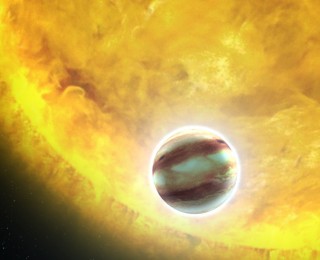
A theoretical study of what we can expect to see when a hot Jupiter crashes into its host star.
by Lauren Weiss | Aug 14, 2011 | Daily Paper Summaries
Title: “SOPHIE velocimetry of Kepler transit candidates IV. KOI-196b: a non-inflated hot-Jupiter with a high albedo Authors: A. Santerne, A. S. Bonomo, G. Hébrard, M. Deleuil, C. Moutou, J.-M. Almenara, F. Bouchy, R. F. Díaz Institutions: Laboratoire d’Astrophysique de Marseille, Institute d’Astrophysique de Paris, Observatoire de Haute-Provence. In the search for planets around other stars, astronomers have stumbled upon a class of planets called “hot Jupiters,” which are large (like Jupiter) and close to their parent stars (and thus hot). What makes these planets interesting is their absurdly low densities, some of which are less dense than styrofoam! How did these planets achieve such low densities? These planets have been “inflated” due to an additional heat source, possibly from the tidal energy of the star or stellar radiation on the atmosphere. While the source of the hot Jupiter inflation remains a mystery, the plethora of inflated hot Jupiters testifies that inflation is common. However, not all hot Jupiters are inflated. Santerne et al. (2011) report the detection of a non-inflated hot Jupiter. This planet, formerly planetary candidate KOI-196.01 in the “Kepler Objects of Interest” (KOI) catalog, was discovered by the Kepler Mission and confirmed by the authors, who used high-precision radial velocity measurements from the SOPHIE instrument at the Observatory of Haute-Provence to calculate the mass of the planet and confirm its planetary nature. By supplementing the publicly available light curves from the Kepler Mission with their measurements from SOPHIE, the authors were able to very precisely determine the mass and radius of both the star and planet.The planet is 0.49 Jupiter masses and 0.841 Jupiter radii, giving it an average density 1.02 grams per cubic centimeter. For...
