A Machine Learning View of Supernova GWs
How does one measure the gravitational wave signal of a supernova if each event is unique? Is machine learning up to the task? Or is it unknowable?

How does one measure the gravitational wave signal of a supernova if each event is unique? Is machine learning up to the task? Or is it unknowable?
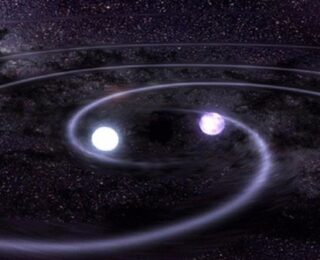
Today’s paper describes an unusually circular binary system – where both components are neutron stars.
The authors of today’s paper seek to uncover what is occulted in the final moments of a massive star’s death. To this end, they outline the feasibility of measuring the background flux of “relic neutrinos” and connect them to their origins.
We report on Day 4 of the 2022 April APS Meeting!
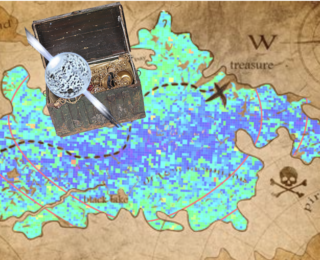
Black holes colliding and neutron stars merging are not the only ways to create GWs! Dergachev and Papa, the authors of today’s paper, searched through the first half of the third LIGO observing run (called “O3a”) for continuous wave signals. They searched every point on the sky and recorded the deepest SNR they were able to search for a CW signal, leaving behind a treasure map (or atlas) for future studies
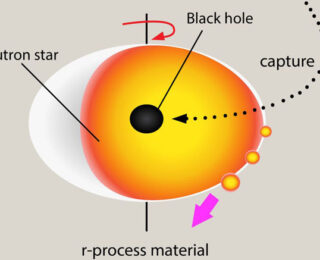
Have you ever wondered where gold comes from? What if it came from the bits of neutron star flesh that dribbled out from a black hole’s maw as it ate the neutron star alive?