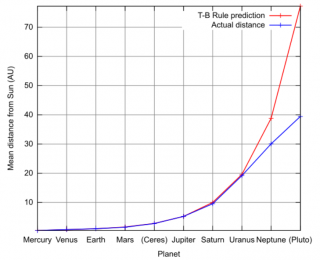
Testing the Titius-Bode law on exoplanets
From examining extrasolar planetary systems, we can test if the Titius-Bode “law” is actually a law.

From examining extrasolar planetary systems, we can test if the Titius-Bode “law” is actually a law.
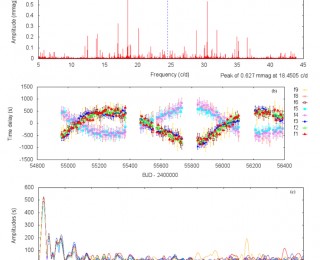
How do pulsating stars give away their secret identities as binary dance partners? In this paper, the authors demonstrate a new way to not only detect binaries we may have missed in the Kepler data, but also to measure their velocities without spectra.
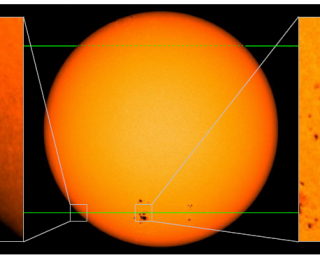
Kepler finds the signature of a transiting white dwarf. Instead blocking the light of its companion star, the white dwarf magnifies it, creating a light curve that periodically brightens.
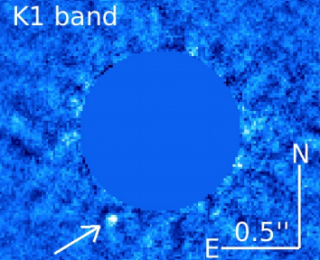
HD 95086 b is one of the first exoplanets directly imaged with the newly commissioned instrument Gemini Planet Imager. This is only the first in what is likely to be a long line of exciting results coming from this state of the art instrument.
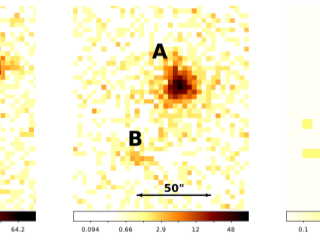
Hot Jupiters offer an interesting mechanism for affecting the rotation and magnetic activity levels of their host stars.
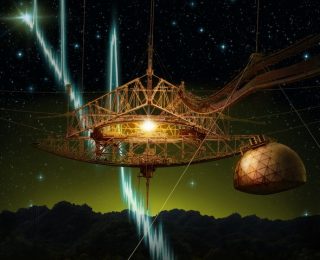
A mysterious Fast Radio Burst (FRB) from beyond the galaxy has been detected at Arecibo. This is the first FRB discovered outside of Parkes Observatory, giving greater credence to the astronomical nature of these signals.