by Korey Haynes | Nov 26, 2013 | Daily Paper Summaries
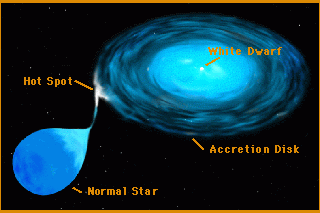
Cataclysmic variables are binary star systems where one of the stars—a white dwarf—devours its main sequence partner over time. Kepler proves yet again that it can find a lot more than just exoplanets by identifying a cataclysmic variable with a period of less than an hour.
by Yvette Cendes | Nov 22, 2013 | Daily Paper Summaries
Title: Evidence of an Asteroid Encountering a Pulsar Authors: P. R. Brook, A. Karastergiou, S. Buchner, S. J. Roberts, M. J. Keith, S. Johnson, R. M. Shannon First Author’s Institution: University of Oxford Pulsars- neutron stars formed during supernovae explosions- are often considered the “precision clocks” of radio astronomy. This is because of two fundamental properties observed from their radio pulses: the average emitted radio beam- known as the pulse profile– remains very stable over decades, and the pulsar has extreme rotational stability thanks to its fast rotation. All pulsars have a rotational frequency, ν, which is gradually decreasing due to a loss of energy, and its change with time, the spin-down rate, tells radio astronomers about the stability of the pulsar. Hundreds of pulsars have been observed to have glitches where the pulsar’s rotational frequency is seen to increase rapidly, and there have even been anti-glitch observations where the pulsar abruptly slowed down, which are thought to be caused by the magnetic fields of the pulsar.But the interesting thing about astronomy is even in a field where things are as precise as pulsars, surprises will still crop up. And this is what happened during a 24-year observing campaign of PSR J0738-4042, when in September 2005 the spin-down rate abruptly changed and a new radio component was observed. In fact, no previously understood mechanism can explain these changes, and the observations led the paper’s authors to propose they witnessed an asteroid encountering the pulsar.The observations were relatively straightforward: PSR J0738-4042 is a bright radio pulsar and was the target of a monitoring campaign by the Hartebeesthoek Radio Astronomy Observatory (HartRAO) in South...
by Becky Smethurst | Nov 21, 2013 | Daily Paper Summaries
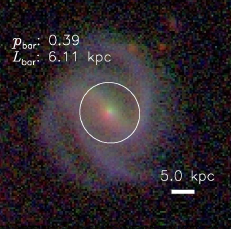
Galactic bars have long been associated with many processes affecting galactic evolution. This paper studies how bars affect the star formation rate, mass and structure of a large sample of morphologically classified galaxies.
by Meredith Rawls | Nov 12, 2013 | Daily Paper Summaries
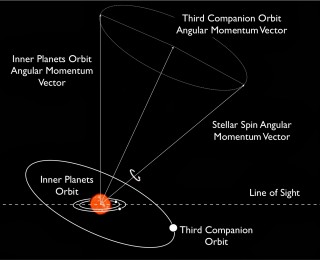
Our Solar System is pretty straightforward. Roughly speaking, all the planets orbit in the same plane, most spin on their axes in the same direction in that plane, and even the Sun rotates in a manner consistent with all this. The small, rocky planets are closer to the Sun, and the big, gaseous planets are farther from the Sun. Simple. Now that we are finding planets orbiting other stars, many are turning out to be multiplanet systems like our own Solar System.
by Chris Faesi | Nov 5, 2013 | Classics, Daily Paper Summaries
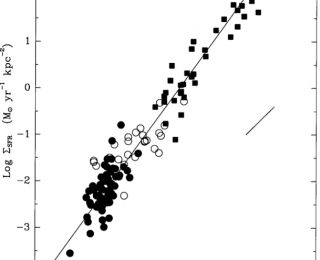
In today’s “astrophysical classic”, we delve into the seminal paper behind the Kennicutt-Schmidt relation, the empirical correlation between the star formation rate and gas density.
by Nick Ballering | Nov 4, 2013 | Daily Paper Summaries
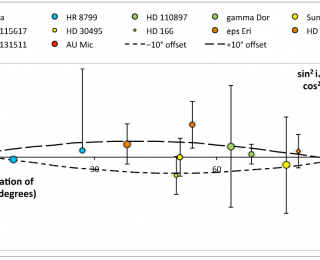
Herschel observations reveal that debris disks are aligned with their stars’ equators, unlike some close-in transiting exoplanets.
