by Lucia Morganti | Dec 16, 2011 | Daily Paper Summaries
Title: Two ten-billion-solar-mass black holes at the centres of giant elliptical galaxies Authors: Nicholas J. McConnell, Chung-Pei Ma, Karl Gebhardt, Shelley A. Wright, Jeremy D. Murphy, Tod R. Lauer, James R. Graham, Douglas O. Richstone First Author’s Institution: Department of Astronomy, University of California, Berkeley This Nature letter reports on a recent discovery that has also met with great interest in the popular press: astronomers have measured the biggest black holes ever! These two ten-billion-solar mass giants are significantly more massive than any other known black hole and more massive than predicted with the widely-used correlations relating the black hole mass to other properties of the host galaxy.First, a bit of context. Black holes are extremely compact concentrations of matter producing such strong gravitational pull that nothing, not even light, can escape. General relativity predicts such gravitational singularities of zero volume and thus infinite density. Studying stellar evolution, we learn that the explosions of heavy stars as supernovae can leave behind remnants of stellar mass-black holes. But super-sized black holes of million solar masses (called supermassive black holes) presumably originate from mergers of other black holes, or by accreting large amounts of stars and gas in an active galactic nuclei (AGN) phase.Nowadays astronomers believe that every galaxy harbours a supermassive black hole at its center, including our own Milky Way where a central mass concentration of four million solar masses has been deduced from 16-years monitoring of stellar proper motions (see also today’s astrobite on the amazing discovery of a huge gas cloud being swallowed by this black hole). As pointed out by Susanna’s astrobite, it is not possible...
by Courtney Dressing | Dec 14, 2011 | Daily Paper Summaries
Today, Mercury rotates only three times in two Mercury years. How did the planet get to this state? Was Mercury tidally locked in the past?
by Courtney Dressing | Dec 8, 2011 | Current Events
The First Kepler Science Conference is occurring this week at NASA Ames. Check out this summary of the conference to learn about the exciting results from the Kepler mission.
by Elizabeth Lovegrove | Nov 21, 2011 | Current Events, Daily Paper Summaries
The OPERA experiment in the Gran Sasso tunnel in Italy recently shocked the physics world by announcing that they had clocked neutrinos violating that ultimate of speed limits – the speed of light. Most scientists, upon hearing the news, rightly reacted with skepticism, and the results were closely examined to unearth any unaccounted-for sources of error that could have resulted in an incorrect measurement. On November 17th, the OPERA collaboration responded by pushing a new paper to the arXiv that eliminated one of their systematics, the length of the neutrino pulses received from CERN, and found that their data still show a significant superluminal signal.
by Kim Phifer | Nov 20, 2011 | Daily Paper Summaries
Title: Fermi Detectiqon of a Luminous γ–ray Pulsar in a Globular Cluster Authors: The Fermi LAT Collaboration Principle Investigator: Dr. Peter Michelson, Stanford UniversityThe Fermi Large Area Telescope, which was launched in 2008, is a gamma ray space telescope which can observe high-energy photons with energies ranging between 20 MeV and 300 GeV. These photons are emitted by particles nearing the speed of light! The Large Area Telescope (LAT) is true to its name, and can observe around 20% of the sky at a time. It scans the sky continuously, observing the entire sky every 3 hours. This all sky gamma-ray survey has already had many exciting results. It observed the GRB 080916C, the most energetic outburst ever seen (see Susanna’s post to learn more about gamma-ray bursts), discovered a link between supernovae remnants and cosmic rays, found out that most of the gamma-ray background does not arise from active galactic nuclei as was previously suspected, and it discovered Fermi bubbles, completely new (or at least previously unseen) substructures emerging from the Galactic center. In addition to all of this, Fermi LAT has proven fantastic tool for the discovery of pulsars.Pulsars form during some type II supernovae events, and are spun up to high rotation speeds by some “kick” due to collapse or explosion asymmetries. They are also highly magnetized, and thus emit periodic synchrotron radiation in two beams. For a more in depth discussion of the observables of pulsars, see this astrobite. The first pulsar discovered, at the heart of the Crab Nebula, was initially observed in radio wavelengths. This was quite a discovery, so much so that...
by Courtney Dressing | Nov 10, 2011 | Daily Paper Summaries
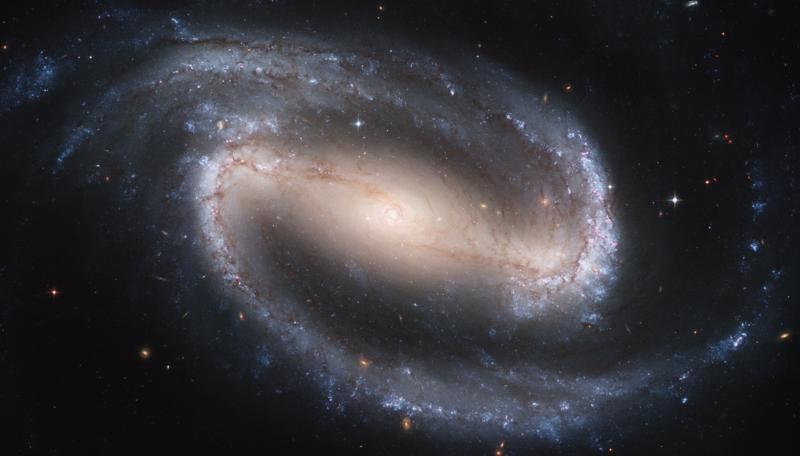
Paper title: Bars rejuvenating bulges? Evidence from stellar population analysis Authors: Paula Coelho and Dimitri A. Gadotti First author’s affiliation:Núcleo de Astrofísica Teórica, Universidade Cruzeiro do Sul, São Paulo, Brasil SummaryAs you may recall from Nathan Sanders’ April post, some spiral galaxies have central bulges with high concentrations of stars. Coelho and Gadotti examine a sample of 575 of these galaxies to investigate whether the presence or absence of a bar (a bar-shaped overdensity of stars) influences the rate of star formation in the central bulge. Astronomers expect to see a higher star formation rate in the bulges of barred galaxies because bars can transport gas from the outer regions of the galaxy into the center and supply fuel for growing stars. Previous detections of star-formation indicators (such as enhanced Hα emission) have indicated that the current star formation rates are higher in barred spirals than in unbarred spirals, but Coelho and Gadotti take the alternative approach of determining the ages of the stellar populations in the bulges. They find that the bulges of barred galaxies are systematically younger than the bulges of unbarred galaxies, which is consistent with the expectation that bars should promote star formation. The Galaxy SampleIn a previous paper, Gadotti derived stellar masses, bulge stellar masses, bar properties, and other parameters for a sample of face-on galaxies observed by Sloan Digital Sky Survey (SDSS). All of the galaxies had stellar masses above 10^10 solar masses and redshifts between 0.02 and 0.07. Selecting face-on galaxies reduced the effect of dust and simplified the process of identifying bars and bulges in the galaxies. In this paper, Coelho...
