• RSS
  • Submit a Guest Post
  • Undergraduates: Submit your Research!
  • Suggest a Paper Topic!
astrobites
  • About
    • About Astrobites
    • Meet the Authors
    • Statement of Inclusivity
    • Copyright & Permissions
  • Latest Research
    • Daily Paper Summaries
    • Classics
    • Undergrad Research
    • Physical Review Coverage
  • Beyond astro-ph
    • Beyond astro-ph Library
    • Interviews
    • Career Navigation
    • Personal Experiences
    • Current Events
    • Teaching with Astrobites
  • Guides
    • EM Spectrum
    • Galaxies & AGNs
    • Spectroscopy and Spectral Lines
    • Adaptive Optics
    • Gravitational Waves
    • Transient Astronomy
    • Astrophysical Software
    • Graduate School
    • Writing a personal statement for grad apps
    • First Observing Run
    • …More Guides!
Select Page
Boomerang, Slingshot, or Torque-Dependent? How to Classify Your Favorite Ring-Satellite System

Boomerang, Slingshot, or Torque-Dependent? How to Classify Your Favorite Ring-Satellite System

by Will Saunders | Jan 16, 2020 | Daily Paper Summaries

When moons and rings orbit together, the results can be crazy. This paper proposes three regimes to more easily understand these complex interactions.

Clearing Up Stellar Streams with Gaia

Clearing Up Stellar Streams with Gaia

by Nora Shipp | Jun 21, 2018 | Daily Paper Summaries

What will new data from Gaia reveal about the formation and evolution of stellar streams in the Milky Way?
How Weird Is Our Solar System?

How Weird Is Our Solar System?

by Jaime Green | Apr 23, 2014 | Daily Paper Summaries

Earth and its Solar System compatriots all have nearly circular orbits, but many exoplanets orbit their stars on wildly eccentric paths. Is our home system strange? Or is our sense of the data skewed?
How Green Can a Planet in a Resonant Orbit Be?

How Green Can a Planet in a Resonant Orbit Be?

by Jaime Green | Feb 28, 2014 | Daily Paper Summaries

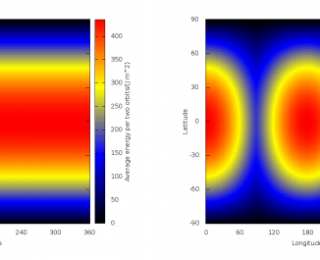
Planets orbiting close to type-M dwarf stars are in the habitable zone, but if their orbits are in a 3:2 spin resonance, do their long, strange days and nights have a chance of supporting photosynthetic life?
Orbital Decay of X-ray Binaries

Orbital Decay of X-ray Binaries

by Josh Fuchs | Nov 27, 2013 | Daily Paper Summaries

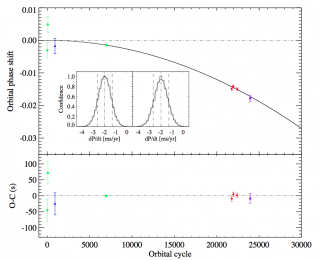
In today’s paper, the authors study how the periods of two black hole x-ray binaries are changing. They find that the periods are decaying faster than expected based on standard theoretical arguments.
How to Drag an Asteroid to Earth

How to Drag an Asteroid to Earth

by Justin Vasel | Aug 14, 2013 | Daily Paper Summaries

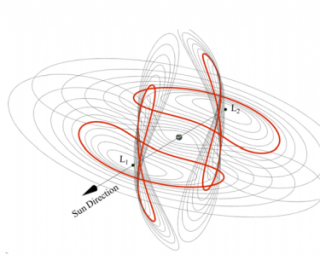
With some assistance from gravity, it is possible with currently-available technologies to bring small asteroids into orbit next to Earth to be studied and mined.

« Older Entries
Next Entries »

Loading

Follow our socials

  • Bluesky
  • Facebook
  • Instagram
  • RSS Feed

More Posts About

AAS AGN astronomy astrophysics binary stars black holes cosmology dark matter dwarf galaxies exoplanets galaxies galaxy evolution gravitational waves habitability JWST Kepler Milky Way observations planetary science planet formation protoplanetary disks radio astronomy simulations solar system spectroscopy star formation stars stellar evolution supernovae theory

Posts by Category

  • Accessibility
  • Applications
  • Beyond
  • Book Reviews
  • Career Navigation
  • Classics
  • Climate Change
  • Course Assignments
  • Crossposts
  • Current Events
  • Daily Paper Summaries
  • Game Reviews
  • Guides
  • Historical Astronomy
  • Instrumentation
  • Interviews
  • Outreach
  • Personal Experiences
  • PRJ
  • Quick Notes
  • Satellites
  • Teaching
  • Undergraduate Research

More Astronomy

  • AAS
  • AAS Nova
  • astro-ph
  • AstroBetter
  • APOD

Read Astrobites in Other Languages

  • Astrobitos (Spanish)
  • Astropontos (Portuguese)
  • staryab (Farsi)

Listen to Astrobites

  • astro[sound]bites

Discover More Incredible Science

  • ScienceBites Network
  • RSS

© 2026 Astrobites | All Rights Reserved | Supported by AAS | Designed by Elegant Themes | Powered by WordPress