by Sukrit Ranjan | Oct 17, 2012 | Daily Paper Summaries
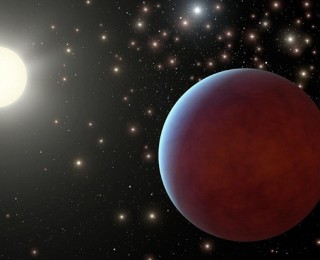
This paper looks at the role a young star’s environment plays in forming planets around it.
by Justin Vasel | Sep 17, 2012 | Daily Paper Summaries
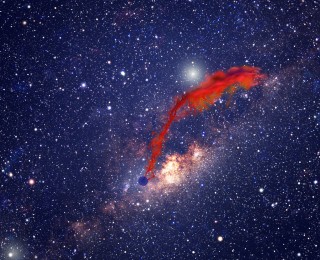
Paper Title: Disruption of a Proto-Planetary Disk by the Black Hole at the Milky Way Centre Authors: Murray-Clay, R. A. and Loeb, A. Institution: Harvard-Smithsonian Center for Astrophysics (CfA)If our solar system lives in suburbia, the center of our galaxy is a sprawling metropolis shining bright for all to see. The center of our Milky Way Galaxy is a crowded, bustling and hectic place. Stars race around like cars on a freeway. Densely-packed hot stars and supernova explosions flood the region with deadly radiation. The supermassive black hole at the center destroys anything that dares to wander too close and test its strength. The galactic center is different than what we’re used to. It’s exciting. It’s dangerous. It’s the kind of place that’s fun to visit, but you wouldn’t want to raise your kids there. The traditional wisdom among astronomers is that stars feel the same way; There is just too much excitement going on in the galactic center for planets to form around stars…Or is there?Last year, a team of astronomers at the Very Large Telescope (VLT) in Chile discovered a cloud of gas falling towards the black hole at the center, Sagittarius-A* (SgrA*). The team hypothesized that the gas cloud was the result of a collision between two gas clouds streaming from nearby stars. New research from the CfA proposes the seemingly-unlikely explanation the gas cloud is a proto-planetary disk surrounding a star that is too faint to see. A proto-planetary disk is a cloud of gas and dust that orbits a star for millions of years while it slowly coalesces into planets and asteroids and comets; It is where...
by Sukrit Ranjan | Jul 25, 2012 | Daily Paper Summaries
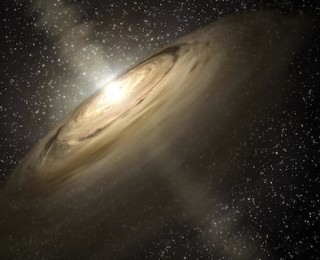
Planet formation theory predicts a water-rich Earth. On a comparative basis, the Earth is water-poor. This paper aims to reconcile theory and observation.
by Nick Hand | Jul 8, 2012 | Daily Paper Summaries
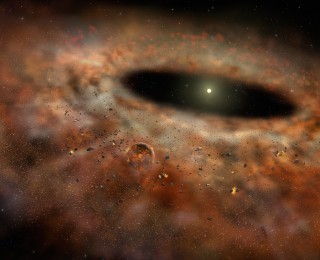
The authors report on a young, Sun-like star with a debris disk of dust and larger rocks that has had the dust particles mysteriously vanish from the disk in a span of less than two years.
by Courtney Dressing | Apr 26, 2012 | Daily Paper Summaries
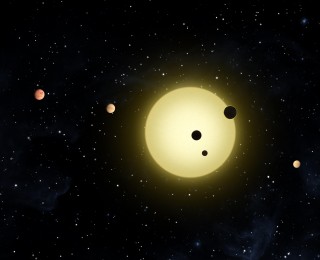
Many Super-Earths appear to be less dense than the Earth. How do such planets form? Could a rocky Super-Earth accrete a hydrogen-helium atmosphere in-situ?
by Elisabeth Newton | Mar 14, 2012 | Daily Paper Summaries
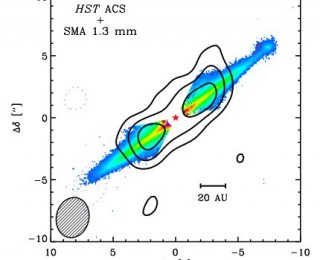
AU Mic is a low mass star that undergoes unpredictable brightening events, called flares. It’s located just 10pc and has a circumstellar disk. In this paper, Wilner et al. report on observations of the disk at millimeter wavelengths and find evidence for a planetesimal ring.
