by Nick Ballering | May 21, 2013 | Daily Paper Summaries
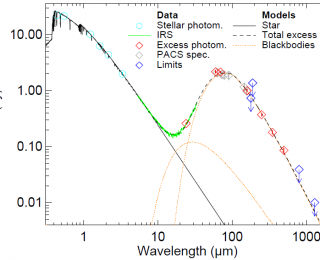
The disk around 49 Ceti is known to show characteristics of both protoplanetary and debris disks. New observations with Herschel reveal that it is likely a debris disk with gas generated by evaporating comets.

by Nick Ballering | Mar 25, 2013 | Daily Paper Summaries
Spectroscopy with Herschel can probe the dust in the heart of protoplanetary disks through the 69 micron feature of forsterite. Examining these features in detail reveals that the dust grains are small, iron poor, and confined to narrow rings.
by Nick Ballering | Dec 24, 2012 | Daily Paper Summaries
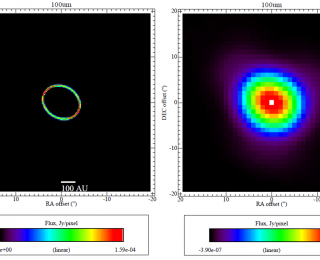
Resolved images of debris disks with Herschel reveal their true sizes, and test the assumptions used in unresolved observations.
by Caroline Morley | Dec 13, 2012 | Daily Paper Summaries
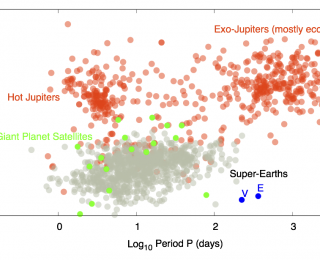
Do planets form in place, or migrate?
How planets form is still a remarkably open question. We haven’t even figured out definitively whether planets formed in the places they are now, or formed in different places and then migrated to their present locations.
by Elisabeth Newton | Dec 11, 2012 | Daily Paper Summaries
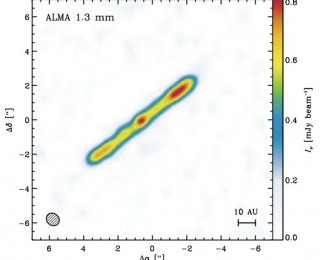
I’ve got pretty bad eyesight. If I take off my glasses and look at the flowers on my window sill, they look like a fuzzy yellow blob. But with glasses, the petals and the patterns cast on them come into focus. This is how I felt when looking at the new observations of the debris disk around AU Mic. Putting on our ALMA glasses, the fuzzy debris disk around AU Mic is sharpening into something surprisingly consistent with our own Solar System.
by Sukrit Ranjan | Nov 14, 2012 | Daily Paper Summaries
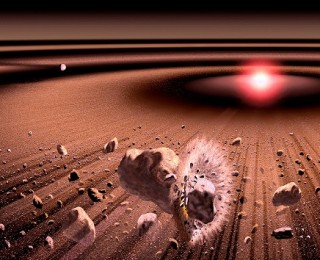
Paper Title: Comet-Like Mineralogy of Olivine Crystals in an Extrasolar Proto-Kuiper Belt (arxiv: 1211.2626) Authors: B. L. de Vries et al First Author’s Affiliation: K. U. Leuven, Flanders, Belgium Journal: Nature OverviewThis paper describes observations of the mineral olivine in the famous debris disk surrounding the star Beta Pictoris. Olivine is very important as it is one of the primary building blocks of rocky planets. They find its composition and temperature to match what we find in our outer solar system, hinting that we are spying on a proto-Kuiper belt. The similarity between solar systems suggests similar processes may be operating in other systems as happened here around Sol.More DetailIn the past decade, we’ve made huge advances in remote characterization of planetary bodies. From the atmospheres of exoplanets to the surfaces of asteroids, astronomers have conducted some pretty extraordinary measurements (for example, the discovery of Alpha Centauri Bb, which entailed measuring the motion of Alpha Cen to 51 cm/s — a slow walk!). However, most of these measurements have been surface measurements. It’s much harder to study the interiors of objects, because we don’t receive photons from them.There are exceptions, though. Consider a young planetary system with plenty of asteroids. These asteroids will run into each other, shattering apart and generating dust. Light passing through these dust clouds will then have their spectral signature imprinted on them, letting us study their interior composition!Astronomers have discovered several such systems, allowing us for the first time to characterize the interior composition of rocky bodies remotely. This paper presents the results of the latest such study, on the system Beta Pictoris. Beta...
