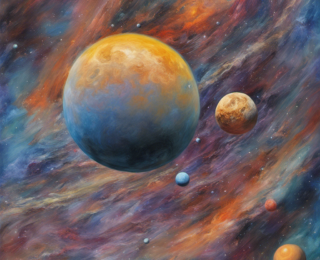
Sednoids: Echoes of a Rogue Planet in the Early Solar System?
Ancient rogue planet could explain why sednoids in our Solar System follow such unusual, distant orbits.

Ancient rogue planet could explain why sednoids in our Solar System follow such unusual, distant orbits.
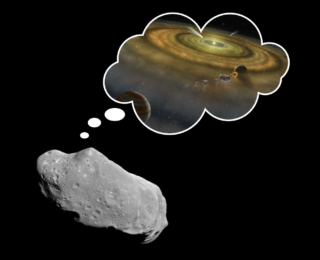
Meteorites may hold a key piece of information for understanding planet migration in our solar system!
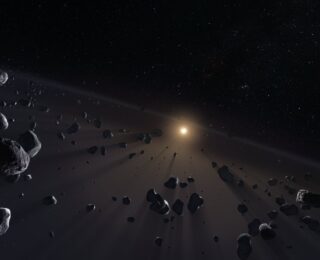
Can the Kuiper Belt’s mystery be uncovered with machine learning? This astrobrite article explores how researchers use advanced statistical techniques to calculate the dimension of our vast cosmic ring.
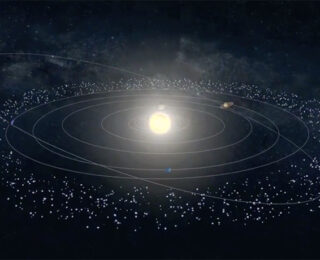
Dive into the weeds of modeling the small bodies in the far reaches of the solar system.
A supposed extrasolar meteorite made a big splash in both the headlines and the Pacific Ocean. Today’s authors ask whether this object might not have been interstellar at all.
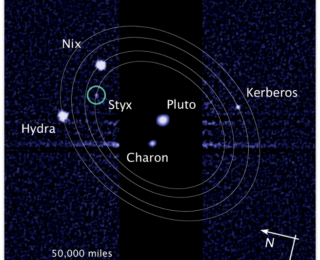
Pluto and Charon form a binary system. Around their barycenter, four recently discovered moons are orbiting: Styx, Nix, Kerberos and Hydra. In this work, two separate approaches were utilized to model their orbits. At first, all bodies were simulated using an n-body integrator and then outcomes were validated by a theoretical model. The motions that the four small moons follow are a superposition of forced oscillations by the binary system and mutual gravitational interactions. Results indicated that we cannot use Keplerian elements to describe the circumbinary orbits, as the central potential by the dwarf binary planet forces the small moons into several oscillations. Even when demanding a zero-orbital eccentricity, distances appeared to have many fluctuations through time. Lastly, we noticed that the mutual effects induce many long period perturbations, especially for the lighter moons, whereas the binary effects mainly dominate in the high frequency region.