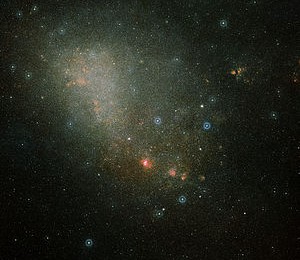
Interstellar Lithium in the Small Magellanic Cloud
What can a nearby dwarf galaxy tell us about the the chemical evolution of the universe?

What can a nearby dwarf galaxy tell us about the the chemical evolution of the universe?
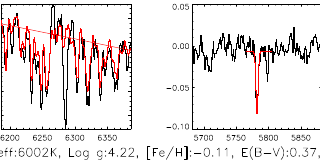
The current and next generation of large scale spectroscopic surveys could provide new clues in the hunt for the carriers producing mysterious interstellar absorption features.
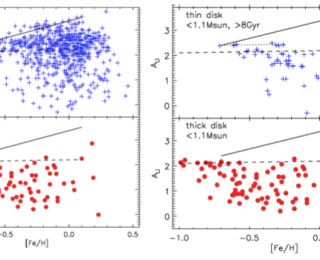
Is there a link between lithium abundance, galactic chemical evolution, and exoplanets? Ramirez et al. examine metallicities, lithium abundances, and stellar characteristics of 1381 Sun-like stars to find out.
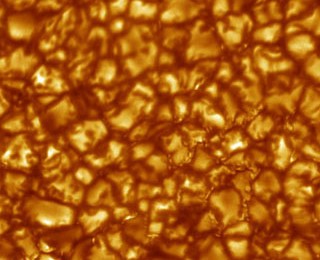
One prediction of General Relativity is that because of the way that gravity affects time, the frequency of electromagnetic radiation (light) emitted at the solar surface should decrease as it escapes the Sun’s gravitational potential well, i.e., the solar spectrum should appear gravitationally redshifted. Surprisingly, according to this recent paper by Takeda and Ueno, that prediction had yet to be definitively verified…until now.
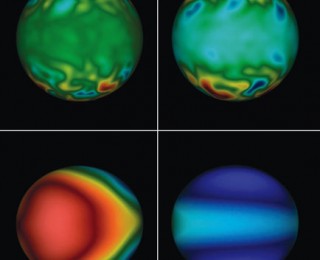
“Characterizing atmospheres beyond the Solar System is an endeavor no longer confined to the realm of science fiction.”
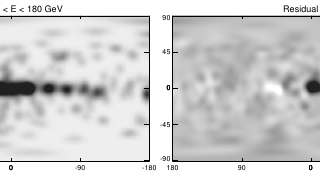
A flurry of recent papers point to detection of a ~130 GeV gamma-ray emission line from near the Galactic center. If real, this could be the first detection of a signature of annihilating dark matter.