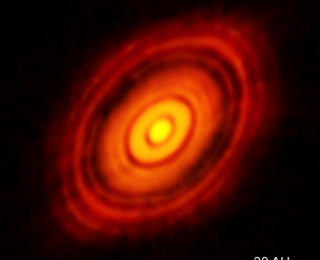
Opening the Envelope on Protostars
Protostars aren’t quite stars yet, but that doesn’t mean they aren’t important in stellar evolution. Today’s paper looks at the magnetic field across the different regions in a protostar.

Protostars aren’t quite stars yet, but that doesn’t mean they aren’t important in stellar evolution. Today’s paper looks at the magnetic field across the different regions in a protostar.
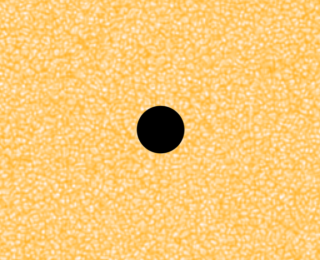
In the era of precise exoplanet detection, what fundamental limit does stellar variability place on exoplanet properties?

We know that Gaia is an amazing instrument to learn more about the Milky Way. Well, it turns out it could also be used to detect gravitational waves!
In this bite, we follow Betelgeuse’s rise to fame (and in magnitude).
Long-term space missions have left us with a wealth of stellar data. Come to Dr. Jennifer van Saders’s talk at #AAS235 to learn more about how these data, along with stellar models, can reveal a star’s evolutionary past and future.
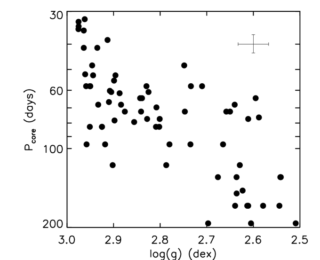
All stars rotate, and stellar rotation can impact a star’s evolution greatly. However stellar rotation remains poorly understood. Can studying stellar pulsations shed light on this topic?