by Ian Czekala | Apr 15, 2012 | Daily Paper Summaries
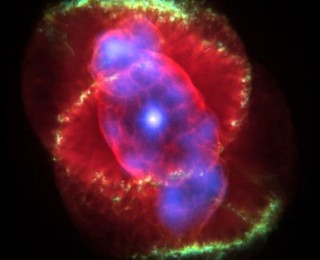
It’s a fact of the universe that most stars are members of a binary system. However, our knowledge of stellar evolution has most thoroughly treated the case of a single, isolated star evolving according to its own schedule, dictated by the well-understood equations of stellar structure. What happens when the binary stars have tight enough orbits to influence each other?
by Courtney Dressing | Apr 12, 2012 | Daily Paper Summaries
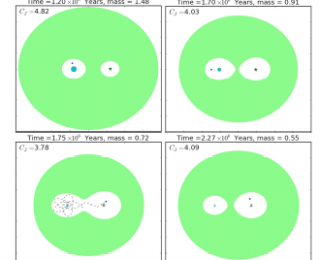
What happens to planets in binary star systems when the primary star evolves off the main sequence? Can the planet survive?
by Elisabeth Newton | Apr 11, 2012 | Daily Paper Summaries
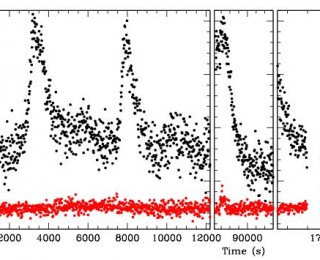
Title: SDSS J184037.78+642312.3: The First Pulsating Extremely Low Mass White Dwarf Authors: J. J. Hermes, M. H. Montgomery, D. E. Winget, Warren R. Brown, Mukremin Kilic, Scott J. Kenyon First Author’s Institution: UT Austin, TX97% of all stars — those with initial masses less than about 8 solar masses — end their lives as white dwarfs (WDs), hot objects with roughly the mass of the Sun but with the radius of the Earth. They have virtually no internal source of energy and so simply cool with time. Some of the coolest white dwarfs have been around for quite a while and are probes of conditions in the early Universe. They are also tracers of galaxy evolution and can be used to date stellar populations. Understanding their nature is key if we are to use white dwarfs for these purposes.Asteroseismology of pulsating white dwarfs is one way to learn about the interior structure of these fascinating objects. Asteroseismologists use stellar vibrations in much the same way as seismologists use earthquakes to study Earth’s interior (see this astrobite and this one). The authors of this paper are on a hunt for DAV WDs. For those of us who don’t speak white dwarf lingo, that’s a white dwarf (“D”) with a hydrogen atmosphere (the “A” subclass) that pulsates (“V” for variable). There are actually quite a few of these DAV WDs, but the 150 we know of are fairly massive for white dwarfs, with masses between 0.5 and 1.1 solar, and are believed to have carbon-oxygen cores. These authors are after a rarer beast: a pulsating helium-core white dwarf, which would have...
by Courtney Dressing | Mar 15, 2012 | Daily Paper Summaries
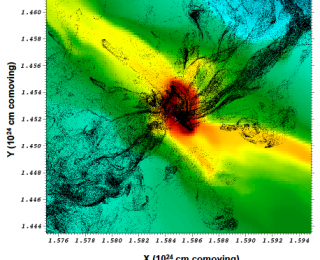
What if the first stars were only 1-50 times as massive as the Sun? Would they still be able to enrich the intergalactic medium and trigger the birth of the next generation of stars?
by Elisabeth Newton | Mar 14, 2012 | Daily Paper Summaries
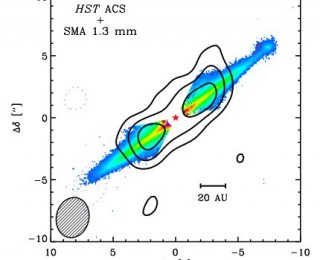
AU Mic is a low mass star that undergoes unpredictable brightening events, called flares. It’s located just 10pc and has a circumstellar disk. In this paper, Wilner et al. report on observations of the disk at millimeter wavelengths and find evidence for a planetesimal ring.
by Courtney Dressing | Feb 16, 2012 | Daily Paper Summaries
This post has been removed. Please see the Astrobites Statement on Harassment Case at Leiden University for more details about this removal.
