by Elisabeth Newton | Feb 15, 2012 | Daily Paper Summaries
The basis for something called the “G dwarf problem” is the comparison between observations and a simple model for chemical evolution in a galaxy. To cut to the chase, there are fewer very metal poor G dwarfs than are predicted by this basic understanding. This discrepancy has been shown to hold for the Milky Way as well as for other galaxies. It also holds for K dwarfs in the Milky Way – and now for M dwarfs as well.
by Kim Phifer | Feb 14, 2012 | Daily Paper Summaries
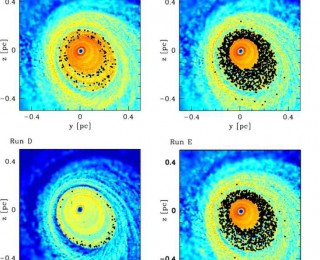
The Center of our Galaxy is one of the most extreme dynamical environments we can observe in detail because individual stars can actually be resolved using adaptive optics. Over time, monitoring individual stellar orbits has firmly established the presence of a supermassive black hole of about 4 x 10⁶ M☉ (check out this video too). Further examination of these fast-moving stars’ properties (via infrared spectroscopy) revealed a surprising detail — many of these stars are young!

by Shannon Hall | Feb 12, 2012 | Daily Paper Summaries
This paper discusses the observed anomalies caused by starspot occultations due to transiting exoplanets. They are useful in determining the obliquity of the star with respect to the orbital plane of the transiting planet.
by Maria Drout | Feb 8, 2012 | Daily Paper Summaries
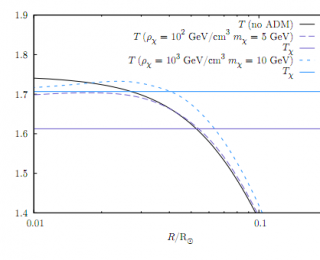
What happens to the structure and properties of a star in a the presence of dark matter?
by Elisabeth Newton | Feb 1, 2012 | Daily Paper Summaries
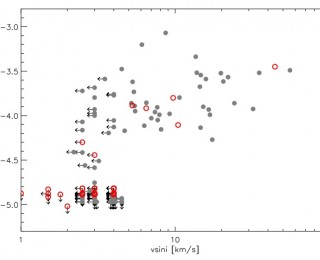
This paper delves into some of the physical properties of early M dwarfs (M0-M4.5), focusing on chromospheric/magnetic activity and rotation. The authors present a catalog of activity and rotation for 334 early M dwarfs.
by Evan Schneider | Jan 25, 2012 | Daily Paper Summaries
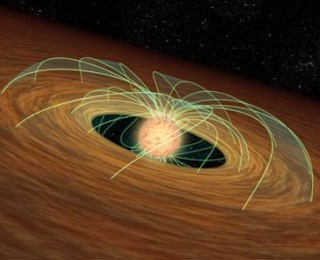
Young massive stars have a variety of different rotation rates, but what sets these initial speeds? In this paper, the authors investigate whether magnetic fields could be the answer.
