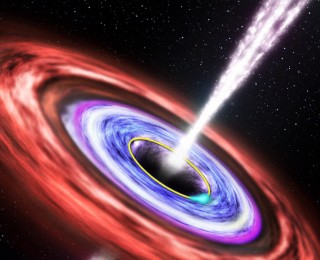
by Justin Vasel | Aug 10, 2012 | Daily Paper Summaries
If there was a cosmic play with the universe as its stage and the celestial bodies as its actors, undoubtedly there would be one character more notorious than the rest; a villain feared by all: the infamous Black Hole. They are truly the things of nightmares, and for one little star out there, that nightmare came true.
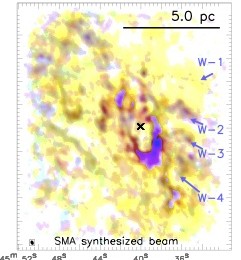
by Alice Olmstead | Jul 31, 2012 | Daily Paper Summaries
Recent studies have revealed a surprising amount of activity happening in the heart of our own Milky Way. In this paper, Liu et al. explore the kinematics of the gas outside the most central regions of our galaxy, and reveal that the Galactic center is being fed even more material from the main structure of the Milky Way.
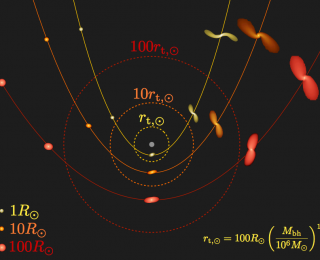
by Nathan Goldbaum | Jun 16, 2012 | Daily Paper Summaries
One possible way to directly infer black hole properties is by observing the sort of event discussed in today’s paper: the tidal disruption of an individual star after a close approach to a supermassive black hole.
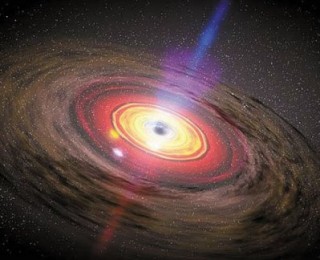
by Evan Schneider | May 16, 2012 | Daily Paper Summaries
We know that supermassive black holes exist, but how did they get so big? In this paper, the authors seek to shed some light on their progenitors – rapidly accreting, intermediate-mass black holes.
by Anna Rosen | Mar 27, 2012 | Daily Paper Summaries
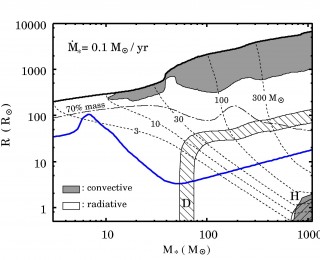
Could stars with masses 100,000 times more massive than our Sun exist? Are these the possible progenitors for supermassive black holes that litter our universe today?
by Kim Phifer | Feb 14, 2012 | Daily Paper Summaries
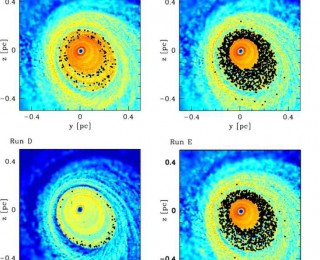
The Center of our Galaxy is one of the most extreme dynamical environments we can observe in detail because individual stars can actually be resolved using adaptive optics. Over time, monitoring individual stellar orbits has firmly established the presence of a supermassive black hole of about 4 x 10⁶ M☉ (check out this video too). Further examination of these fast-moving stars’ properties (via infrared spectroscopy) revealed a surprising detail — many of these stars are young!
