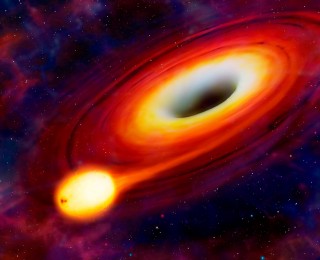
by Kim Phifer | Aug 3, 2013 | Daily Paper Summaries
Maksym et al. investigate a possible tidal flare event in Abell 1795.
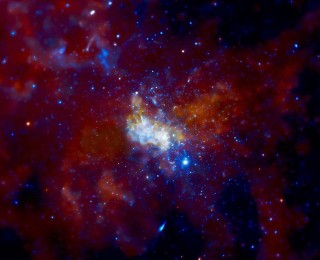
by Anna Rosen | Apr 25, 2013 | Daily Paper Summaries
In this paper, the authors use near-IR imaging and spectroscopy to determine if G2, a galactic center source about to approach our galaxy’s supermassive black hole, is a gas cloud or a star.
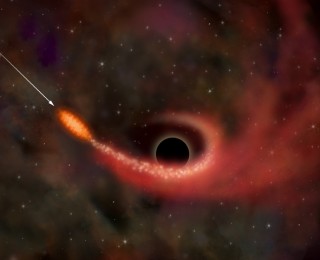
by Maria Drout | Dec 10, 2012 | Daily Paper Summaries
New Observations suggest that we may have just witnessed the relativistic jet associated with the tidal disruption event Sw 1644+57 (first observed in March of 2011) turn off.
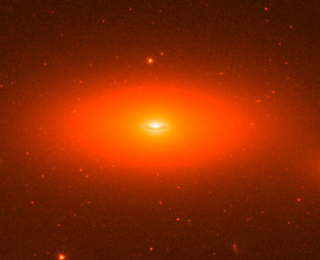
by Justin Vasel | Dec 5, 2012 | Daily Paper Summaries
Weighing in at 17 billion solar masses, NGC 1277 contains the largest black hole discovered to date. What makes this black hole exceptional it not just its size, but also that it does not seem to follow the relationship between most supermassive black holes and their host galaxies known as the M-sigma relation. The author’s discuss their findings and possible implications.
by Evan Schneider | Oct 3, 2012 | Daily Paper Summaries
We know most galaxies host supermassive black holes at their centers, but how do they get so big? In this study, the authors investigate one of the smallest known supermassive black holes (weighing in at only 100,000 solar masses), to shed some light on what a young, accreting black hole might look like.
by Justin Vasel | Sep 17, 2012 | Daily Paper Summaries
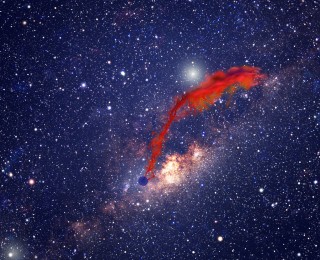
Paper Title: Disruption of a Proto-Planetary Disk by the Black Hole at the Milky Way Centre Authors: Murray-Clay, R. A. and Loeb, A. Institution: Harvard-Smithsonian Center for Astrophysics (CfA)If our solar system lives in suburbia, the center of our galaxy is a sprawling metropolis shining bright for all to see. The center of our Milky Way Galaxy is a crowded, bustling and hectic place. Stars race around like cars on a freeway. Densely-packed hot stars and supernova explosions flood the region with deadly radiation. The supermassive black hole at the center destroys anything that dares to wander too close and test its strength. The galactic center is different than what we’re used to. It’s exciting. It’s dangerous. It’s the kind of place that’s fun to visit, but you wouldn’t want to raise your kids there. The traditional wisdom among astronomers is that stars feel the same way; There is just too much excitement going on in the galactic center for planets to form around stars…Or is there?Last year, a team of astronomers at the Very Large Telescope (VLT) in Chile discovered a cloud of gas falling towards the black hole at the center, Sagittarius-A* (SgrA*). The team hypothesized that the gas cloud was the result of a collision between two gas clouds streaming from nearby stars. New research from the CfA proposes the seemingly-unlikely explanation the gas cloud is a proto-planetary disk surrounding a star that is too faint to see. A proto-planetary disk is a cloud of gas and dust that orbits a star for millions of years while it slowly coalesces into planets and asteroids and comets; It is where...
