To boldly go where no star has gone before
More than 100 massive stars orbit the supermassive black hole at the center of our galaxy incredibly closely.

More than 100 massive stars orbit the supermassive black hole at the center of our galaxy incredibly closely.
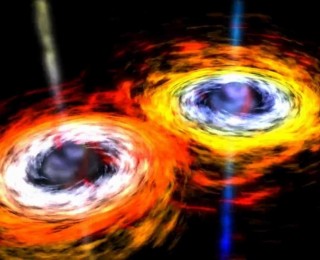
Today’s astrobite is not about disc jockey insects informing us about spacetime. Read on to find out a novel way of detecting electromagnetic counterparts of merging supermassive black holes.
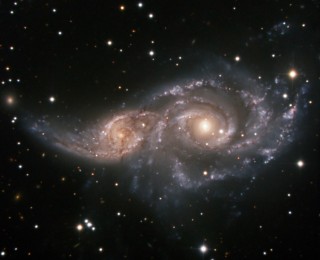
How are supermassive black holes created in the first place? Oh, we need supermassive stars of course! But then, how do we form these supermassive stars…? The answer could be by ramming two protogalaxies against one another at high speeds.
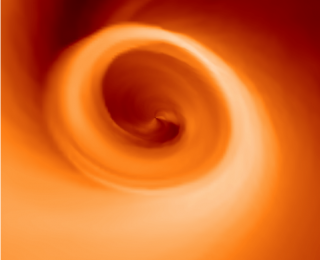
The rare (un)lucky star dies by means of black hole, which shreds the star to bits before swallowing it. It’s a spectacular death to observe, but one which is less bright and hot than we thought they would be…
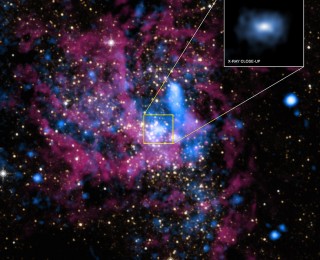
Sgr A* – the supermassive black hole sitting in the center of the Milky Way – is often referred to as a ‘starved’ black hole, meaning that it swallows very little of the nearby cosmic gas and dust. The authors of this paper observed Sgr A* with the Chandra X-ray telescope for 3 mega seconds, throughout which only 1% of the gas available to Sgr A* actually accreted onto the black hole. It swallows cold gas, while rejecting hot gas – ejecting the matter back into space.
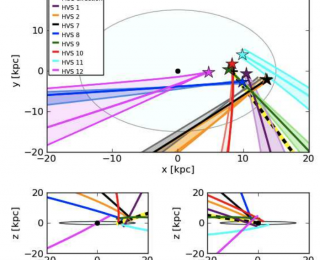
Palladino et al. find 13 new hypervelocity star candidates in the galaxy and find they probably do not originate from the center of the galaxy.