by Andrew Emerick | Oct 1, 2015 | Daily Paper Summaries
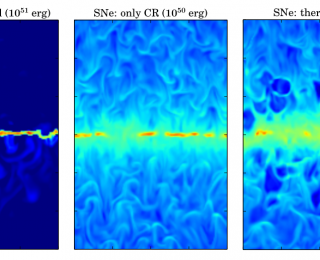
The energy injected into galaxies from dying stars through supernovae plays an important role in how they evolve in a process known as feedback. However, cosmic rays generated by supernovae may be equally important in constructing a complete picture of galaxy evolution. The authors of today’s astrobite investigate this by producing hydrodynamics simulations including supernovae, cosmic rays, and magnetic fields.
by Andrew Emerick | Jun 16, 2015 | Daily Paper Summaries
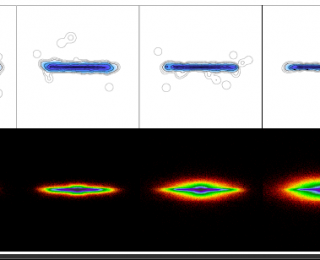
Star formation and supernova explosions play an important role in galaxy formation and evolution, in a process known as feedback. Today’s astrobite discusses how modifying the amount of feedback from supernova explosions affects the properties of the disc of a Milky Way galaxy, and how it affects the hot, gaseous halo surrounding massive galaxies.
by Caroline Huang | Jun 5, 2015 | Daily Paper Summaries
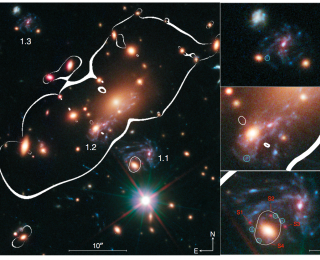
More than 50 years ago, a Norwegian astronomer named Sjur Refsdal outlined an interesting new method for calculating the Hubble constant. Last November, astronomers found the perfect test case.
by Anson Lam | Jun 3, 2015 | Daily Paper Summaries
Dark matter, in the form of primordial black holes, can potentially trigger Type Ia supernovae in white dwarfs.
by Josh Fuchs | May 20, 2015 | Daily Paper Summaries
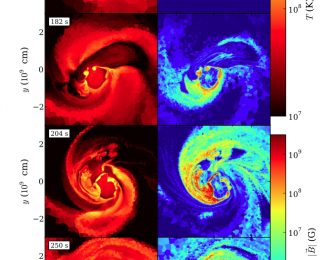
White dwarfs in a binary often merge into a variety of interesting phenomena. However, nobody has sought to understand the role that magnetic fields play during the merger. The authors simulate the merging of two white dwarfs with magnetic fields to see what happens.
by Ashley Villar | May 5, 2015 | Daily Paper Summaries
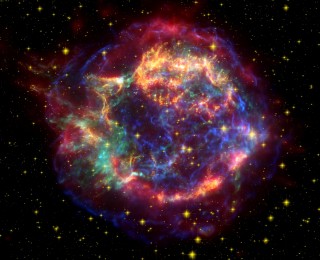
A supernova goes off. A star has died. Can its partner have anything to do with it?
