
Title: Dissociation and destruction of PAHs and PAH clusters induced by absorption of X-rays in protoplanetary discs around T Tauri stars
Authors: K. Lange, C. Dominik, A.G.G.M. Tielens
First author’s institution: Anton Pannekoek Institute for Astronomy, University of Amsterdam, Science-Park 904, 1098 XH Amsterdam, Netherlands
Status: Accepted to Astronomy & Astrophysics [open access]
Polycyclic aromatic hydrocarbons (PAHs) are honeycomb-shaped carbonaceous molecules that contain something like 10-25% of all carbon in the universe. PAHs make up some of the smallest dust grains in the interstellar medium (ISM) and act to dim the light from background objects, a process known as extinction. We know a lot about PAHs from laboratory experiments and observational astronomy because of the vibrational bending and stretching modes of C-C and C-H bonds that produce prominent emission features in the infrared.
PAHs are thus easily observable. However, PAHs seem to be surprisingly absent from planet-forming disks around young T Tauri stars. These are highly variable, young stars that have not yet ignited fusion. Since these systems are so young, they still have protoplanetary disks made of gas and dust leftover from star formation. T Tauri stars also have strong magnetic fields and are thus strong emitters of X-rays. Today’s authors ask whether the X-ray luminosity from these young stars is sufficient to destroy PAHs. The abundance of PAHs is expected to greatly affect the photochemistry of these disks, and consequently planet formation, since PAHs are strong absorbers of high-energy UV and X-ray photons, which T Tauri stars emit abundantly.
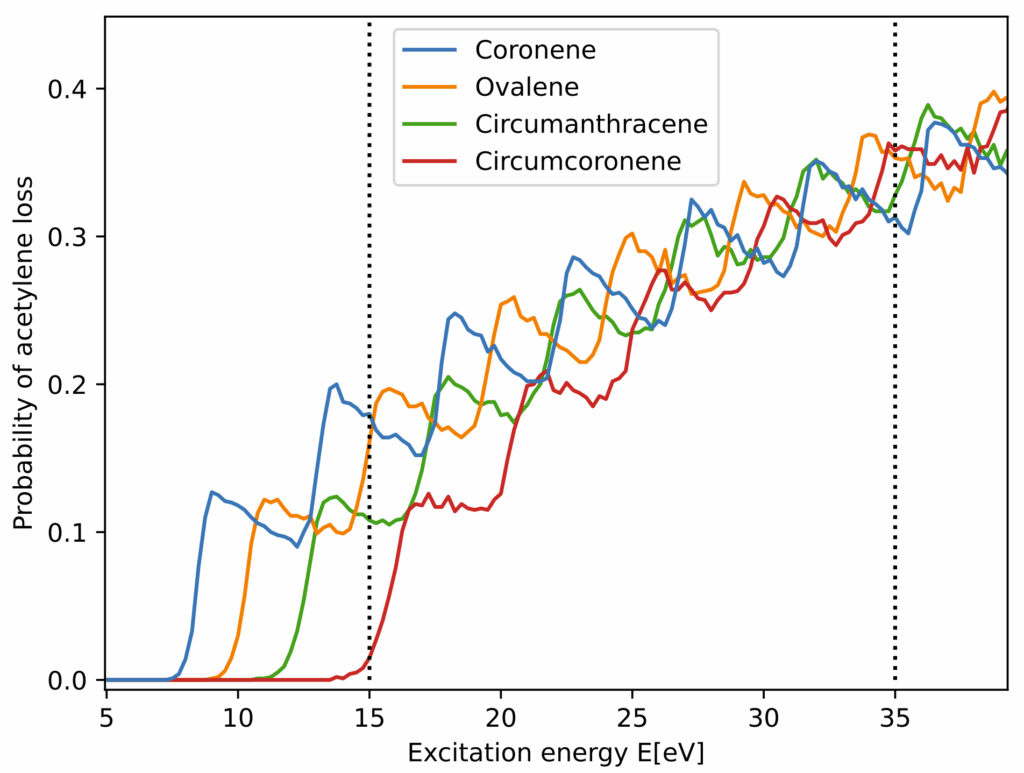
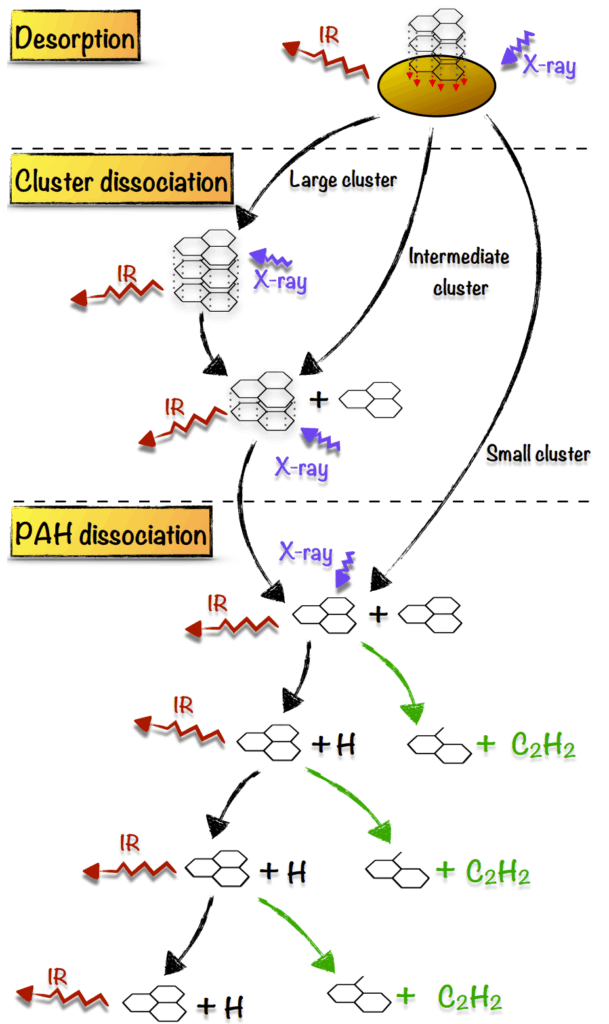
To start, the authors of today’s paper must model the microphysics of X-ray + PAH interactions. First, PAHs can exist in large clusters or as monomers, and on the surface of dust grains or in the gas-phase. A PAH is most stable if it starts as a large cluster on a dust grain, since three steps are required to fully destroy it, as shown in Figure 1: desorption, cluster dissociation and PAH dissociation. A PAH is most fragile if it starts as a monomer in the gas-phase so let’s start with this case. An X-ray hitting a PAH will cause ionization and vibrational excitation. The PAH can lose this extra energy in two ways: non-dissociatively (by emitting photons) or dissociatively (by breaking apart). We care about the dissociative pathway that results in a PAH losing an acetylene (C2H2) and thus breaking up into smaller pieces. Figure 2 shows the probability of PAH destruction for four PAH species as a function of excitation energy, which is shown to be largely independent of the particular PAH species.
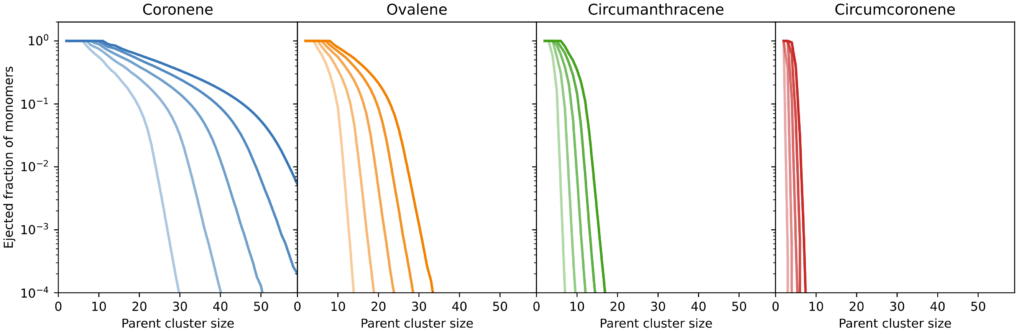
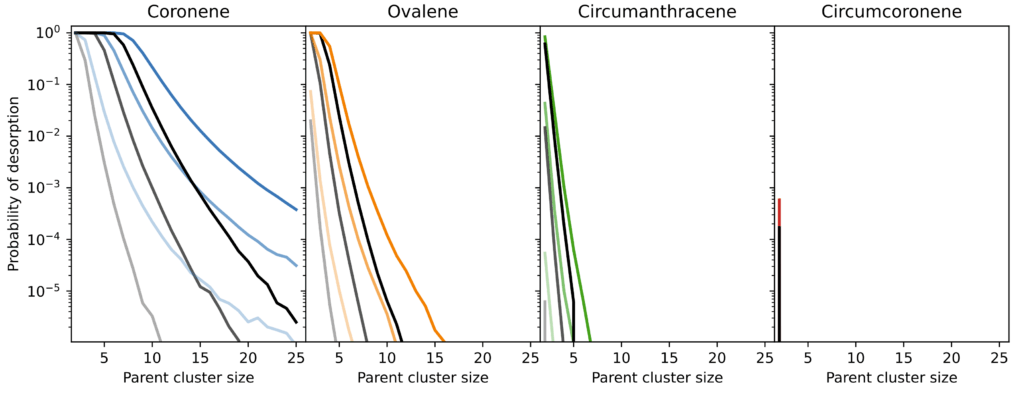
The authors also investigate the other steps of PAH destruction: cluster dissociation and desorption, which is relevant for PAHs in clusters and/or adsorbed on dust grains. Figure 3 shows the fraction of ejected PAH monomers as a function of cluster size and excitation energy. Figure 4 shows the desorption probability as a function of dust grain temperature, excitation energy, and cluster size for four PAH species. In both cases, we see that it is very difficult to destroy large PAH species and large clusters.
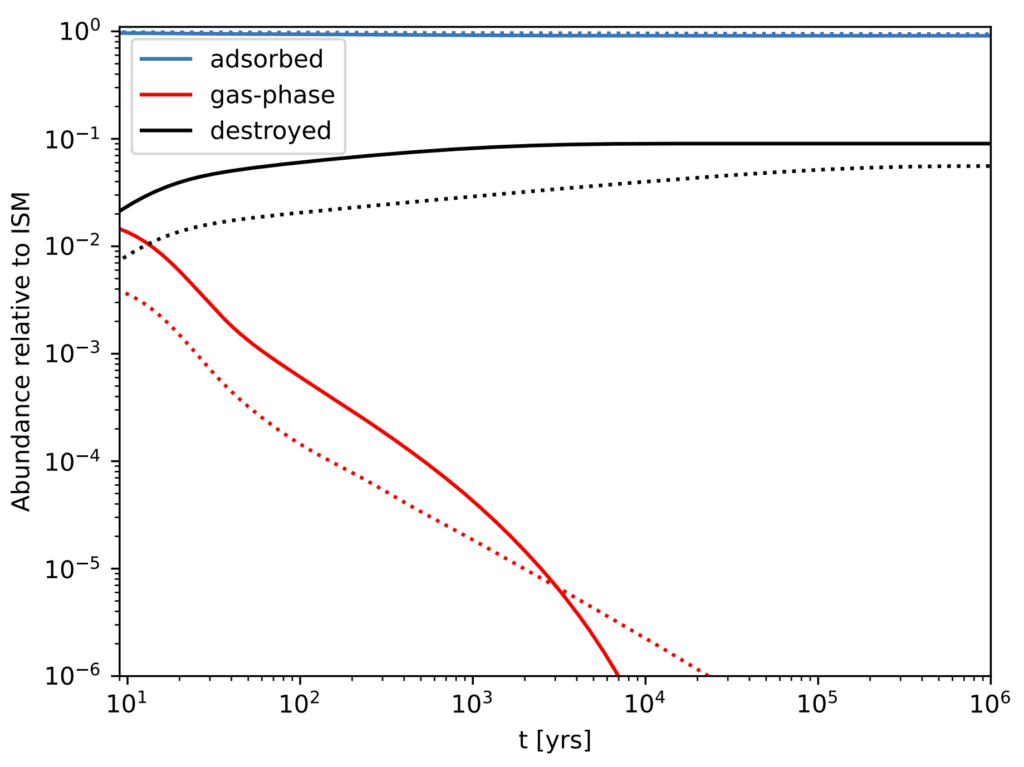
X-rays are clearly capable of influencing PAHs, especially by breaking down smaller PAH monomers and clusters. However, it is more difficult to dissociate large PAH clusters, especially those adsorbed onto dust grains. Figure 5 summarizes the results, showing a substantial reduction in gas-phase PAH abundance over time, largely driven by the destruction of smaller PAH monomers and clusters. Observations of T Tauri disks by JWST could greatly expand our understanding of these systems and whether PAHs are present. Our very own Solar System is thought to have formed out of a T Tauri disk in the past, so studying these systems will elucidate how planets like ours form.
Astrobite edited by Skylar Grayson and Joe Williams
Featured Image Credit: NASA/JPL-Caltech/T. Pyle (SSC)
