
Title: Sporadic radio pulses from a white dwarf binary at the orbital period
Author(s): I. de Ruiter, K. M. Rajwade, C. G. Bassa, A. Rowlinson, R. A. M. J. Wijers, C. D. Kilpatrick, G. Stefansson, J. R. Callingham, J. W. T. Hessels, T. E. Clarke, W. Peters, R. A. D. Wijnands, T. W. Shimwell, S. ter Veen, V. Morello, G. R. Zeimann & S. Mahadevan
First Author’s Institution: Sydney Institute for Astronomy, School of Physics, The University of Sydney, Sydney, New South Wales, Australia
Status: Published in Nature Astronomy [open access]
A brief history of radio pulsators
Periodic radio sources have been studied for several decades, beginning with the discovery of the pulsar by Jocelyn Bell Burnell as a graduate student in 1968. Pulsars are made up of highly magnetized (up to a quadrillion times the magnetic field of the Earth) neutron stars, the remnants of massive stars left behind after their energetic death in a supernova. Pulsars are among the most precise clocks in the universe. In 2006, sporadic, unusual pulses from neutron stars were identified and dubbed Rotating Radio Transients (RRATs) for their distinctive, unpredictable behavior. Shortly thereafter, in 2007, Fast Radio Bursts (FRBs) were identified, but only a small fraction of FRBs are known “repeaters” (see this live catalog of repeaters from the CHIME collaboration). The origin of FRBs remains debated, although promising observations of FRBs in our own galaxy suggest that one origin is magnetars. Still, it’s possible that the objects that generate FRBs aren’t all the same.
Since FRB signals arrive randomly and telescope time is at a premium, it is challenging to search for candidates for this phenomenon. Most discoveries of FRBs are serendipitous; we were lucky to be observing the right part of the sky with the right telescope at the time of the FRB pulse’s arrival. However, the global radio astronomy community recognizes the importance of sensitive, all-sky coverage, leading to increased efforts to produce surveys that observe the same regions of the sky multiple times. An example of this is the LOFAR Two-Metre Sky Survey (LoTSS), which utilizes the Low Frequency Array (LOFAR) in the Netherlands. Today’s authors use the LoTSS to observe at 120-168 MHz (just above FM radio, spanning 88-108 MHz) and identify a new kind of repeating radio source.
Rotation or orbits?
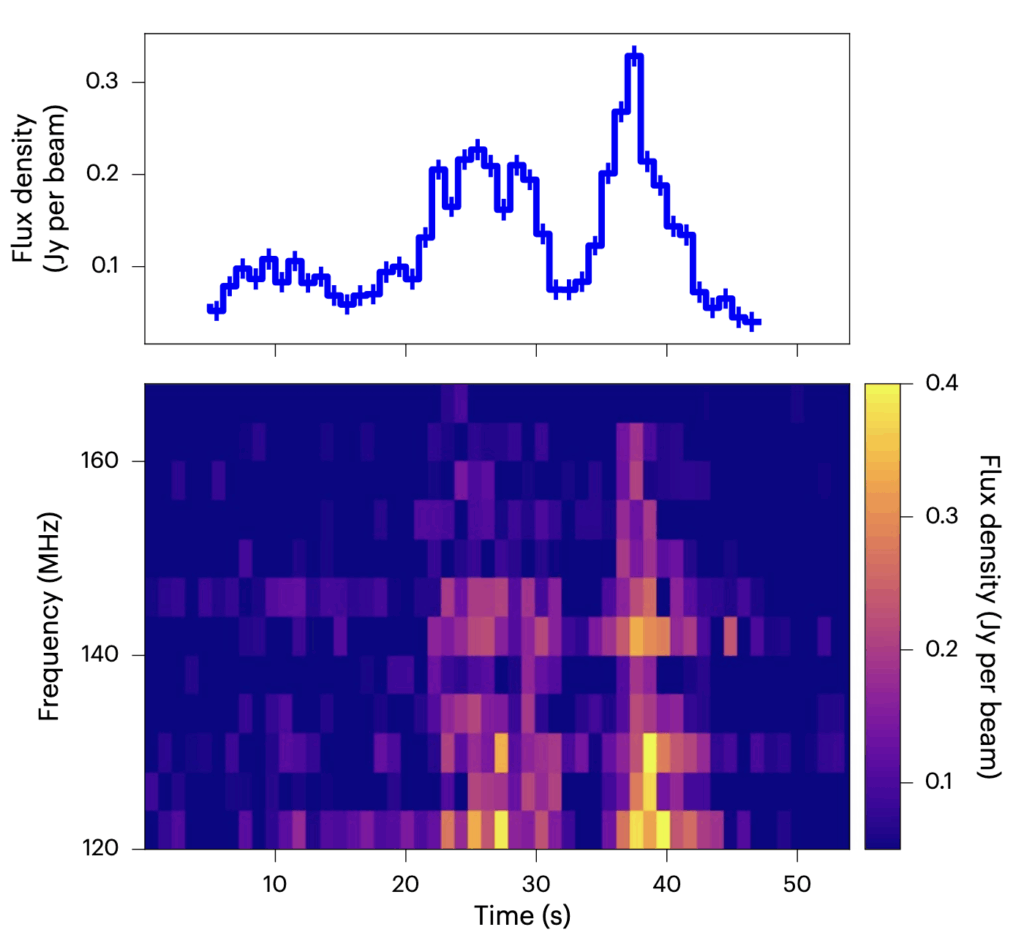
By searching for rapidly changing sources in the LoTSS survey, today’s authors were able to identify a single bright radio pulse from an object named ILT J110160.52 + 552119.62 (ILT J1101 + 5521 for short). Once identified, the authors searched other archival observations collected with LOFAR and found six additional pulses, lasting between 30 seconds and 90 seconds. The pulses were actually periodic, occurring at the same time in a 125.52978-minute period (+/-1.2 millisecond uncertainty). Additional inspection of the brightest pulse revealed a very intriguing double-peaked structure in its light curve and a strong dependence on the observed frequency, with higher frequencies significantly dimmer; see Figure 1. Such a long period is atypical of a traditional radio pulsator source, which are usually much faster (e.g., pulsars, which can rotate with periods as short as milliseconds).
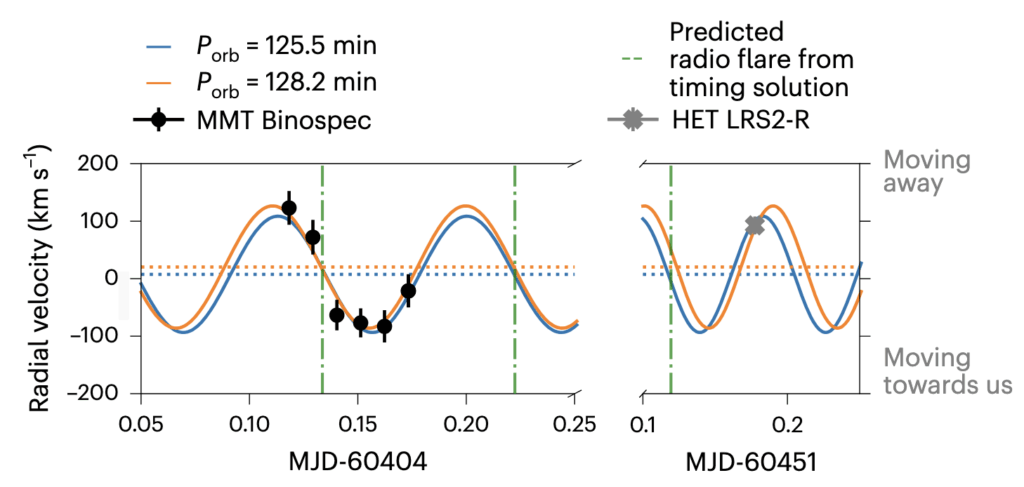
To determine the origin of this unique radio signal, today’s authors searched archival observations spanning the near-ultraviolet through the optical spectrum and beyond to the near-infrared. They found a candidate optical source with a roughly 1 in 10,000 chance of not originating from the same coordinates as the radio pulse, indicating that they are very likely to originate from the same star system. By modeling the source’s luminosity across this wavelength range, they were able to suggest that this source is a combination of an M dwarf (a low-mass star) and a white dwarf. By following up on the source with additional spectroscopy observed over multiple, closely spaced times (see Figure 2), they observed radial velocity variations with the same period as the radio pulsations. The RV measurement revealed periodic variations in the line profile centroids at the same period as the radio pulsation, allowing today’s authors to infer that the periodic effect is one due to an orbit, rather than the rotation of a single body, like in the pulsar scenario.
Prospects
This system is remarkably similar to a known class of binary objects called “polars,” consisting of an old M dwarf and a magnetized WD that are in a close orbit, sometimes as short as 90 minutes. Polars are known to be occasional radio emitters but remain understudied in detail. Today’s authors identified a very similar system, suggesting that more of this type could be found and that other polars may display similar radio behavior. Follow-up of known polar systems at different wavelengths to search for correlations between the radio pulse and the system’s orbit would allow further comparison with systems like ILT J1101 + 5521 to understand better the mechanism of the periodic radio emission and its origin in the binary.
Edited by Erica Sawczynec
