
Authors: Qinyue Fei, Seiji Fujimoto, Rohan P. Naidu, John Chisholm, Hakim Atek, Gabriel Brammer, Yoshihisa Asada, Volker Bromm, Lukas J. Furtak, Jenny E. Greene, Tiger Yu-Yang Hsiao, Junehyoung Jeon, Vasily Kokorev, Jorryt Matthee, Priyamvada Natarajan, Johan Richard, Alberto Saldana-Lopez, Daniel Schaerer, Marta Volonteri, Adi Zitrin
First Author’s Institution: University of Toronto
Status: Available on arXiv [open access]
In the late 2010s, astronomers were getting hints of something strange going on in the early universe. Using the most powerful telescopes on the ground, we were able to find black holes in the centers of some of the most distant galaxies. The light from these active galactic nuclei (AGN) was emitted over 12 billion years ago, revealing conditions close to the beginning of cosmic time.
To an astronomer, that’s the mundane part. I’m only half joking – thousands of AGN had already been identified in the previous half century. However, the most distant of these sources were startling because their central black holes appeared much more massive than expected. To be specific, we know how much mass black holes can start with, and we can write down equations to predict how quickly they should grow. The AGN we observed seemed to violate these predictions. This raised some serious questions and was highlighted as a major point of inquiry to focus on going into the 2020s.
Then JWST launched, and the mystery grew deeper. No matter where we looked, enormous black holes kept cropping up in astonishing numbers. Astronomers who model the universe with equations and computer simulations have tried to explain these results, but this has been a serious challenge. Some researchers have broken the emergency glass and reached for a highly theoretical tool: the direct collapse black hole (DCBH). Unlike the normal pathway for forming black holes (the deaths of massive stars), this model suggests that an enormous cloud of gas could directly collapse into one without forming a star at all. The resulting DCBH could have as much mass as a hundred thousand Suns put together – orders of magnitude more than a “normal” black hole. Although this pathway can explain the presence of huge black holes so early in the universe’s history, we’ve never directly seen this happen, so for now it remains just a theoretical possibility.
However, if DCBHs were widespread at early times, there is one indirect signature we might be able to detect: a large population of intermediate-mass black holes (IMBHs) with masses between a hundred thousand and a million times that of the Sun. If we can find such a population, we’ll have strong evidence for the DCBH model. Let’s go looking!
Intermediate Mass, Impossible Difficulty
Identifying IMBHs requires a tricky combination of spectral resolution and sensitivity. Light from an object must be examined very finely in order to detect the telltale features of an IMBH. However, these sources are already quite faint, so spreading their emission this thin means that any potential signal is very likely to get lost in the noise.
The authors of today’s paper use an unprecedented set of observations to leap over this hurdle and directly probe IMBHs. They not only use the most sensitive spectroscopic instrument (NIRSpec) on the most powerful space telescope (JWST), but they take advantage of a phenomenon known as gravitational lensing.
According to Einstein’s general theory of relativity, gravity is the result of matter curving spacetime. Areas with more concentrated matter will experience stronger curvature. When an object traveling in a completely straight line moves through curved space, its path appears bent. This same effect happens to light. Intriguingly, a large concentration of matter can redirect diverging rays of light to a focus, acting like an enormous magnifying glass.
Astronomers take advantage of gravitational lensing by pointing telescopes at massive clusters of galaxies. The intense gravity of these regions can magnify sources in the background by tens or even hundreds of times. Galaxies that would be impossibly faint to see under normal conditions can thus be observed if they are strongly lensed, making this a powerful technique to examine otherwise hidden objects.
Putting Faint AGN Under a Lens
The GLIMPSE program took extremely powerful observations of a galaxy cluster called Abell S1063 using JWST. The long exposure time, combined with the lensing power of the cluster, allows extremely faint sources in the background to be seen in unprecedented detail. The researchers scoured through the data to search for signs of active black hole growth in the observed galaxies. Specifically, they carefully studied the emission lines in the spectrum of each object.
Normally, emission lines appear narrow. However, gas surrounding a massive black hole circulates at rapid speeds. A phenomenon known as the Doppler effect then comes into play. This is the same effect responsible for the characteristic rise and fall in the pitch of a siren from an emergency vehicle passing by. Emission from gas moving towards our line of sight appears bluer than it otherwise would, and gas moving away from us appears redshifted. The net effect is that a single emission line is widened, and we see characteristic “broad wings”. The width of the emission line can be used to estimate the mass of the central black hole, where broader wings imply a more massive black hole.
The researchers uncover ten AGN which display broadened Balmer series lines. Strikingly, they estimate that these galaxies have central black holes with masses as low as 400,000 times that of the Sun. While that might sound like a lot, it’s practically nothing compared to the monstrous 100 million Solar mass black holes that JWST consistently turns up in other studies. Detecting such lightweight black holes, pushing into the realm of IMBHs, is only possible due to the incredible sensitivity of these observations.
The researchers also compute what’s known as a black hole mass function (BHMF). This is a measure of how many black holes exist at each mass. In other words, the BHMF measures how common lightweight black holes are compared to heavy ones. The BHMF computed in this work and several other points of comparison are shown in Figure 1.
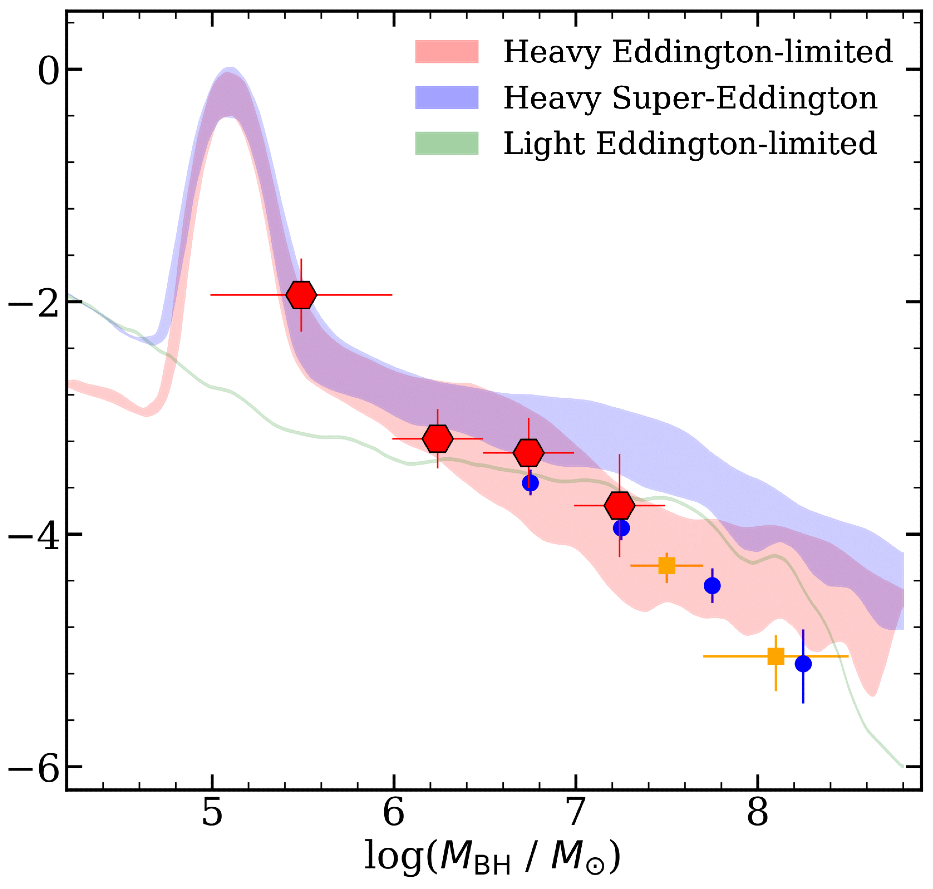
Because the AGN analyzed in today’s paper host central black holes with much lower masses than any that have been observed in the past (at this early time in the universe), the authors are able to probe a completely new region of the BHMF. As seen in Figure 1, the leftmost red hexagon (lowest-mass data point) deviates from the roughly straight line traced by the other data points. This suggests that there are substantially more black holes with a few hundred thousand Solar masses than previously expected.
Amazingly, this is exactly the measurement you would get if the DCBHs (the hypothetical kind of massive black holes mentioned earlier in this article) were common in the early universe. If you scatter huge seeds across a large field, then you shouldn’t be surprised to see a sea of barely larger plants a few months later. Likewise, since DCBHs start off so massive, they only need to grow a tiny bit to reach the threshold of that first red hexagon.
So is this proof that the early universe was filled with DCBHs, with this study probing the tip of an astonishing iceberg? It’s too early to tell for sure. While this is certainly an exciting result which sheds light on a previously unexplored population of objects, one can only do so much with a sample size of ten. More follow-up observations will be needed to measure the BHMF more precisely. Still, it’s amazing to think how much has changed in just a few years. JWST continues to provide unprecedented insight into some of the most breathtaking questions in all of astronomy.
Astrobite edited by Tori Bonidie
Featured image credits:
Black hole – NASA’s Scientific Visualization Studio – KBR Wyle Services, LLC/Scott Wiessinger, University of Maryland College Park/Barb Mattson, University of Maryland College Park/Francis Reddy, University of Maryland College Park/Jeanette Kazmierczak
Sprouts – Wikimedia Commons user Sperezimsa
