
Paper title: Orthogonally magnetized Richtmyer-Meshkov instability in two-fluid plasma
Authors: Owen Thompson, Kyriakos Tapinou, Daryl Bond, and Vincent Wheatley
First author institution: University of Queensland
Status: Published in Physical Review Fluids (closed access)
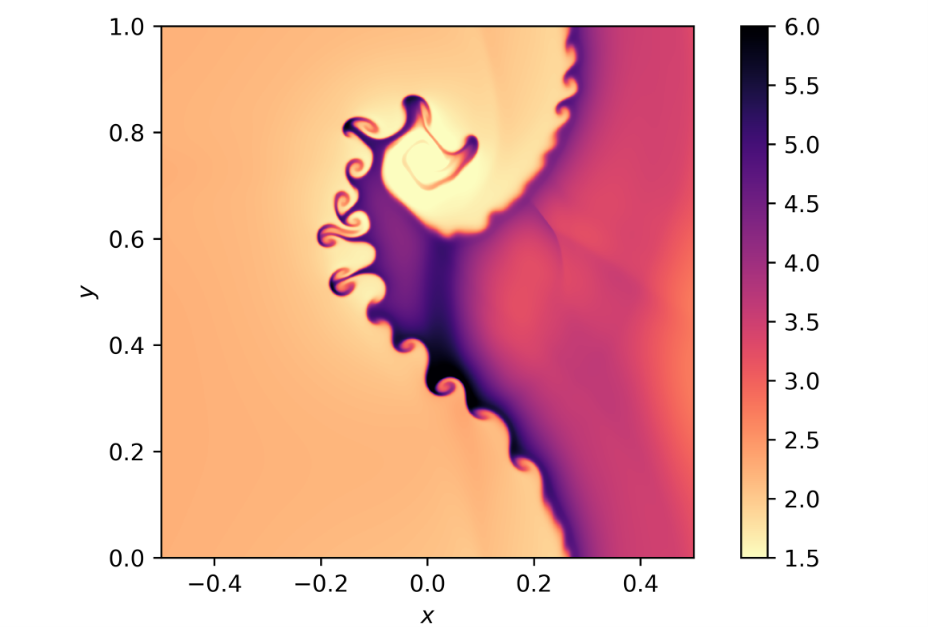
The sky may seem to be full of stars, but nothing is truly more ubiquitous in space than plasma, whether it’s in the interstellar medium distorting our radio observations, swirling in the vicinity of a supermassive black hole at the center of an active galaxy, or making waves (literally) in a supernova. Compared to something solid and spherical, like a planet, predicting the behavior of a plasma is quite challenging. First of all, since plasma is a fluid, any part of it you try to model is not only changing in position and time relative to itself, but also relative to all the other bits of plasma (holy Chain Rule!). What’s more, for most fluids, the governing equation of motion, the Navier-Stokes equation, has no solution. This is especially true if the fluid motions are chaotic and turbulent, which is almost always the case in astrophysical settings (after all, if our Sun did not have a turbulent protoplanetary disk a few billion years ago, Earth would probably not exist and there wouldn’t be anyone around to come up with solutions to the Navier-Stokes equation for any fluid). Moreover, plasmas have electric charge, and are often found in the strong electromagnetic fields littered all over the cosmos (so now you have to throw in Maxwell’s equations as well). On top of everything else, these electromagnetic fields can have complex geometries that change over time. Sometimes this whole setup can be located right next to a supermassive black hole and you have to account for general relativity (but we’ll leave this particular problem for another day).
Two plasmas are better than one!
Here, our authors are interested in what happens when two plasmas with different densities slam into each other within an ambient magnetic field, such as in a supernova. Considering a supernova was a star only moments before, there’s plenty of plasma around, and the catastrophic explosion causes shocks to propagate through the plasma. In this case, when two distinct plasmas meet, we expect to see a chaotic feature known as a Richtmyer-Meshkov instability (or RMI), which is an extreme version of the phenomenon that you see when you mix water and oil or create a mushroom cloud with a nuclear bomb. This is especially important since RMI can explain why we observe certain elements earlier than otherwise expected in supernovae. In previous works, which treated this system as a single fluid plasma (unrealistic, but easier to model), waves carry any chaotic spinning motions (also known as vorticity) away before any instabilities can grow, and we do not see RMI. Today’s authors seek to answer the question of whether RMI will develop if we model the system as two separate plasmas located within an external magnetic field, and if so, how the presence and orientation of the magnetic field will affect this result.
Setting up the model
First, to set the scene: we have two plasmas with very different densities: one comprised of electrons (teeny-tiny) and another consisting of ions (way less teeny-tiny, considering an ion, by definition, will have at least one nucleon). To simplify our system a little, we assume the following:
- Before any shenanigans (aka propagation of shocks), each plasma has the same temperature throughout.
- There are no neutral particles (lone neutrons, or atoms with no missing or extra electrons).
- After any shenanigans, the time it takes for the plasmas to stabilize to a uniform density is very long.
- The individual ions and electrons in the two plasmas do not collide with each other and may only interact via an electromagnetic field (in other words, there are no extraterrestrial bumper cars).
- The plasmas are two-dimensional, and any magnetic fields are only one-dimensional.
To fully describe the behavior of our system over time (and catch the RMI in-action!), we need to solve three different fluid equations per plasma (conservation of energy, mass continuity, and the actual equation of motion) plus the four Maxwell’s equations. In short, a chalkboard analytical solution is probably a pipe dream, and our authors turn toward solving them numerically. While this sounds like a let-down (I personally hated wasting time on Riemann sums in my first Calculus class until, many years later, I realized all the interesting integrals can’t be solved without them!), finding solutions numerically comes with its own unique challenges. Since we know the state of the system before any shocks start propagating (our assumed initial conditions, you could say), we can use this to determine the state of the system a tiny bit in the future; which we then use to determine the state another tiny bit further in the future; and so on, until we either see RMI or some other form of chaos develop.
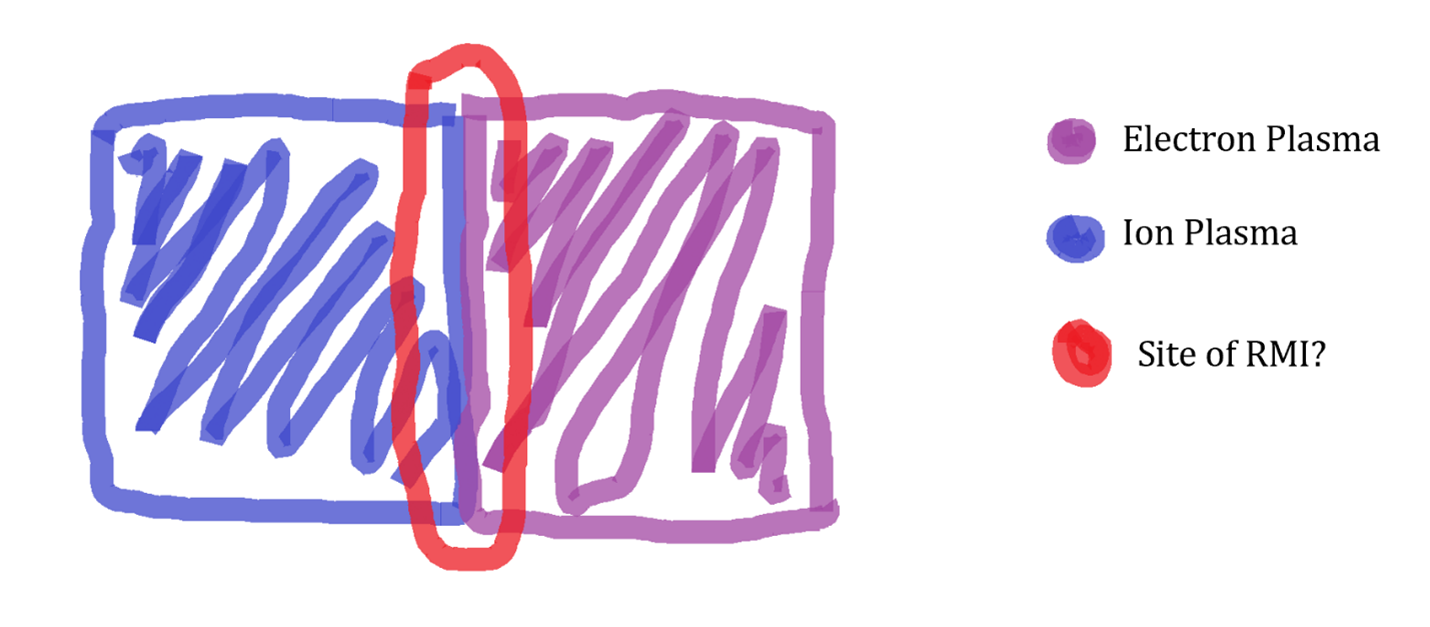
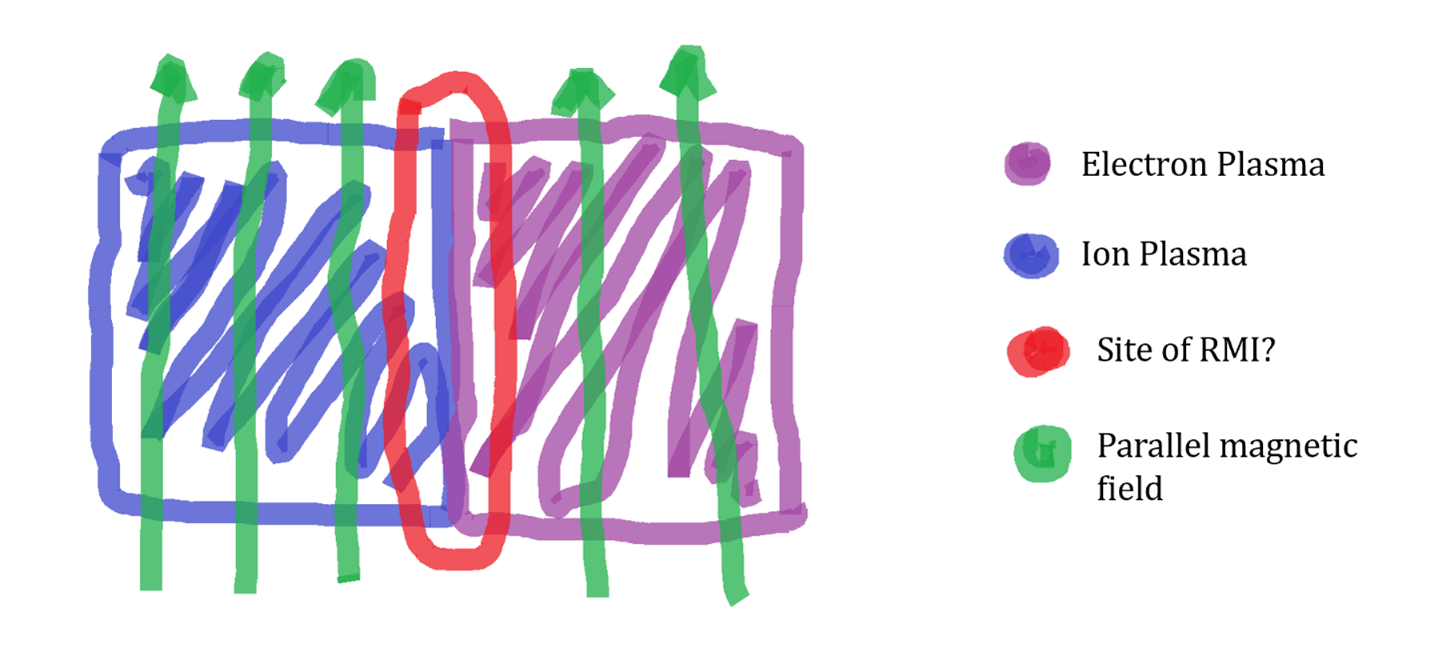
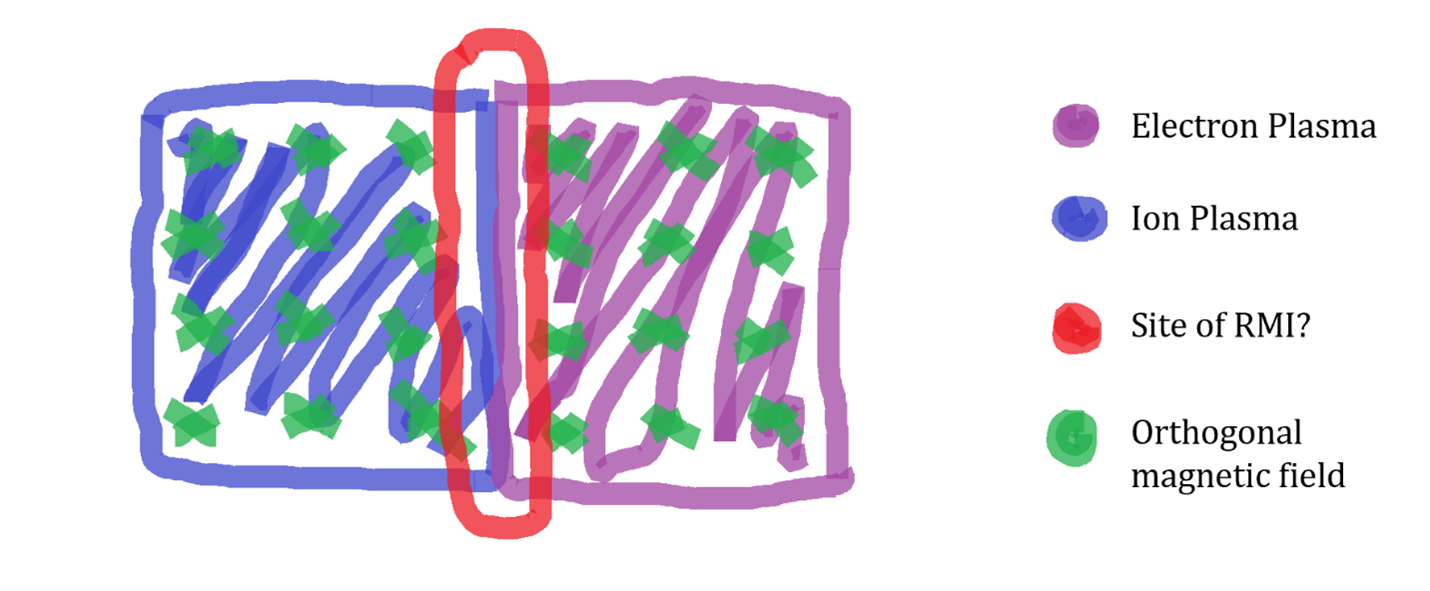
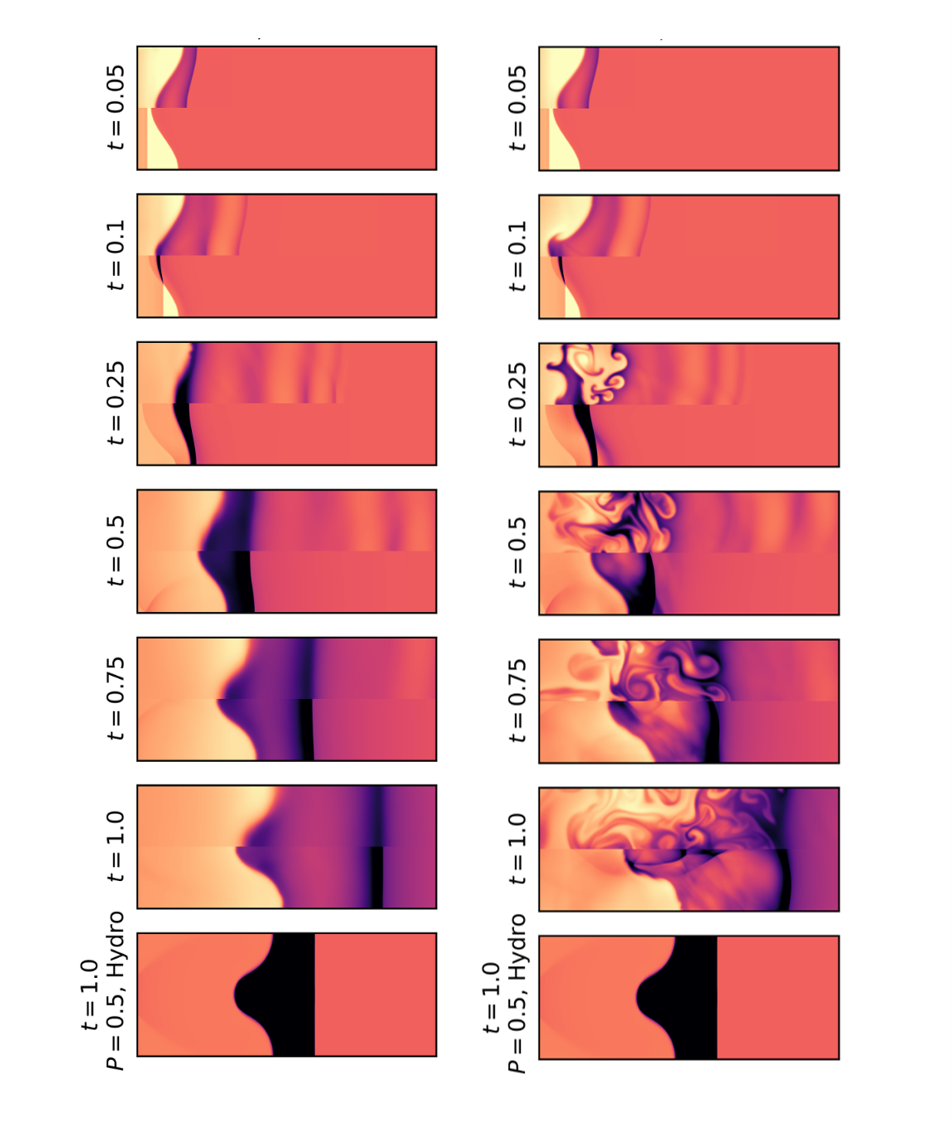
Our authors model three different scenarios1: two plasmas and no magnetic field (Figure 2), two plasmas in a magnetic field directed in-line with them (Figure 3), and two plasmas in a magnetic field directed perpendicular (well, orthogonal, as any linear algebra enthusiast will point out) to them (Figure 4).
Results! Orthogonal magnetic fields are winners (if the prize is RMI, that is)
In all three scenarios, some disturbance (presumably, the collapse of a massive star’s core in the event of a supernova) creates a shock in both the ion and the electron plasmas. The shocks travel much faster in the presence of a magnetic field, and in all three cases, the electron plasma shock propagates faster than the ion plasma shock. As the shock passes through the electron plasma, the electrons get jumbled and pushed around, and we get a region with excess charge. Interestingly, when the magnetic field is parallel to the plasmas, any chaos that arises is quickly dispersed and we do not see RMI. On the contrary, when the magnetic field is orthogonal, the region with extra charge gets accelerated by the magnetic field, disrupting the symmetry of the system, and leading to the growth of RMI!! Even with this magnetic field orientation, this is only possible in the authors’ novel two-plasma model, rather than the traditional single-plasma model. Now, the only thing left to do is scale this simulation up to three dimensions (with magnetic fields directed in multiple directions), and see what happens!
- Actually, they model five scenarios; the other two, which assume both plasmas have no charge, are not super interesting so I didn’t include them, lest my astrobites – which already tend to verge on astro-meals – start turning into astro-banquets. ↩︎
Astrobite edited by Neev Shah
Featured image is Figure 4 from today’s paper.
