Title: Investigating the origin of optical and X-ray pulsations of the transitional millisecond pulsar PSR J1023+0038
Authors: G. Illiano, A. Papitto, F. Ambrosino, A. Miraval Zanon, F. Coti Zelati, and others
First Author’s Institution: INAF-Osservatorio Astronomico di Roma, Italy and Tor Vergata University of Rome, Italy
Status: Published in Astronomy & Astrophysics [open access]
The Pulsar Recycling Process
Pulsars are cosmic lighthouses, periodically blasting us with radio light as they rotate at dizzying speeds. These pulsars are rapidly spinning, highly magnetized neutron stars—remnants of massive stars that have undergone core collapse supernovae. Pulsars shoot out beams of radio light from their magnetic poles, and these beams then sweep across the sky as the pulsar rotates. If we’re lucky, that beam will shine straight at the Earth for a brief instant each rotation period, putting the “pulse” in “pulsar.”
Most pulsars are young neutron stars, with rotation periods between 0.01 and 1 seconds. As such a pulsar blasts out its radio beams, it gradually loses angular momentum, and its magnetic field weakens. After about 100 million years, its radio beams peter out, and the pulsar dies, leaving behind an ordinary neutron star.
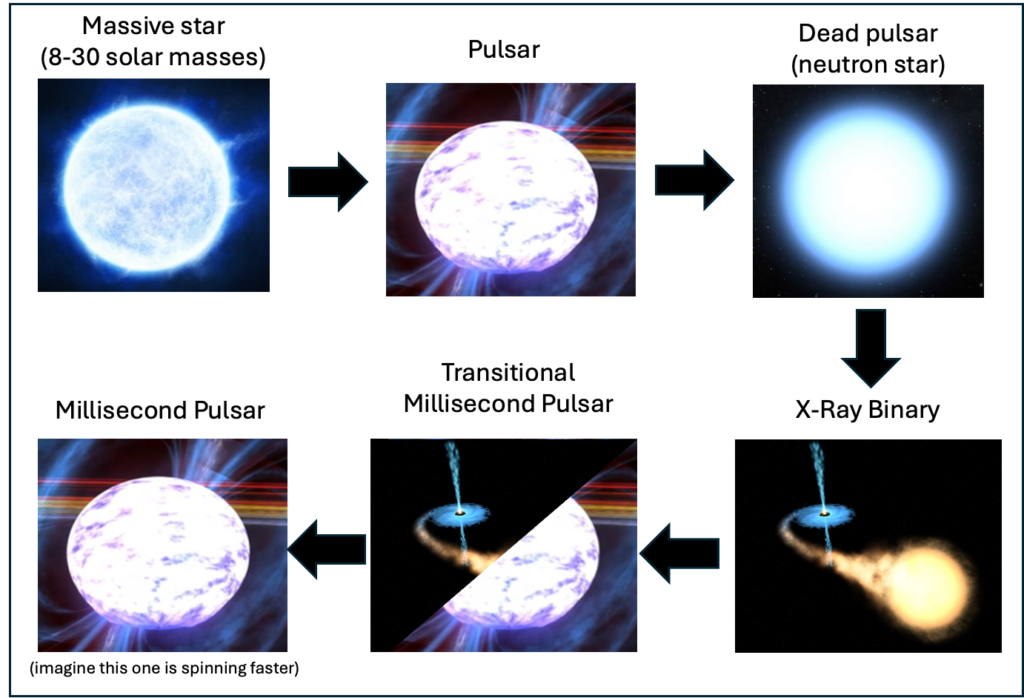
However, some lucky neutron stars have a second chance at pulsarhood! If a neutron star is in a binary with another star, that star might transfer some of its matter to the neutron star. This matter bunches up into an incredibly hot accretion disk before falling onto the neutron star, and the system, called an X-ray binary, emits an enormous amount of X-ray light. The accretion also makes the neutron star spin faster and faster, up to 1000 times per second! This rapid rotation can re-invigorate radio beams from the neutron star, making it a pulsar once more—a radio millisecond pulsar. Figure 1 shows the progression of these phenomena. Today’s paper focuses on the penultimate step of this progression.
It’s a bird! It’s a plane! Maybe it’s both?
From roughly 2007 to 2013, the source of interest in this paper, PSR J1023+0038 (J1023 from here on out), was observed as a radio millisecond pulsar in a binary with some other star. But around 2013, its radio pulses stopped! Instead, it began emitting copious amounts of pulsed X-ray and visible light. These X-ray and visible light pulses arrived at the same period the radio pulses had arrived at. Astronomers think objects like J1023, dubbed “transitional millisecond pulsars,” could be the missing link between X-ray binaries and radio millisecond pulsars. Under this interpretation, the companion star is in its final throes of transferring matter to the neutron star. Once this mass transfer stops for good (likely because the newborn pulsar radiatively evaporates its companion), the millisecond pulsar is free to shine uninterrupted.
Putting two fingers on the pulse
However, our understanding of transitional millisecond pulsars—especially their emission of X-ray and visible light—is far from complete. Astronomers think that the X-ray pulses in J1023 could be powered by magnetic fields compressing infalling matter into ultra-energetic channels that strike the poles of the neutron star. However, this mechanism wouldn’t produce nearly enough visible light to explain the pulses of visible light that we observe. By figuring out where the X-ray and visible light pulses actually come from, we can learn a great deal about extreme physical environments (enormous magnetic fields and relativistic particles, all spinning extremely fast) that we can’t recreate on Earth.
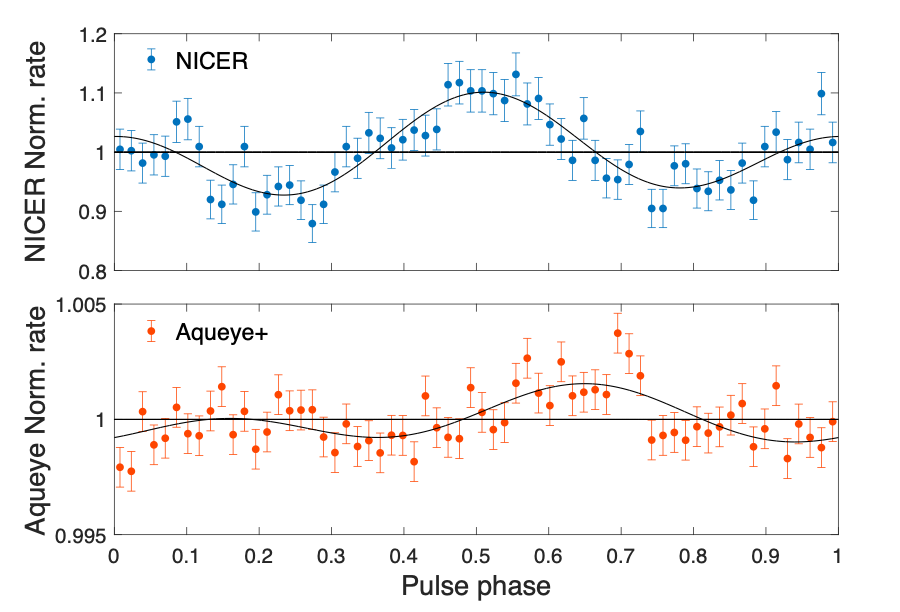
The authors of today’s paper used simultaneous X-ray and visible observations to suss out where these pulses could be coming from. Only a few instruments in the world can operate fast enough to resolve structure within the 1.7 millisecond-long pulses of J1023. The authors primarily used the NICER space telescope to observe in the X-ray and the Aqueye+ instrument on the Copernicus Telescope to observe in the visible. Both of these instruments are designed to measure the arrival times of individual photons with extremely high precision. Even so, each pulse of X-ray or visible light might carry only a few photons. Therefore, to make a light curve, which represents how the brightness fluctuates within individual pulses, they had to observe J1023 for millions of pulses (i.e., minutes to hours) and then average all of these pulses with a procedure called phase folding (see this astrobite).
Figure 2 shows the light curves for the X-ray and visible light pulsations of J1023 measured in 2019. They repeated this measurement in 2020 and 2022. In all three epochs, they observed two key facts: the two pulses had similar double-peaked profiles, and the peaks in visible light consistently lagged slightly behind the peaks in X-ray light, by ~150 microseconds. The pulse similarity and close temporal alignment suggest that the X-ray and visible light pulses are created in the same place and by the same mechanism.
Color me shocked
The model that seems to best explain the emission of both X-ray and visible light pulses is called a “shock-driven mini pulsar nebula.” In this model, twice during every rotation of the neutron star, charged particles from near the neutron star surface slam into the inside of the accretion disk, creating a shock wave. This shock wave releases all of the energy stored in the nearby magnetic field, causing a dramatic reconnection event. All of the energy from this magnetic bomb is quickly radiated away, with X-rays emitted first and visible light a touch later. This exotic process can only happen in the final stages of pulsar recycling, where a millisecond pulsar is surrounded by a dense accretion disk. See? Recycling can be exciting!
Astrobite edited by Nathalie Korhonen Cuestas