
Title: JWST Reveals CH4, CO2, and H2O in a Metal-rich Miscible Atmosphere on a Two-Earth-Radius Exoplanet
Authors: Björn Benneke, Pierre-Alexis Roy, Louis-Philippe Coulombe, Michael Radica, Caroline Piaulet, Eva-Maria Ahrer, Raymond Pierrehumbert, Joshua Krissansen-Totton, Hilke E. Schlichting, Renyu Hu, Jeehyun Yang, Duncan Christie, Daniel Thorngren, Edward D. Young, Stefan Pelletier, Heather A. Knutson, Yamila Miguel, Thomas M. Evans-Soma, Caroline Dorn, Anna Gagnebin, Jonathan J. Fortney, Thaddeus Komacek, Ryan MacDonald, Eshan Raul, Ryan Cloutier, Lorena Acuña, David Lafrenière, Charles Cadieux, René Doyon, Luis Welbanks, and Romain Allart
First Author’s Institution: Department of Physics and Trottier Institute for Research on Exoplanets, Université de Montréal
Status: Preprint on arXiv.
Whether you’re a six-year-old scouring the backyard on Easter morning, or an exoplanet astronomer with observing time on the James Webb Space Telescope (JWST), nothing beats the feeling of finding what you’re looking for. So, you can imagine the authors of today’s paper were pretty excited when they received their transmission spectroscopy data of the sub-Neptune known as TOI-270 d.
A Painted Shell
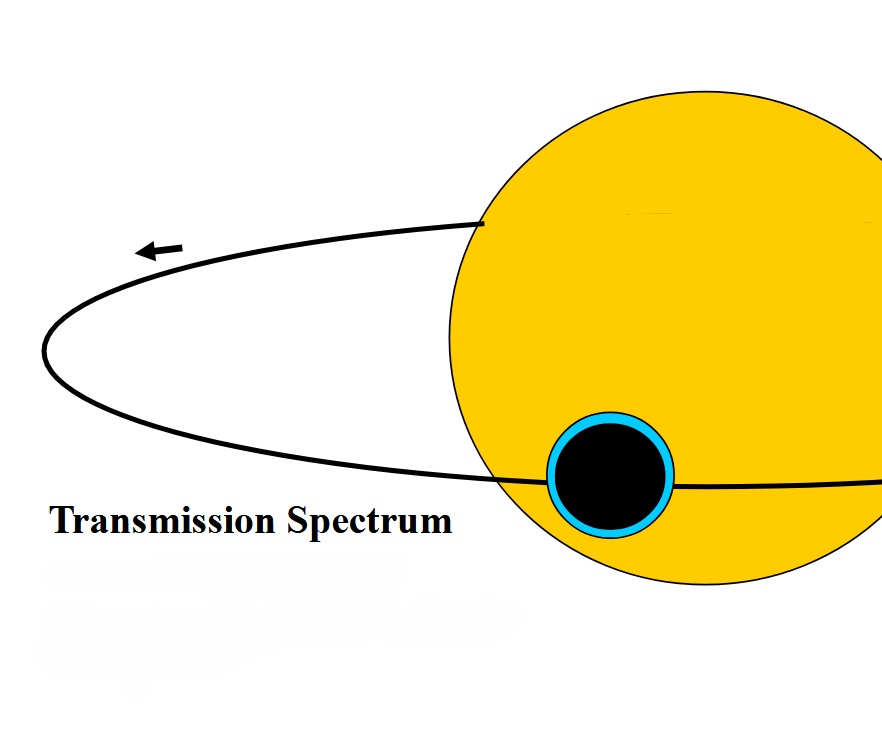
Transmission spectroscopy is an innovative technique used to characterize exoplanet atmospheres, only possible in the last few years thanks to the arrival of JWST. During a transit, some amount of a star’s light will be blocked by an exoplanet. Some light, however, will pass through the exoplanet’s thin upper atmosphere, getting partially absorbed, but still reaching our telescope. Since some molecules in the exoplanet’s atmosphere will more strongly absorb certain wavelengths of light, the exoplanet will actually appear larger in those absorbed parts of the spectrum. I’ve tried to explain to my friends that my muscles look bigger in the infrared, but they don’t buy it. Nonetheless, this ‘transmission spectrum’ allows us to decode exoplanet characteristics like atmospheric temperature and composition from light-years away.
Today’s authors use transmission spectroscopy to study the composition of TOI-270 d. The question of what sub-Neptunes are made of is an infamous one. These exoplanets, larger than Earth but smaller than Neptune, have no analog in our Solar System, but seem to be common around other stars. Constrained only by planetary mass and radius, their internal density profiles are more degenerate than that person you know who spends all of their money on sports betting. To conceptualize the interior structure degeneracy, imagine finding an Easter egg in your back yard. How do you tell what it’s made of without unwrapping it? Maybe it has a chocolate shell around a gooey caramel centre. Or maybe it’s just fudge all the way through. Delicious either way but ultimately you can’t tell based solely on the egg’s size and weight. A similar problem exists for sub-Neptunes. In one model extreme, they may have large atmospheres dominated by low molecular weight gases, like hydrogen and helium, on top of dense rock/iron cores. In the other extreme, they may have smaller atmospheres composed of larger molecules like water and methane, but have more ice in their interiors. Less tasty than a mystery Easter egg but equally frustrating!
Cracking Open TOI-270 d
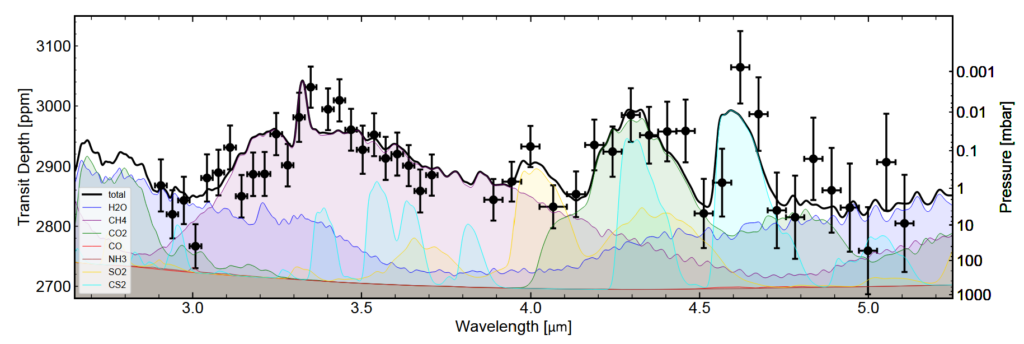
To solve this degeneracy, the authors perform an atmospheric retrieval on the transmission spectrum of TOI-270 d. This hard-boils down to creating many simulated spectra from different possible atmospheres and comparing them to the observed spectrum to figure out what the planet’s atmosphere is likely made of. They find unmistakable evidence for molecules like methane, carbon dioxide, and water at the top of TOI-270 d’s atmosphere but no evidence of chocolate or caramel. The authors go even further and use a new quenched-chemistry model that assumes the composition observed at the top of the atmosphere is determined by deeper chemically active layers that mix upwards. This allows them to constrain the metal mass fraction (Zatm) throughout the entire atmosphere (not just the top), where ‘metal’ here refers to all elements heavier than hydrogen and helium. Yes, even elements like nitrogen, carbon, and oxygen that you wouldn’t usually call metals. Blacksmiths, you can leave your complaints in the comment section below. The authors find the atmospheric mass of TOI-270 d to be more than half comprised of volatile ‘metals’ (Zatm = 58%), the rest being hydrogen and helium. Combining this new information with the exoplanet’s known mass and radius, the interior structure degeneracy can be broken to paint a picture of the sub-Neptune’s internal structure. It has a mixed atmosphere of hydrogen, helium, and volatile metals that’s relatively small (10% by mass), overlying a large dense rock/iron core (90% by mass).
This finding highlights how the sub-Neptune TOI-270 d isn’t very Neptune like at all! Neptune and Uranus, the ‘ice giants’ of our Solar System, have outer shells dominated by hydrogen gas, not methane and other volatile metals like TOI-270 d. This contrast inspires the authors to create a categorization scheme for sub-Neptunes which I have presented below as a Buzzfeed style personality quiz.
What Kind of Sub-Neptune are You??? (click to find out)
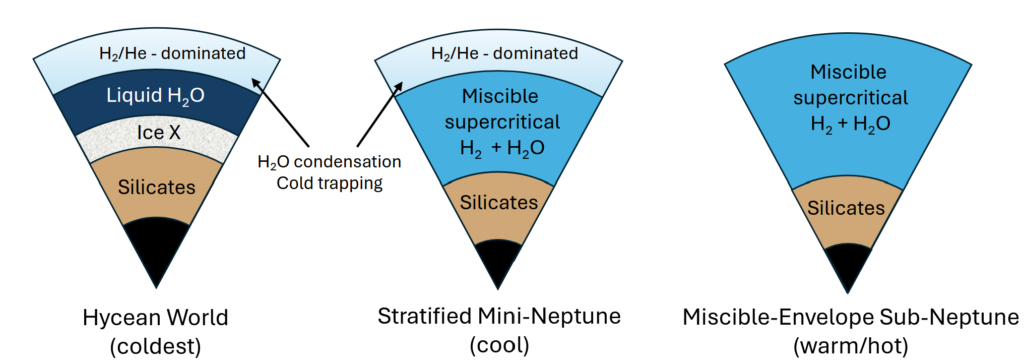
Question 1 – How cold are you?
Super cold! (< 200 K)
You’re a Hycean World: a unique and intriguing planet with the possibility of hosting a distinct liquid water layer hidden under an atmosphere rich in hydrogen. You’re the apple of an astrobiologist’s eye.
Cool! (200 – 300 K)
You’re a Stratified Mini-Neptune: a tricky and mischievous planet with a mixed atmosphere of hydrogen and volatile metals hidden under a thin envelope of just hydrogen. You hide what’s really inside, never letting astronomers see the real you.
Warm! (300 – 400 K)
You’re a Miscible-Envelope Sub-Neptune: a confident and trustworthy planet who proudly shows off their mixed atmosphere of hydrogen and volatile metals for everyone to see! You’re just like TOI-270 d! Never stopping owning who you are!
Hot! (> 400 K)
You’re a Cloud-Deck sub-Neptune: a bland and featureless planet due to your high-altitude opaque cloud layer. Maybe if you weren’t hiding who you are under a thick layer of aerosols you wouldn’t have such a boring transmission spectrum and more astronomers would find you interesting.
Question 2 – How much metal do you have in your atmosphere?
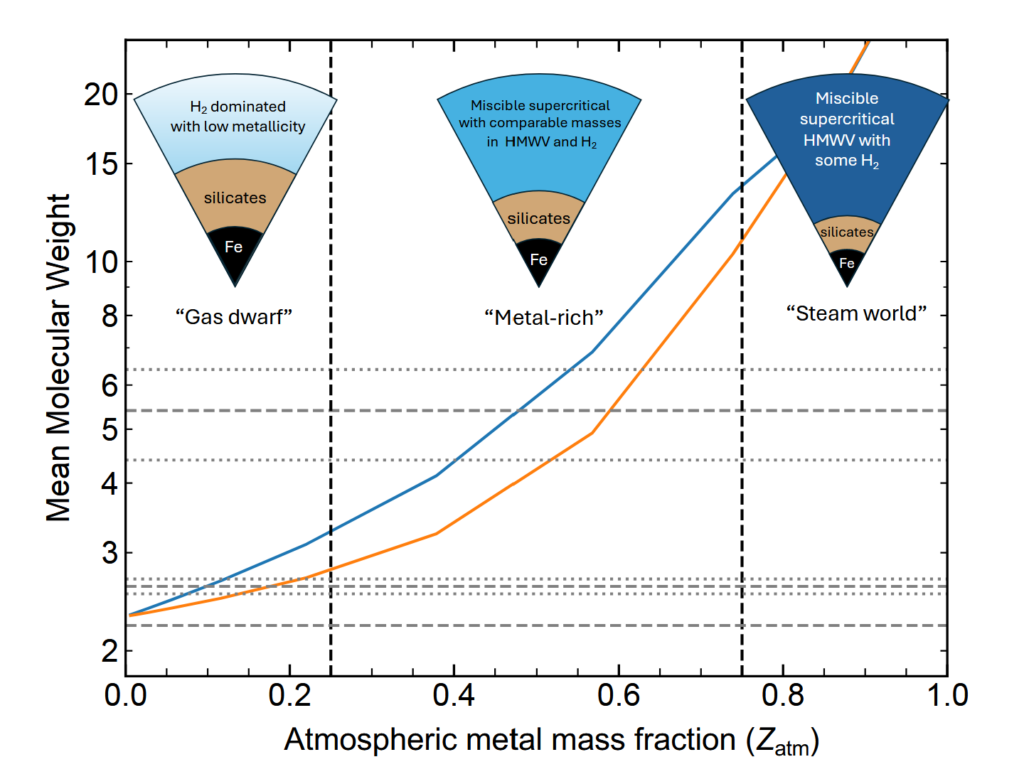
Very little! (Zatm < 25%)
You’re a Gas Dwarf: an au naturel planet, owning your beautiful primordial hydrogen atmosphere. You’re like the little sibling of Jupiter and Saturn, the Gas Giants of our Solar System. Some might confuse you for a Hycean World or a Stratified Mini-Neptune but never forget that you don’t need any metal enhancements. You’re incomparably in a class of your own!
A fair bit! (25% < Zatm < 75%)
You’re a Metal-Rich Sub-Neptune: a modest and tasteful planet, realizing that a bit of both is best. Your commitment to balance still leaves you with a tough question, however. Do you show off a well mixed atmosphere, or separate your hydrogen and metal components into two distinct layers? Only you can decide (see question 1).
Lots! (75% < Zatm)
You’re a Steam World: a passionate and intense planet that goes all in with your high-volatile-metal atmosphere. Depending on what metals are around, your atmosphere could be dominated by water, methane, oxygen, or some other molecule, and you’re into it. You might still have a little hydrogen, but that’s just because you’re down for anything.
Eggsoplanet Unknowns
With all of these possibilities outlined, the authors comment on how miscible-envelope sub-Neptunes like TOI-270 d present an excellent opportunity to study the interior structures of sub-Neptunes. Which is good because there’s still lots we don’t know! One open question is where metal-rich atmospheres come from in the first place. Astronomers still aren’t sure if it’s mostly controlled by the accretion of extra metals during formation, the loss of hydrogen to space, or some kind of magma-atmosphere interaction.
So, when you unwrap your chocolate eggs this Easter, and learn what your sweet treat is made of on the inside, think about TOI-270 d and the astronomers chewing on its yet unsolved mysteries. Happy Easter!
Astrobite edited by Elise Koo
Featured image credit: NASA/JPL (edited by Evan Nelles Henderson). “Our Solar System Features Eight Planets.” NASA Photojournal, PIA11800, 19 November 2008. https://science.nasa.gov/photojournal/our-solar-system-features-eight-planets/

Never have I ever…laughed out loud while reading about exoplanets, taken a personality test about ‘my gas inside’, nor will I ever eat an Easter Egg the same again!
Thoroughly enjoyed!!
An extremely funny and very informative article!!