Title: Astrometry meets pulsar timing arrays: Synergies for gravitational wave detection
Authors: N.M. Jiménez Cruz, A. Malhotra, G. Tasinato, I. Zavala
First Author’s Institution: Physics Department, Swansea University, Swansea, United Kingdom
Status: Published in Physical Review D [open access]
The promise of low-frequency gravitational waves
One way physicists hope to uncover physics beyond the standard model (our current best model for how all particles behave) is by detecting gravitational waves emitted right after the Big Bang. Many exotic phenomena that are currently only theoretical, like cosmological phase transitions or the decay of cosmic strings, may have created such waves. However, just like light waves, these gravitational waves would be stretched to very long wavelengths by the expansion of the universe, so they would likely not be detectable by ground-based instruments like LIGO.
Pulsar timing arrays (PTAs) are a promising tool for detecting such long-wavelength (A.K.A. low-frequency) gravitational waves. In short, gravitational waves can stretch or squeeze spacetime in between pulsars and the Earth. By monitoring whether the pulses from many pulsars arrive earlier or later than we expect, we can infer the properties of the gravitational waves passing between us. PTAs can’t yet resolve individual gravitational wave events, but they have found evidence for a background of many low-frequency gravitational waves all added together—a hum permeating throughout the universe. As of yet, it is unknown whether this stochastic (a fancy word meaning “random”) gravitational wave background (SGWB) is coming from the early universe, from binary supermassive black holes orbiting each other, or a combination of the two.
A “smoking gun” that we’re seeing gravitational waves from the early universe would be if the SGWB is slightly brighter in the direction that the Earth is moving relative to the extragalactic universe. This pattern, called a dipole anisotropy (anisotropy just means “not the same in all directions”), is caused by the blueshift of waves as the Earth hurtles through the universe due to gravitational attractions.
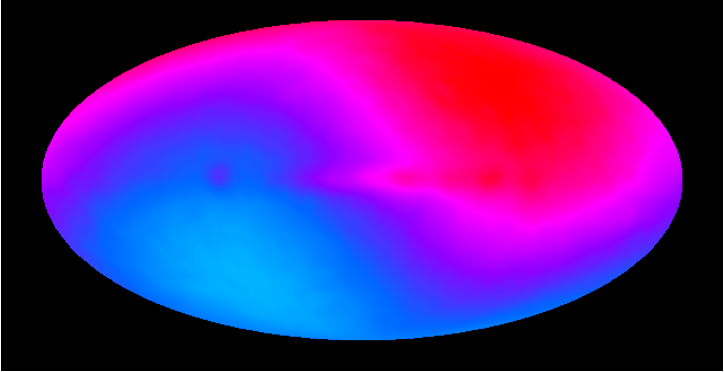
As shown in Fig. 1, this dipole structure is present in the cosmic microwave background (CMB; light emitted everywhere roughly 380,000 years after the Big Bang). If we find that, like the CMB, the SGWB is ~0.1% brighter in the direction of Earth’s motion, it will be strong evidence that we are seeing waves from the early universe. If the SGWB primarily comes from binary supermassive black holes, it would have a stronger anisotropy (with a strength of several percent) in a different direction. Currently, PTAs can’t detect anisotropies smaller than ~20%, so they can’t yet distinguish between these two possibilities.
Enter the stars of the show
The authors of today’s paper wondered if we could study the SGWB with greater precision and potentially observe a dipole anisotropy by using another cosmic-scale gravitational wave detector: the positions of stars in our galaxy. Just like gravitational waves passing over the Earth cause pulsars to appear to move farther and closer to us, the waves also slightly shift where stars appear in the sky.
The study of star positions is called astrometry. Over the past decade, astrometry has been revolutionized by the Gaia space observatory, which precisely measures the positions of over a billion stars in the Milky Way roughly fifteen times each year. A previous Astrobite highlighted a paper discussing how Gaia-based astrometry might be used to detect gravitational waves from individual supermassive black hole binaries.
Today’s authors lay out a more general mathematical framework for relating both the motions of stars and the time delays of pulsar pulses to the underlying SGWB. The classic approach when using PTAs to probe the SGWB is to correlate the time delays of pairs of pulsars: if two pulsars are very near each other in the sky, gravitational waves will increase or decrease the time it takes their pulses to reach us by roughly the same amount. Therefore, if you multiply these two delays together, you get a positive number. If, instead, the pulsars are separated by 90 degrees in the sky, then gravitational waves that bring one pulsar closer to us will push the other farther from us. In this case, if you multiply the time delays of the pulsars, you’ll get a negative number. Measuring these correlations at different pulsar separations lets you study the strength of the SGWB, its spectrum (how the strength depends on gravitational wave frequency), and its anisotropies.
In the same way, you could correlate the deflections in position that two stars undergo to probe the SGWB. Or you could cross-correlate the deflection of a star’s position with the time delay of a pulsar. Today’s authors consider these less well-understood correlation techniques and derive equations relating measured correlations to properties of the SGWB.
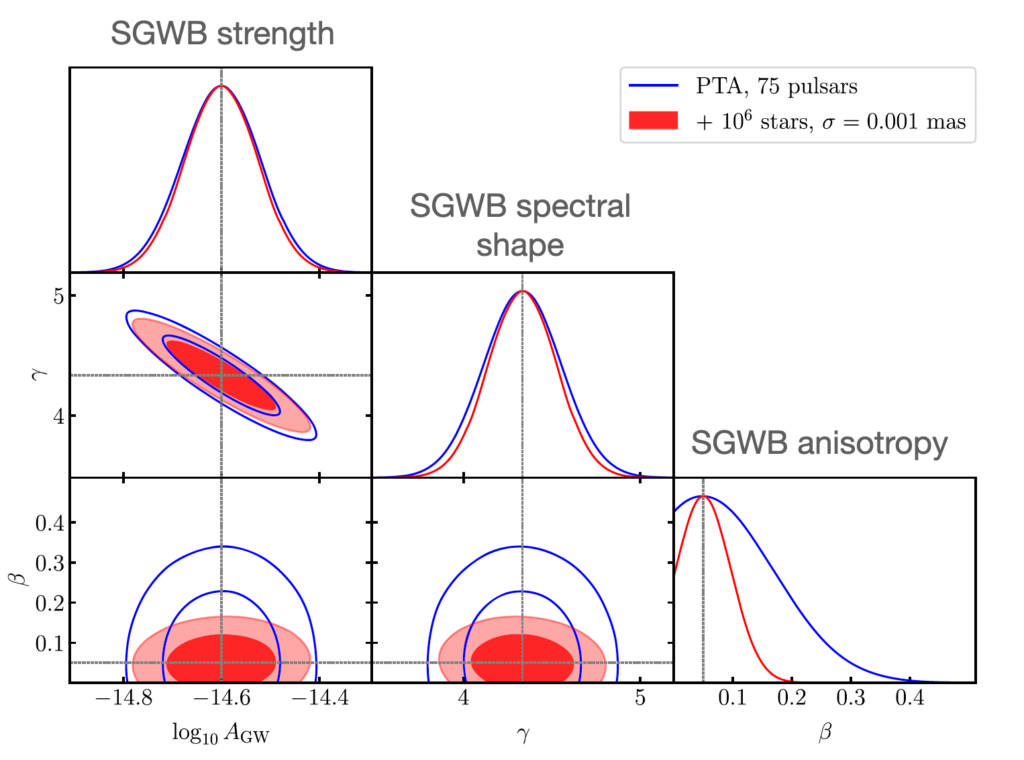
Using their equations, the authors predict how well astronomers could measure the strength, spectrum, and level of dipole anisotropy in the SGWB by cross-correlating star deflections and pulsar time delays (see Fig. 2). The blue curves indicate the best constraints that PTAs can place on these parameters, while red curves show the tighter constraints made possible by including astrometry. Gaia will not provide precise enough star position measurements to deliver real improvements, but a next-generation satellite like the proposed Theia mission could. When we have astrometric data with high enough precision, today’s paper gives us the tools to constrain the SGWB dipole anisotropy and possibly tell whether we are seeing ripples from just after the Big Bang or binary supermassive black holes. Aren’t astronomers lucky that supermassive black holes might be the more mundane explanation to an open question in our field?
Astrobite edited by Viviana Cáceres