
Title: Collapsar black hole spin evolution in 3D neutrino transport GRMHD simulations
Authors: Danat Issa, Beverly Lowell , Jonatan Jacquemin-Ide, Matthew Liska , and Alexander Tchekhovskoy
First Author’s Institution: Center for Interdisciplinary Exploration and Research in Astrophysics (CIERA), Northwestern University & MIT Kavli Institute for Astrophysics and Space Research
Status: Published in Physics Review Journal D [closed]
Introduction
While stars like our Sun have long, fruitful lives before puffing up into a red giant and their demise as a white dwarf, very massive stars (where Mstar >> 8 Msun) are not so lucky. Their fate is a core collapse supernova, which can result in either a neutron star or a black hole. In the latter case, the system is known as a collapsar – which may be responsible for gamma ray bursts (GRBs), one of the most energetic and mysterious types of phenomena we observe. The black holes formed by collapsars may also be progenitors for black-hole-black-hole merger events – which produce gravitational waves.
What is a collapsar?
Stars produce energy via nuclear fusion. Very massive stars are able to fuse heavier elements than low mass stars, which ends when an iron core is formed at the center. However, when the mass of this iron core exceeds the Chandrasekhar limit, the gravitational force exceeds the degeneracy pressure and the star collapses. In the case of many stars, this is accompanied by a spectacular core collapse (type II) supernova, which leaves behind a neutron star. But, for some of the most massive systems (such as Wolf-Rayet stars), this stellar death is dramatic in a different way. The star may collapse directly into a black hole – no explosion necessary. While the majority of stellar matter is encapsulated in the black hole, some of it ends up forming a rapidly rotating, highly magnetized accretion disk around the fast-spinning black hole. This accretion disk-black hole system may produce powerful jets, which can power long duration gamma ray bursts.
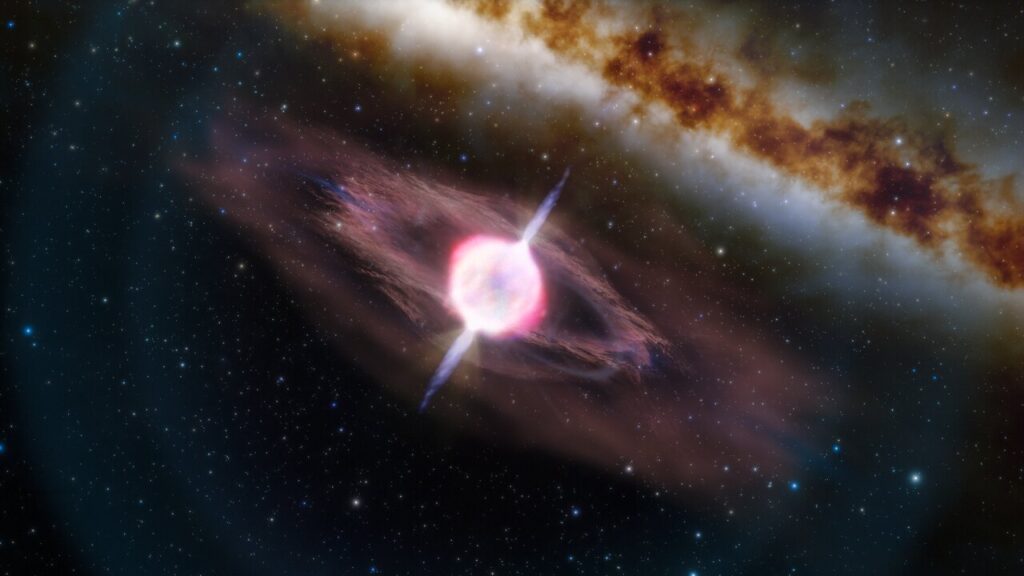
Gamma ray bursts have puzzled astronomers since they were first detected. Thus far, collapsars seem like a promising candidate for the long duration ones.
The authors of today’s paper simulate collapsars to understand the dynamics of the black hole-accretion disk system. Specifically, they set out to examine the spin (rate) of the black hole – and how that may be affected by the emission of neutrinos.
Do neutrinos cool down MAD black holes?
The jets are thought to be powered by the spin of the central black hole and the strength of the magnetic field – in other words, the luminosity of the resultant gamma ray burst is proportional to how fast the black hole is spinning and how powerful the magnetic field of the accretion disk is.
One of the key predictions about these systems is that, to produce these jets and thus emit a gamma ray burst, the magnetic field has to be in an extreme “magnetically arrested disk” (MAD) state. In this state, the force exerted by the magnetic field is equal to the gravitational force of the black hole. The production of the jets and the force of the magnetic field drives a torque, which draws energy away from the system over time – leading to a reduction in the spin of the black hole (a “spin down”).
For a long time, it has been speculated that neutrinos also play a role in these systems. Neutrinos are produced during the core collapse and travel away from the system – taking energy with them and “cooling” the system. However, because astronomers have not had computers powerful enough to simulate the neutrinos along with everything else, modelling this has been challenging until now. This paper presents results from one of the latest simulations – where they are now able to include neutrino cooling.
The authors model two different collapsar types: one with a constant, initial density, and one with a more typical “power law slope” – i.e. one where the density varies with radius.. These initial densities affect the rate of mass accretion onto the black hole and show that black holes that spin slower accrete matter faster. These “mass accretion rates” also affect the efficiency at which neutrinos are emitted and thus the effectiveness of neutrino cooling.
As mentioned earlier, the black hole spin rate affects the jet power. This paper shows that slow spinning black holes lead to weaker jets – which may become unstable and bend, which can kick the magnetic field out of its MAD state and shut off the jet (as shown in Figure 2). This can lead to fainter gamma ray bursts.
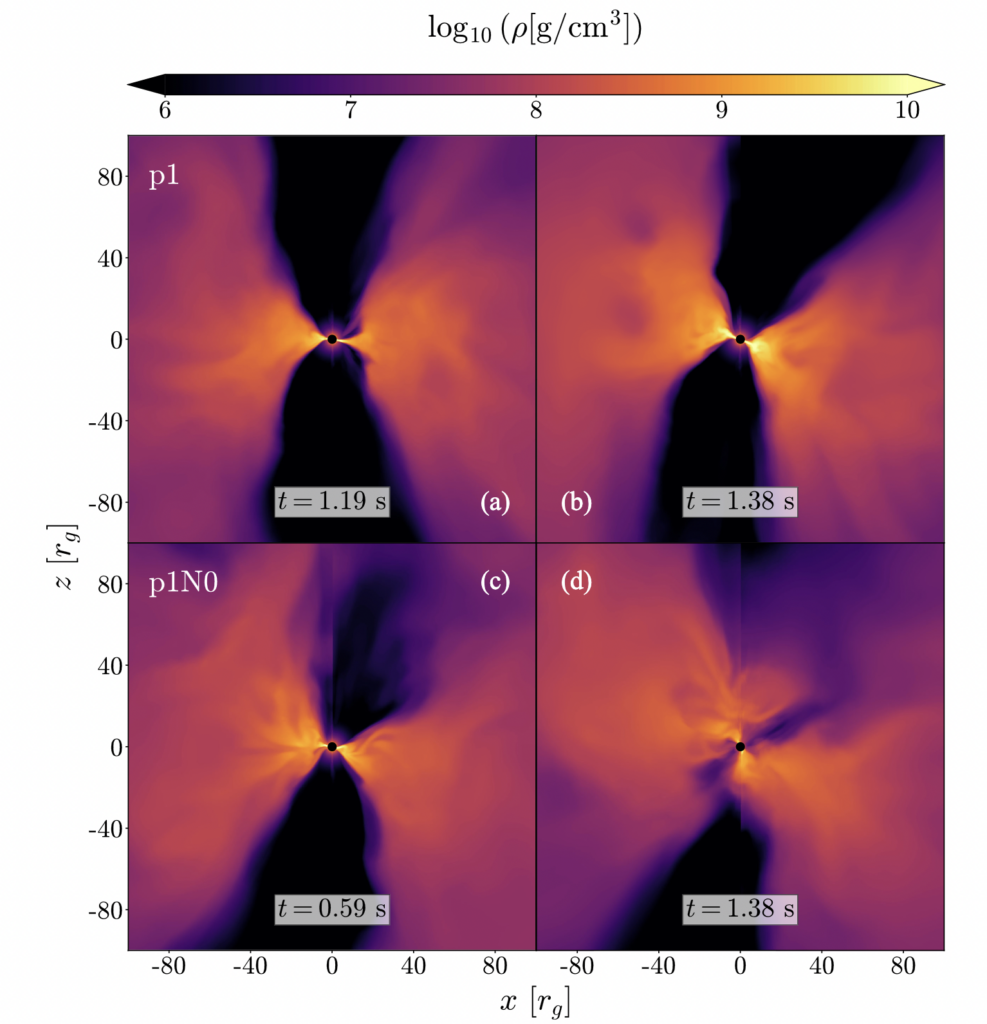
Interestingly, the authors find that the expected neutrino cooling doesn’t affect the spin of the black hole directly. Instead, the neutrino cooling may affect the other sources of torque – such as the magnetic field.
Overall, these simulations can be compared with gamma ray burst observations and gravitational wave observations to narrow down the sources of these phenomena.
Astrobite edited by Ansh R. Gupta
Featured image credit: International Gemini Observatory/NOIRLab/NSF/AURA/J. da Silva, M. Zamani
