
Title: Astrometric Methods for Detecting Exomoons Orbiting Imaged Exoplanets: Prospects for Detecting Moons Orbiting a Giant Planet in α Centauri A’s Habitable Zone
Authors: Kevin Wagner, Ewan Douglas, Steve Ertel, Kyran Grattan, S. Pete Worden, Aniket Sanghi, Billy Quarles, Charles Beichman
First author’s institution: Department of Astronomy and Steward Observatory, University of Arizona, AZ, USA
Status: Accepted to The Astrophysical Journal Letters [open access]
Six of the eight planets in our Solar System host at least one moon; the innermost planets Mercury and Venus are the exceptions. The origins of these moons are widely studied and hotly debated. Earth’s very own Moon seems to have formed in the aftermath of a collision between the young Earth and another protoplanet. Mars seems to have captured two asteroids as its moons, Phobos and Deimos, a process thought to have produced many of the irregular satellites orbiting the gas giants as well. Using our Solar System as a model, the presence of moons seem like a natural outcome of planet formation.
Why then don’t we observe exomoons, moons orbiting any of the ~6000 known exoplanets? Well, the largest moon in our Solar System, Ganymede, is 2.5% as massive as Earth and has 40% of the radius, making it marginally larger than Mercury but still less massive. You might have heard how difficult it is to find Earth-like exoplanets, and finding exomoons is even harder. A few exomoon candidates have been announced, via microlensing and transits, but the authors of today’s paper investigate whether a different technique, astrometry, could help find moons.
Astrometry involves precisely tracking the positions of objects like stars or planets in the sky. In a simple star-planet system, the star and planet trace out ellipses around their shared center of mass. With a moon present, there is an additional deviation, as the planet wobbles to and fro due to the gravitational tug of the moon. The authors of today’s paper check whether moons can be detected by tracking such wobbles exhibited by directly-imaged planets.
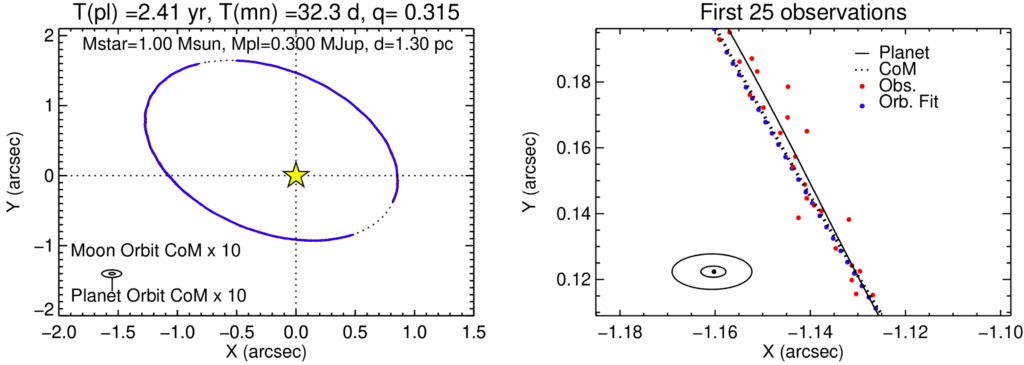
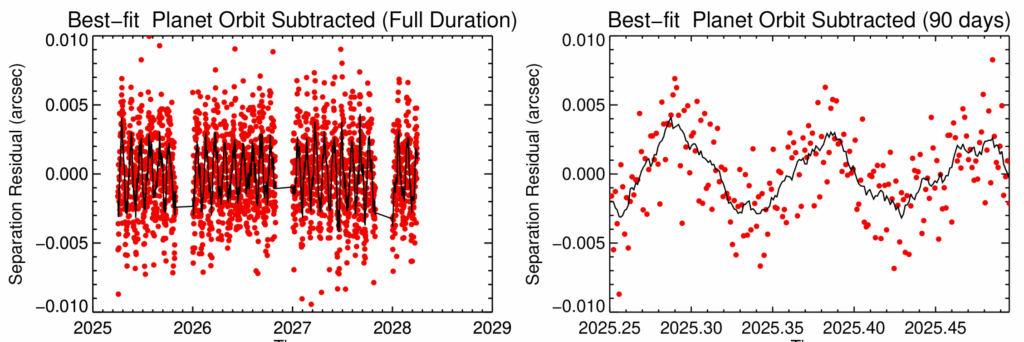
To start, the authors consider whether any known planets are promising targets for astrometric moon searches. There just so happens to be a giant planet candidate in Alpha Centauri, and if there were a massive moon orbiting this large planet around this nearby star, it would be as good as it gets. The authors simulate orbits of this system (a Saturn-like planet in a 1.8 AU orbit around a Sun-like star at a distance of 1.3 pc) with a 30-Earth-mass moon injected. They simulate observing such a system with a space-based 6.5-meter telescope (similar to the planned Habitable Worlds Observatory) with realistic noise over a three-year observing campaign. The simulated and modeled orbits are shown in Figure 1. After the authors subtract the best-fit planet orbit, they are left with what is shown in Figure 2, where a clear periodic perturbation from the moon as it orbits is visible.
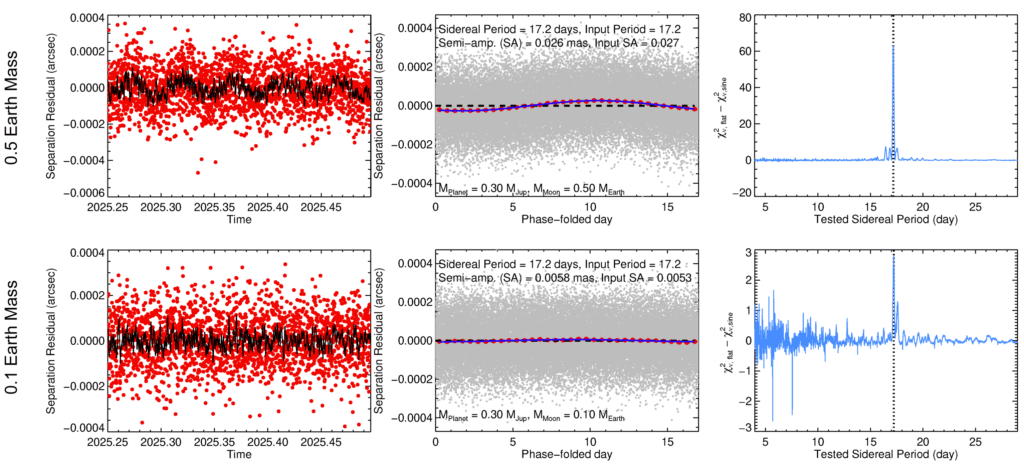
The authors then repeat this procedure with more realistically sized moons and a more optimistic observing campaign (5-year baseline, 1-hour observing cadence, precision = 0.1 mas) looking at the Alpha Centauri giant planet candidate. They use the difference in the Chi-Squared (χ2) test statistic to determine whether the presence of a moon is statistically preferred. Figure 3 shows the moon-induced deviations for two different moon masses and the resulting χ2 difference. Using their χ2 difference threshold of ~5, the lowest mass detectable moon is ~0.2 Earth masses. This is much more massive than our Moon, which is around 1% of Earth’s mass. The authors additionally vary the moon’s orbital period and find that periods of 4 – 30 days are detectable.
The authors continue to consider more specific observing scenarios: a 39-meter ground-based telescope (similar to the planned European Extremely Large Telescope) and a 3-meter space telescope built specifically to find moons. They find that the ground-based telescope observing once per day could detect an Earth-mass moon around a Saturn-like planet over a five-year observing campaign. The dedicated space telescope observing once per hour could make the same detection observing over five years. While detecting moons astrometrically is neither easy nor fast, it may be feasible to start finding moons around planets orbiting nearby stars in the coming decades.
All of this is great news for fans of the hit movie (and still the highest-grossing movie of all time) Avatar, which features a habitable exomoon in the Alpha Centauri system. Searching for moons will help us understand their properties and formation, probe whether our Solar System is unique, and even look for life on rocky moons orbiting gas giants in the habitable zones of their stars.
Astrobite edited by Ryan White
Featured Image Credit: NASA, ESA, and L. Hustak (STScI)
