
Title: The JWST EXCELS survey: Insights into the nature of quenching at cosmic noon
Authors: Maya Skarbinski, Kate Rowlands, Katherine Alatalo, Vivienne Wild, Adam C. Carnall, Omar Almaini, David Maltby, Thomas de Lisle, Timothy Heckman, Ryan Begley, Fergus Cullen, James S. Dunlop, Guillaume Hewitt, Ho-Hin Leung, Derek McLeod, Ross McLure, Justin Atsushi Otter, Pallavi Patil, Andreea Petric, Alice E. Shapley, Struan Stevenson, Elizabeth Taylor
First Author’s Institution: William H. Miller III Department of Physics and Astronomy, Johns Hopkins University, Baltimore, Maryland, USA
Status: Published in the Astrophysical Joural [open access]
How to Quench a Galaxy
Look at an image of the sky taken with a sufficiently sensitive telescope, and you’ll quickly notice that galaxies tend to cluster into two main types: blue spiral galaxies, which have flat disk shapes with a central bulge, and red elliptical galaxies, which look like spherical or elliptical balls of red stars. Blue spiral galaxies can form 10s–100s of stars every year, while elliptical galaxies have completely stopped forming stars, meaning that some process has to transform star-forming spirals into non-star-forming, or “quiescent,” elliptical galaxies. To form the current population of massive elliptical galaxies, this process had to be common about 8–10 billion years ago at “Cosmic Noon,” the period when star formation in the Universe peaked. The processes that “quench” star formation in massive galaxies are still being studied, and one of the best ways to do it is to find galaxies that recently quenched and look for clues about the processes that quenched them.
Post-starburst galaxies are galaxies that have rapidly quenched after a short burst of star formation. Because these galaxies quenched so quickly and so recently, it’s often possible to find signs of whatever quenched them, like the signatures of past galaxy mergers, feedback from supermassive black hole accretion, or the shutoff of gas flowing into the galaxy. Rapid quenching is pretty uncommon now, but it was a much more common way for galaxies to quench at Cosmic Noon. Understanding post-starburst galaxies at Cosmic Noon is therefore critical for understanding the formation of massive elliptical galaxies in the local Universe.
The quest for quenched galaxies
Today’s paper uses data from the JWST Early eXtragalactic Continuum and Emission Line Survey (EXCELS) to identify post-starburst galaxies at Cosmic Noon and try to determine why they quenched. EXCELS is a spectroscopic survey, so the authors get a spectrum for every galaxy. The spectrum encodes information about the galaxy’s stellar population, including the mass of stars in the galaxy, the number of stars forming every year, and the history of star formation throughout the galaxy’s life.
The authors use a technique called Principal Component Analysis (PCA) to further divide the sample into young and old post-starbursts. Principal Component Analysis is a machine learning technique that learns the most important features of a data set. This technique is used for “dimension reduction,” or reducing the number of data points needed to learn something about the object. A typical spectrum has hundreds or even thousands of data points, which means performing data analysis on a spectrum can be very computationally expensive. PCA takes these thousands of data points and learns broad patterns that correlate with each other. These patterns are called “supercolors” in the context of spectral data, and they encode things like the overall shape and color of the spectrum as well as the spectral shape around key features (see Figure 1 for a visualization). Since the overall shape, color, and emission/absorption line features of a spectrum come from the galaxy’s stellar population, PCA can be used to identify galaxies with lots of stars that formed a billion years ago but very little star formation today—in other words, post-starburst galaxies.
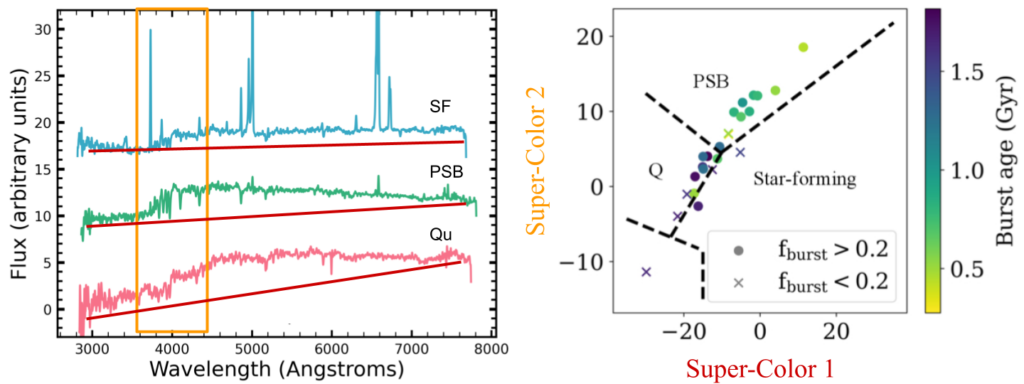
The authors apply PCA to the galaxies in their sample and find that 11 of the galaxies in their sample are PCA-classified as post-starburst, 9 are quiescent, and 4 still have some star formation. To further analyze the stellar populations of the post-starbursts in their sample, the authors use a program called Bagpipes to fit the galaxies’ spectra. Bagpipes is an SED fitting software, which means that it takes the observed spectrum of a real galaxy and tries to match it to a library of different stellar spectra. By measuring the relative contribution of different kinds of stars (which all have different lifetimes), Bagpipes can compute the likely history of star formation in the galaxy (e.g. when the star formation rate peaked) as well as the present-day properties of the galaxy (things like the mass in stars versus dust and the current star formation rate). The authors use the galaxies’ star formation histories to try to find clues as to how they quenched.
How quickly do post-starbursts quench?
First, the authors measure something called a “quenching timescale,” which they define as the length of time between when the galaxy’s star formation rate peaked and when it fell low enough that the galaxy was quenched. The quenching timescale depends on which process shut down star formation in the galaxy—feedback from black hole accretion or star formation should cause fast quenching, while galaxies that are starved of gas from the intergalactic medium should quench more slowly. The authors find that 15 of their galaxies quenched in under 500 million years, 6 took between 500 million and one billion years, and 3 took longer than a billion years to quench. The galaxies that had the highest peak star formation rates quenched the fastest, suggesting that feedback from star formation could have played a role in quenching these galaxies.
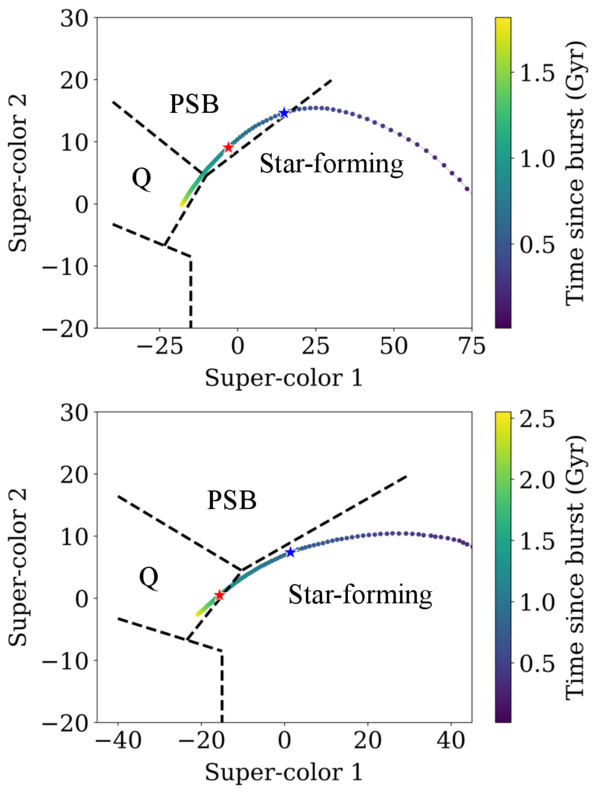
Next, the authors measure how important the post-starburst phase is to form massive quiescent galaxies. Not all galaxies that quench go through a post-starburst phase; some objects, especially those that quench slowly, will transition directly from star forming to quiescent. The authors use the star formation histories from their SED fits to predict how the galaxies’ supercolors changed after their star formation peaked (Figure 2) and find that six of the nine quiescent galaxies went through a post-starburst phase in the past, while the other three did not. For the objects that went through a post-starburst phase, the median time spent as a post-starburst was around 600 million years. They can use this measured “visibility timescale” to constrain whether the post-starburst phase is important for forming massive quiescent galaxies. If the fraction of post-starburst galaxies in a sample is high, that can be for two reasons: either a larger fraction of galaxies will eventually go through a post-starburst phase, or the post-starburst phase is very long, making it easy to find post-starburst galaxies. Using the measured 600 million year timescale and combining with results from another paper, the authors find that 40% of quiescent galaxies likely went through a post-starburst phase; for the more massive end of the sample, this fraction increases to around 73% due to the shorter visibility timescale. This suggests that the post-starburst phase is very important for forming the kind of massive quiescent galaxies we see in the local Universe.
While the post-starburst phase is important, the different quenching timescales present across the sample suggest that multiple pathways existed to quench galaxies at Cosmic Noon, similar to what has been found in less distant galaxies and at Cosmic Noon in other samples. This is also supported by the fact that four of the five galaxies with sufficient data show evidence of an actively accreting supermassive black hole that may help shut down star formation in many (but perhaps not all) massive galaxies. While the precise processes that quench massive galaxies are still uncertain, one thing is clear: JWST EXCELS at solving the mystery!
Astrobite edited by Anavi Uppal
Featured image credit: NASA’s Scientific Visualization Studio – NASA, ESA, CSA, STScI. Modified by Margaret Verrico.
