
Title: Thick lunar crust amplifies deci-hertz gravitational-wave signals
Authors: Lei Zhang, Han Yan, Xian Chen, Jinhai Zhang
First Author’s Institution: Institute of Geology and Geophysics, Chinese Academy of Sciences, Beijing 100029, China
Status: Accepted to Physical Review Letters [closed access]
Unaccounted Spacetime Ripples
The historic 2015 detection of gravitational waves (GWs) from a black hole merger by the Laser Interferometer Gravitational-wave Observatory (LIGO) revolutionized the field of astronomy (read this bite for a great overview on LIGO and the detection). Since then, we’ve observed many more similar black hole mergers with ground-based interferometers in addition to GW detections using pulsar timing arrays . Such events occur in the high-frequency band (~100 Hz) and lower-frequency band (nanohertz) respectively. Yet, in between these frequencies lies the elusive mid-band (0.001-0.1 Hz), which includes phenomena such as supermassive black hole seeds, colliding binary stellar mass black holes/neutron stars, and also supernovae. Ground-based detectors currently can’t reach the requirements and sensitivity for making detections at these frequencies, meaning we’re missing out on important insight from such events (read this bite for a good discussion).
While space-based missions have been proposed to fill this gap, we might already have access to a nearby, giant, free-floating GW detector: the Moon.
Using the Moon as an Antenna
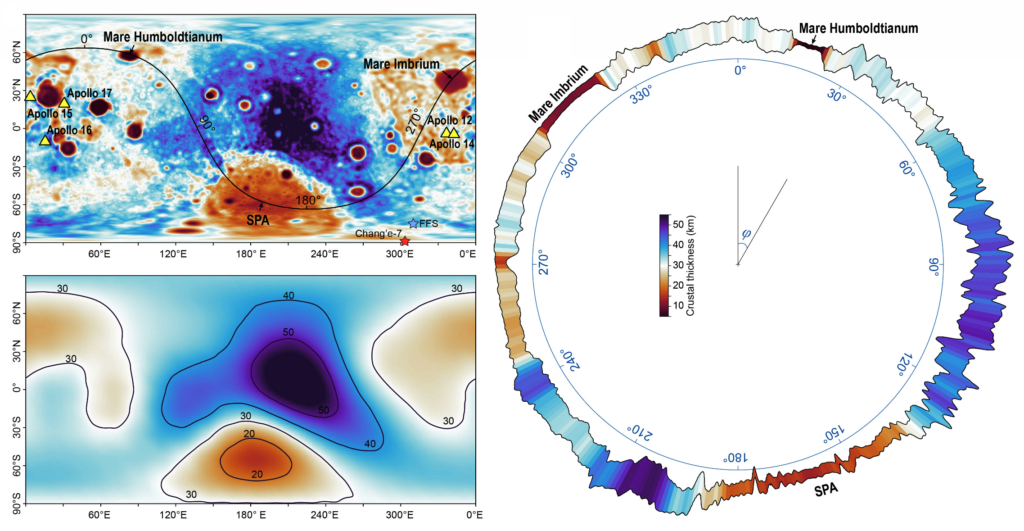
The Moon has been proposed as a natural GW detector, as GWs passing through it would make it vibrate slightly, like ringing a bell. The Moon is a much quieter and thus more ideal location compared to Earth for detecting these sensitive signals (thanks to no oceans, weather, or humans creating noise). However, no one was sure if its rugged surface and heterogeneous crust would assist or inhibit its ability to detect GWs.
So, the authors tackle this question using two modeling methods for simulating and understanding GW interactions on the Moon:
- Spectral Element Method (SEM): High resolution numerical simulations that calculate how seismic waves propagate and interfere within the Moon when hit by GWs
- Normal-mode Perturbation Method: Analytical method that provides the mathematical framework for describing the Moon’s vibrations
The SEM simulations provide in extreme detail how GWs interact with the lunar interior, using topographical and crust-thickness data from the LOLA and GRAIL missions and focusing on its response within the mid-band frequency. The downside to these simulations is that they are very computationally intensive and are limited to a 2D slice of the surface (see Figure 1). While the SEM simulations show the detailed interactions of GWs, the normal-mode perturbation theory approach is then able to provide a physical explanation for the observed effects seen in the SEM simulations. Both methods are necessary for painting a complete picture of GW interactions on the lunar surface.
Big Crust, Big Sound
The authors uncover an exciting result: regions with thicker lunar crust measure stronger GW-induced seismic signals (see Figure 2). The SEM simulations show that thick-crust regions act to amplify an input signal by 10–20%, but why is this the case?
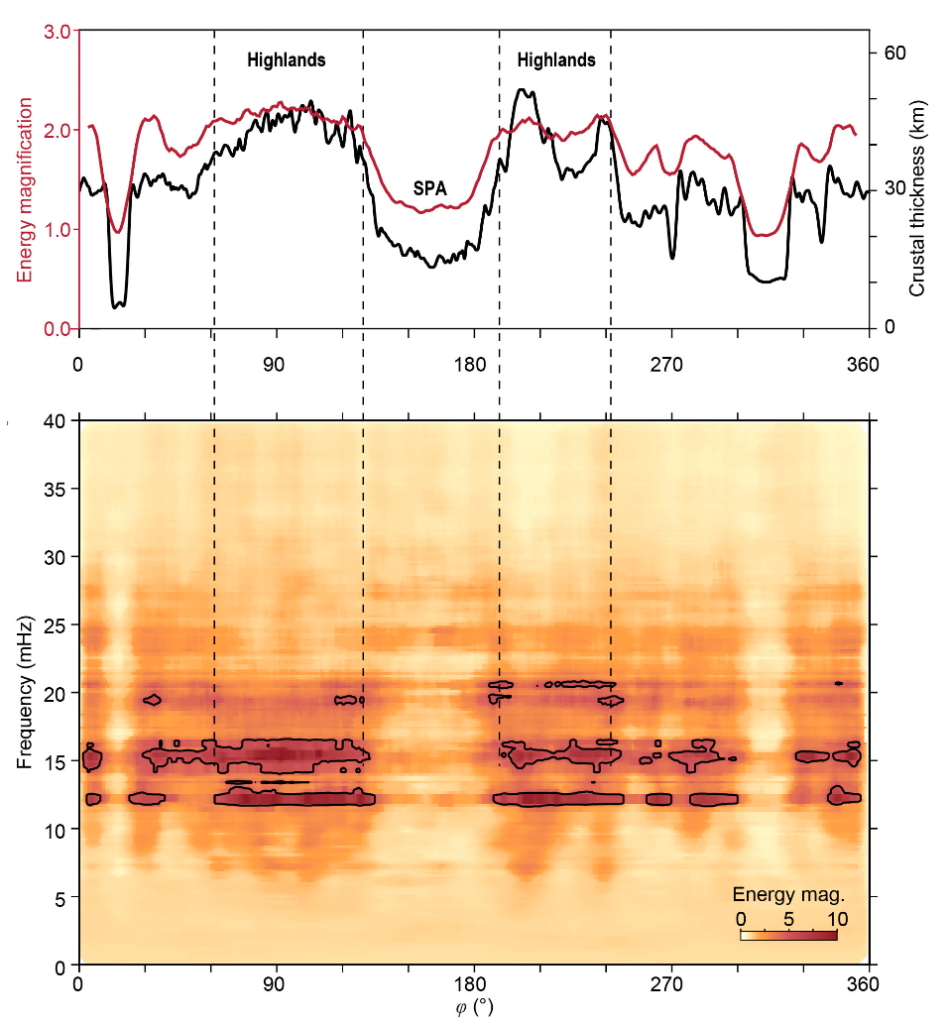
Initially taking a “spherical cow” approach for modeling the Moon, assuming a spherically symmetric and isotropic object, vibrations induced by GWs can be described with normal modes, or fundamental vibration patterns. When adjusting the model to account for the Moon’s imperfections (ex. crust thickness variations), these patterns then begin to mix together, resulting in mode coupling and patterns combining constructively/destructively across different regions. The thick-crust regions act to constructively combine the patterns, thus amplifying the observed signal. Perturbation theory is used to predict these new patterns by starting with the normal modes in the simplified assumption of the Moon’s surface, and then making slight corrections to it based on the crustal variations.
To the Moon and Back
This isn’t the first time someone has had the idea of lunar GW detection, but these results provide a guide for future site selection of such a detector. A previous theoretical curiosity is now becoming closer to a realistic mission for GW detection. The lunar farside highlands are bound to become prime real estate for GW hunters.
Astrobite edited by Kasper Zøllner
Featured image credit: muratart / Elena11 / Shutterstock.com Modified by IFLScience

