• RSS
  • Submit a Guest Post
  • Undergraduates: Submit your Research!
  • Suggest a Paper Topic!
astrobites
  • About
    • About Astrobites
    • Meet the Authors
    • Statement of Inclusivity
    • Copyright & Permissions
  • Latest Research
    • Daily Paper Summaries
    • Classics
    • Undergrad Research
    • Physical Review Coverage
  • Beyond astro-ph
    • Beyond astro-ph Library
    • Interviews
    • Career Navigation
    • Personal Experiences
    • Current Events
    • Teaching with Astrobites
  • Guides
    • EM Spectrum
    • Galaxies & AGNs
    • Spectroscopy and Spectral Lines
    • Adaptive Optics
    • Gravitational Waves
    • Transient Astronomy
    • Astrophysical Software
    • Graduate School
    • Writing a personal statement for grad apps
    • First Observing Run
    • …More Guides!
Select Page
Hot Jupiters prefer long distance relationships

Hot Jupiters prefer long distance relationships

by Leonardo dos Santos | Jul 5, 2016 | Daily Paper Summaries

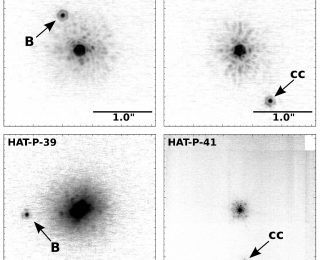
How can we explain hot Jupiters? The answer is not completely clear yet, but we are closing in on it: it seems that binaries may play an important role on the formation of these oddball planets.

The gruntwork behind Kepler’s new batch of exoplanets

The gruntwork behind Kepler’s new batch of exoplanets

by Leonardo dos Santos | May 18, 2016 | Daily Paper Summaries

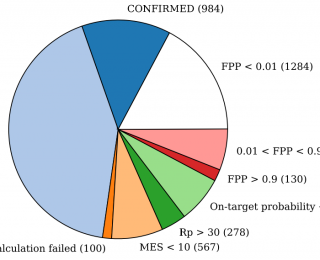
The first Kepler mission observed hundreds of thousands of stars, and approximately 7500 of them are of potential interest. In this astrobite, we learn how astronomers are sifting through all these data in search for exoplanets.
Pursuing eternal youth: stellar cannibalism in the wilds of our galaxy

Pursuing eternal youth: stellar cannibalism in the wilds of our galaxy

by Leonardo dos Santos | Apr 12, 2016 | Daily Paper Summaries

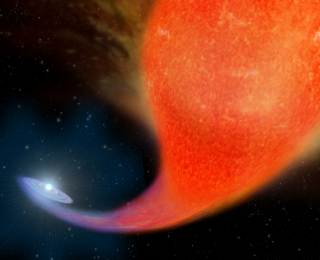
Recent surveys of the sky showed the presence of stars that seem to be too young for the population that they belong to. In today’s bite, we will see that cannibalism between two very close stars could be a viable way to produce these curious objects.
Tracing cosmic siblings in the Milky Way

Tracing cosmic siblings in the Milky Way

by Leonardo dos Santos | Feb 5, 2016 | Daily Paper Summaries

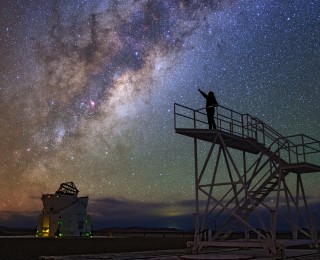
Using data obtained from surveys of stars in the Milky Way and some clever programming, it is now possible to find stellar siblings scattered throughout our Galaxy, and thus obtain invaluable information on its evolution.

Optimizing the search for pale blue dots

Optimizing the search for pale blue dots

by Leonardo dos Santos | Jan 25, 2016 | Daily Paper Summaries

How can we find other pale blue dots? Today’s paper studies what could be the most time-effective way to search for Earth-like exoplanets, just by looking at their colors.

« Older Entries
Next Entries »

Loading

Follow our socials

  • Bluesky
  • Facebook
  • Instagram
  • RSS Feed

More Posts About

AAS AGN astronomy astrophysics binary stars black holes cosmology dark matter dwarf galaxies exoplanets galaxies galaxy evolution gravitational waves habitability JWST Kepler Milky Way observations planetary science planet formation protoplanetary disks radio astronomy simulations solar system spectroscopy star formation stars stellar evolution supernovae theory

Posts by Category

  • Accessibility
  • Applications
  • Beyond
  • Book Reviews
  • Career Navigation
  • Classics
  • Climate Change
  • Course Assignments
  • Crossposts
  • Current Events
  • Daily Paper Summaries
  • Game Reviews
  • Guides
  • Historical Astronomy
  • Instrumentation
  • Interviews
  • Outreach
  • Personal Experiences
  • PRJ
  • Quick Notes
  • Satellites
  • Teaching
  • Undergraduate Research

More Astronomy

  • AAS
  • AAS Nova
  • astro-ph
  • AstroBetter
  • APOD

Read Astrobites in Other Languages

  • Astrobitos (Spanish)
  • Astropontos (Portuguese)
  • staryab (Farsi)

Listen to Astrobites

  • astro[sound]bites

Discover More Incredible Science

  • ScienceBites Network
  • RSS

© 2026 Astrobites | All Rights Reserved | Supported by AAS | Designed by Elegant Themes | Powered by WordPress