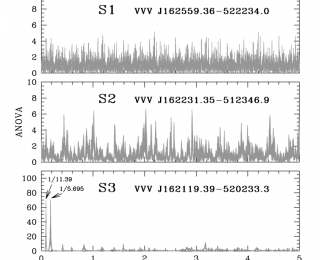
Looking for Dwarf Galaxies with Cepheids: A Cautionary Tale
Today we use a new paper to revisit the possible dwarf galaxy discovered 90 kpc from the Milky Way.

Today we use a new paper to revisit the possible dwarf galaxy discovered 90 kpc from the Milky Way.
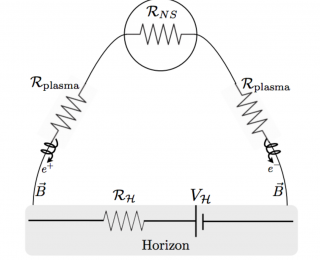
Some fast radio bursts might be the result of a black hole lighting up a neutron star.
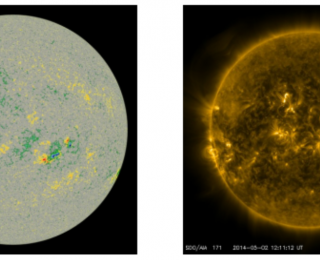
One of the best ways to look for planets around stars is to look for wobbles in the stellar spectrum using state of the art spectrographs. Unfortunately, processes on the star like star spots can also cause shifts in the spectrum. Today’s astrobite uses the Sun to link sunspots to shifts in the solar spectrum. These lessons will help to discover Earth-twins orbiting other stars.
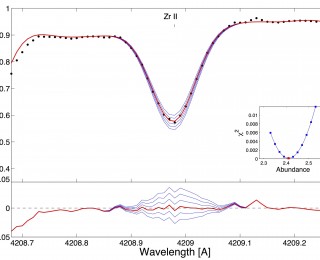
The authors use measurements of heavy element abundances to study the history of how and when the Milky Way became enriched in heavy elements. Specifically, they are concerned with elements formed through slow and fast neutron capture.
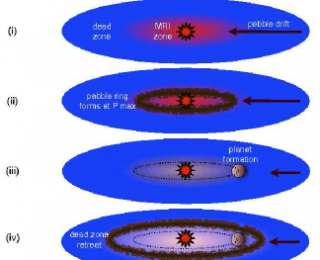
Planets with radii between Earth and Neptune and small radii are the most common in planetary systems. These planets are challenging to explain with classical models of planets. Do planets form instead in-situ in an inside-out manner?
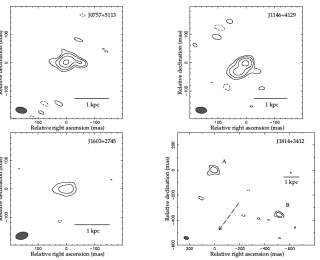
These hot galaxies show signs of AGN and starburst activity occurring within their dusty interiors.