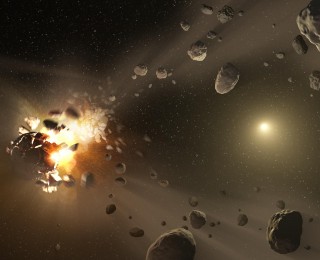
Ripping Apart Asteroids to Account for Earth’s Strangeness
Earth’s composition seemingly does not fit into planet formation theory. Ripping apart its building blocks by collisions during accretion might sound violent, but can be a way to go.

Earth’s composition seemingly does not fit into planet formation theory. Ripping apart its building blocks by collisions during accretion might sound violent, but can be a way to go.
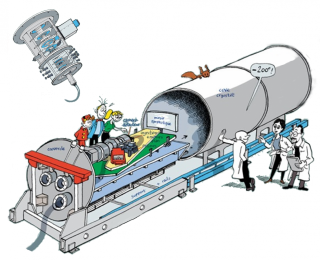
Spirou often runs into fantastic adventures with his courageous, and sharp pet squirrel Spip. Their next adventure: a radial velocity spectrograph. What sophisticated technology is this? How does it work? What can it help us find?
More than 100 massive stars orbit the supermassive black hole at the center of our galaxy incredibly closely.
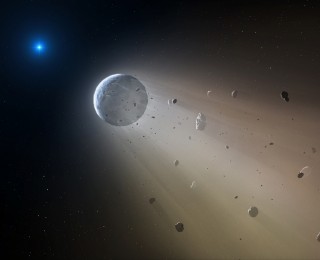
In around five billion years, the hydrogen fuel in the core of the Sun will run out, and our star will begin to die. After swelling up into a red giant, many times bigger than its current size, the Sun will blow away its outer layers to leave a tiny, ultra-dense core, around the size of the Earth. White dwarfs, as these dead, slowly cooling star cores are known, are the ultimate fate for the vast majority of stars in the Universe.
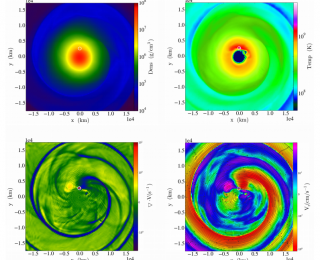
Accretion instabilities driving violent outcome of a merging binary, and its observable signatures.
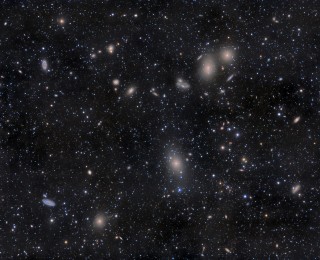
How do galaxy clusters form and evolve? Counting galaxies of different luminosities, masses, and colors can yield surprising insights.