by Yvette Cendes | Nov 1, 2014 | Daily Paper Summaries
Title: Limits on low frequency radio emission from southern exoplanetsAuthors: Tara Murphy, et al.First Author Institution: Sydney Institute for Astronomy, The University of Sydney, AustraliaStatus: Accepted for publication in MNRASAstrobites is no stranger to exotic exoplanet discoveries– the Kepler mission alone has increased our knowledge of these worlds by leaps and bounds, and many exciting discoveries have been done by optical telescopes as well through a variety of methods. In today’s paper, however, the authors present results on yet another method of extrasolar planet detection: the possibility of discovering planets in radio frequencies.How does this work? Well we know that planets with high magnetic fields can give of gigantic radio flares in the right circumstances- in our own solar system, Jupiter gives off flares that can be brighter than the sun in radio frequencies thanks to its powerful magnetosphere (which produces bright aurorae like Earth’s magnetosphere- see Figure 1). This is thanks to something called cyclotron maser emission, where electrons from plasma material interact with the magnetic field in a way that beams them like a laser in radio frequencies. In the case of Jupiter, these bursts are visible from Earth when Io– the nearest Galilean moon to Jupiter, which is constantly spewing out material from its volcanoes- is at a particular point in its orbit and this beam of radio radiation is pointed towards us.Of course, if such a thing is a well-documented phenomenon in our own solar system with Jupiter, shouldn’t it also occur around other planets? Astronomers think so, and such flares have been observed from brown dwarfs, but the question is whether these exoplanet radio flares would be strong enough to be detectable from Earth. The answer is “perhaps,” under circumstances such as if the exoplanet is...
by Becky Smethurst | Oct 30, 2014 | Daily Paper Summaries
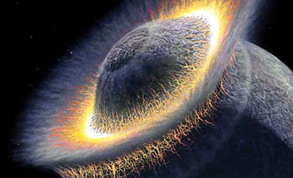
The Giant Impact Hypothesis is the most widely accepted theory for the creation of the Moon; the authors here investigate possible configurations of the early Solar System to produce the right conditions for impact between Earth and the doomed proto-planet Theia.
by Josh Fuchs | Oct 28, 2014 | Daily Paper Summaries
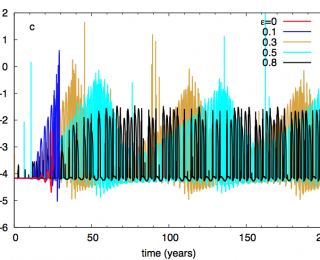
How do the most massive stars explode? A new model of massive stars predicts new observational evidence.
by Meredith Rawls | Oct 24, 2014 | Daily Paper Summaries
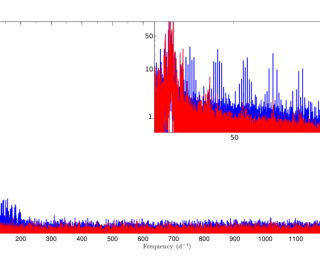
Astronomical data gathered over time has gaps. Even the most reliable space telescopes suffer from occasional pauses in their otherwise constant watchfulness. Why are gaps a problem? Can’t astronomers just analyze the short chunks of data that don’t have gaps? The answer: Fourier transforms.
by Ruth Angus | Oct 22, 2014 | Daily Paper Summaries
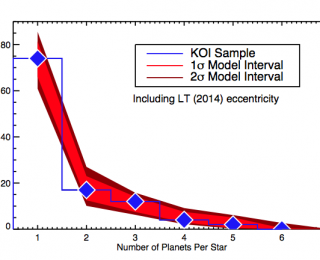
Many exoplanets in our galaxy are all alone. They have no one to cuddle up to on those cold, lonely nights in space…
by Elisa Chisari | Oct 20, 2014 | Daily Paper Summaries
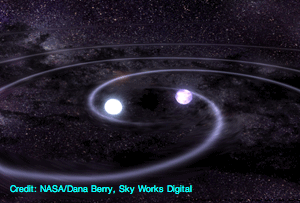
In the next few years, gravitational wave detectors are expected to start finding mergers of compact objects. But their resolution is limited to large areas of the sky. Fast galaxy surveys are needed to aid in the task of locating the source more precisely, but how fast can they go?
