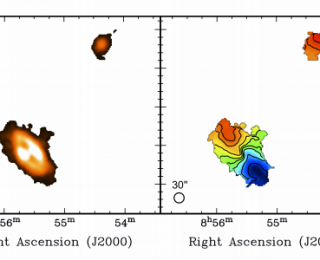
Minor Mergers are Minor Players
Once thought to be the main mechanism by which galaxies feed their star formation; the authors of this paper find that minor mergers cannot account for the observed star formation rates of galaxies.

Once thought to be the main mechanism by which galaxies feed their star formation; the authors of this paper find that minor mergers cannot account for the observed star formation rates of galaxies.
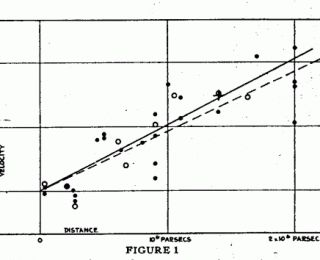
Different methods of measuring the Hubble constant yield slightly different values, but they are still in reasonable agreement.
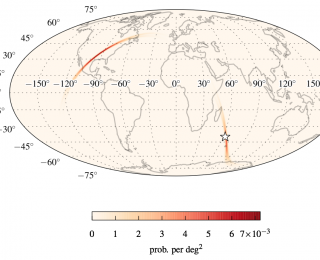
How quickly will Advanced LIGO/Virgo be able to detect a gravitational wave, and how precisely will they be able to tell their partner electromagnetic telescopes where to point? Today’s authors answer these questions for the most promising and best-understood type of system, binary neutron star mergers. Specifically, they take a realistic look at LIGO/Virgo’s first two online years, including their early sensitivity and expected downtime.
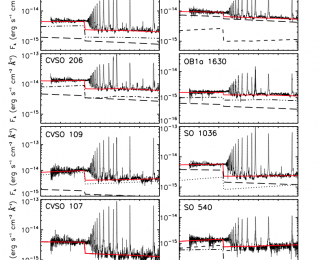
What might be causing the accretion rates in newly formed stars to remain so high?
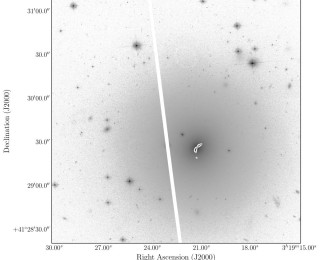
The diffuse gas contained within galaxy clusters can dramatically affect the galaxies moving within it. This includes bending the jets coming out of active galactic nuclei in galaxy clusters. The authors in today’s Astrobite report on extremely bent jets recently discovered in galaxy NGC 1272.
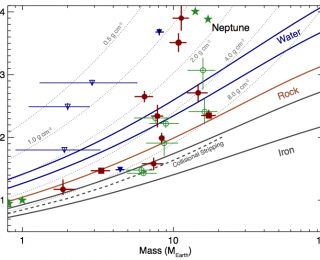
According to planet formation theory, gas giants are more massive than rocky, terrestrial planets. But Kepler-10c is the size of Neptune, and denser than the Earth! Read on to find out more about the discovery of a new class of planets.