
by Brett Deaton | May 14, 2014 | Daily Paper Summaries
In this short critical essay, a computational astrophysicist, Kevin Heng, questions the movement of his field toward more complex models producing larger volumes of data. Toward the end of his essay, Heng poses some open questions to the simulation community. “Is scientific truth more robustly represented by the simplest, or the most complex model?”, and, “How may we judge when a simulation has successfully approximated reality in some way?”
by Andrew Emerick | May 12, 2014 | Daily Paper Summaries
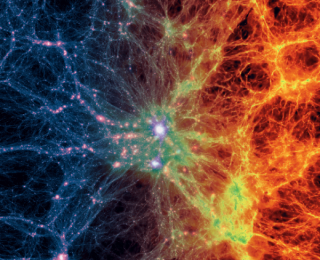
High resolution computational simulations are a valuable means by which Astronomers test our understanding of the Universe, and make predictions. The world of computational astrophysics broke new ground recently with the highest resolution cosmological simulation to date, Illustris, making for some spectacular science and some spectacular images.
by Erika Nesvold | May 9, 2014 | Daily Paper Summaries
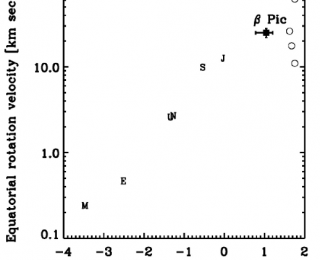
Planets in the Solar System with a higher mass spin faster than lower-mass planets. But what about planets in other systems? The authors of this paper make the first measurement of an exoplanet’s spin to compare its spin and mass to Solar System planets.
by Ruth Angus | May 8, 2014 | Daily Paper Summaries
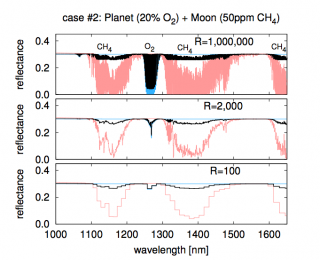
Exoplanets with moons could mimic alien life-signs.
by Elisa Chisari | May 7, 2014 | Daily Paper Summaries
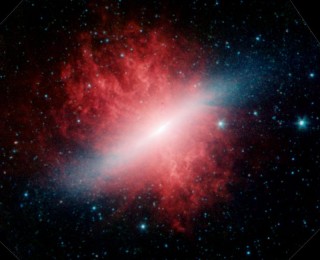
Can we find galaxies using the light emitted by their star forming regions? The authors of this paper explore a technique that would allow us to reach relatively unexplored epochs of the Universe.
by Meredith Rawls | May 5, 2014 | Daily Paper Summaries
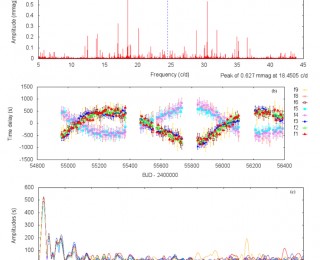
How do pulsating stars give away their secret identities as binary dance partners? In this paper, the authors demonstrate a new way to not only detect binaries we may have missed in the Kepler data, but also to measure their velocities without spectra.
