by Shannon Hall | Jul 20, 2013 | Daily Paper Summaries
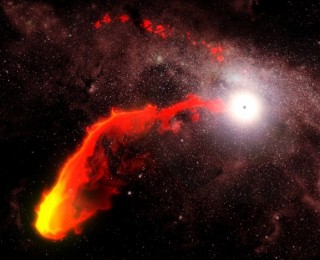
The long discussed gas cloud, G2, has finally begun its descent into the supermassive black hole at the center of our galaxy. The cloud has been so stretched that the head has swung around the black hole entirely and is rapidly coming back towards us (at a speed of 3000 km/s – 1% the speed of light), while the tail is still falling inwards – an event that will last for a year.
by Susanna Kohler | Jul 19, 2013 | Daily Paper Summaries
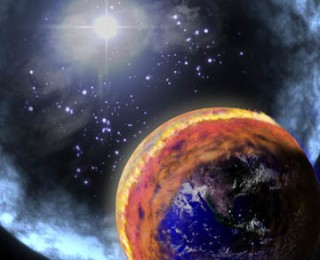
Looking for something fun to consider today? Try this on for size: what happens to life on Earth if a gamma-ray burst points at us from within our own galaxy?
by Shannon Hall | Jul 18, 2013 | Daily Paper Summaries
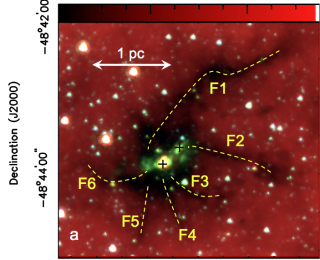
The formation of massive stars is still an intense topic of debate. Observations are difficult because massive star forming regions are heavily obscured by dust – invisible in the optical and near infrared. The trick is to look at much longer wavelengths. Today’s paper does just that, using the Atacama Large Millimeter Array (ALMA) in Chile to observe the birth of a massive star in submillimeter wavelengths. At 500 times the mass of the Sun and 1 million times brighter, it is the largest forming protostar ever seen in our galaxy.
by Nick Ballering | Jul 15, 2013 | Daily Paper Summaries
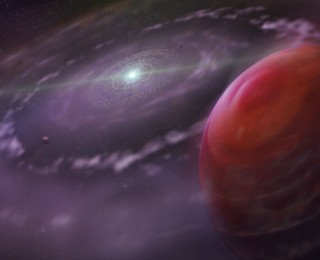
The mass of the cores of giant planets affects their luminosity after formation, complicating how we determine the mass of directly imaged planets.
by Guest | Jul 14, 2013 | Classics, Daily Paper Summaries
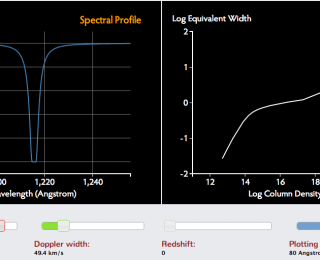
This guest post, the first in a three-part series, reviews the classic article by Gunn & Peterson (1965). This paper proposed several fundamental ideas in cosmology, including using distant quasars as “flashlights” to observe the diffuse gas between galaxies.
by Betsy Mills | Jul 13, 2013 | Daily Paper Summaries
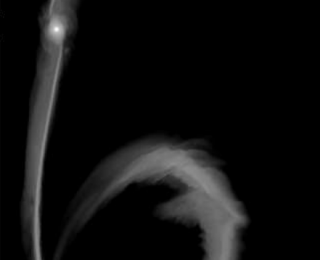
The authors of today’s paper investigate the feeding habits of the elusive quiescent supermassive black hole, finding that in addition to swallowing some stars whole and constantly snacking on the winds of other stars, some black holes may also dine on giant stars slowly disrupted over tens to hundreds of orbits.
