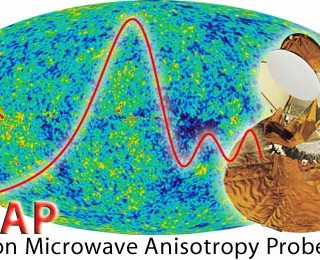
WMAP’s Closing Comments: ΛCDM Stands Strong
The final results from the WMAP satellite show agreement with the standard model of cosmology to unprecedented precision.

The final results from the WMAP satellite show agreement with the standard model of cosmology to unprecedented precision.
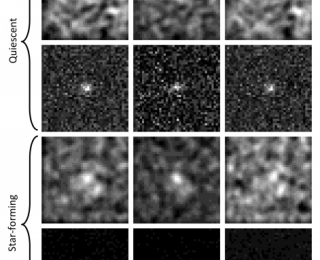
The authors investigate the fraction of massive galaxies at z ~ 2 that contains an Active Galactic Nucleus (AGN), in hopes of understanding the importance of AGN in quenching star formation.

How would the spectrum of the Earth change if our planet orbited a hotter or cooler star? Would alien astronomers still be able to detect signs of life?
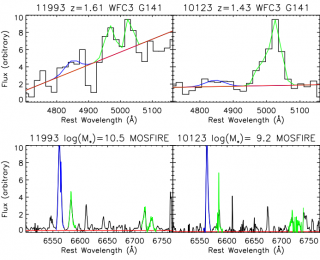
Using new data from the MOSFIRE spectrograph, the authors of this paper test the ability of classic emission line diagnostics to separate star formation activity from supermassive black hole accretion at high redshift. What they find may be important for understanding how the growth galaxies and black holes affect one another over cosmic time.
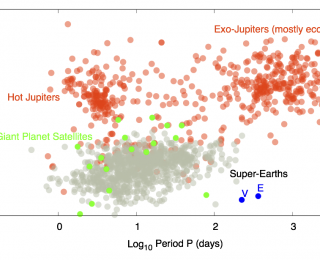
Do planets form in place, or migrate?
How planets form is still a remarkably open question. We haven’t even figured out definitively whether planets formed in the places they are now, or formed in different places and then migrated to their present locations.
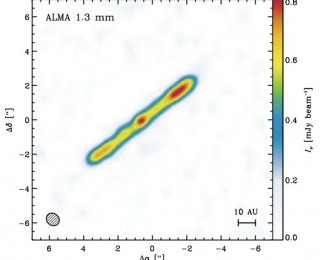
I’ve got pretty bad eyesight. If I take off my glasses and look at the flowers on my window sill, they look like a fuzzy yellow blob. But with glasses, the petals and the patterns cast on them come into focus. This is how I felt when looking at the new observations of the debris disk around AU Mic. Putting on our ALMA glasses, the fuzzy debris disk around AU Mic is sharpening into something surprisingly consistent with our own Solar System.