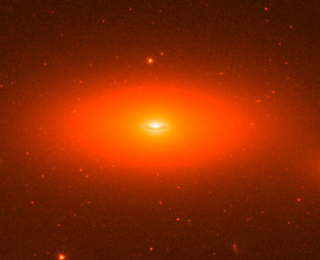
by Justin Vasel | Dec 5, 2012 | Daily Paper Summaries
Weighing in at 17 billion solar masses, NGC 1277 contains the largest black hole discovered to date. What makes this black hole exceptional it not just its size, but also that it does not seem to follow the relationship between most supermassive black holes and their host galaxies known as the M-sigma relation. The author’s discuss their findings and possible implications.
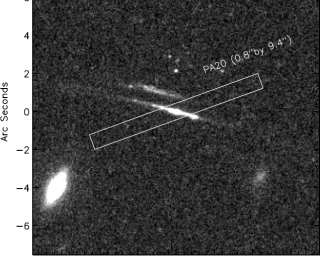
by Ryan Foltz | Dec 3, 2012 | Daily Paper Summaries
Using massive gravitational lenses can help us study the evolution of galaxies over unprecedented time scales.
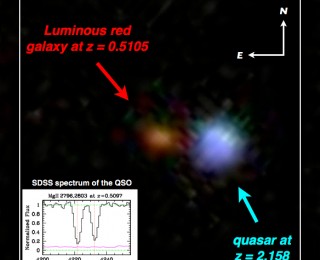
by Evan Schneider | Nov 30, 2012 | Daily Paper Summaries
We know that ellipticals in the local universe are huge galaxies, but how did they get so big? This study uses background quasars to probe the gas in regions around the progenitors of these modern-day giants.
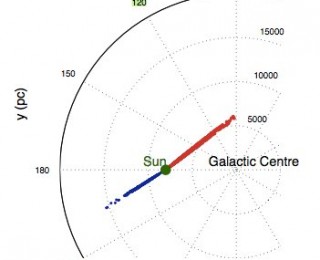
by Elisabeth Newton | Nov 29, 2012 | Daily Paper Summaries
“Galactic archaeology” is the term that has come to refer to using the motions and chemical compositions of stars of different ages to learn about the history of the Milky Way. It seems to me that “galactic paleontology” might be a bit more accurate. I hope to see galactic archaeology v. galactic paleontology fought out in the comments!
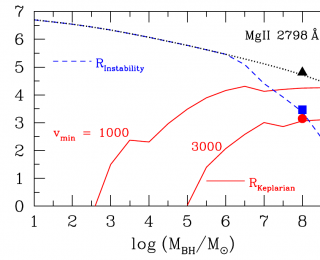
by Nathan Sanders | Nov 26, 2012 | Daily Paper Summaries
Observational surveys looking for the smallest super-massive black holes come up empty; could they be hiding in plain sight?
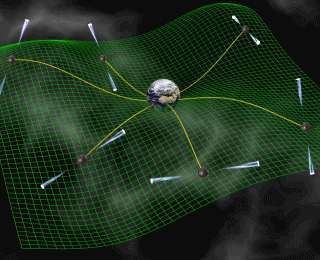
by Chris Faesi | Nov 23, 2012 | Daily Paper Summaries
The race to be the first to detect gravitational waves is on – are pulsar timing arrays on the verge of a discovery? New predictions based on revised galaxy merger calculations suggest that it may be so.
