by Adele Plunkett | Nov 18, 2012 | Classics, Daily Paper Summaries
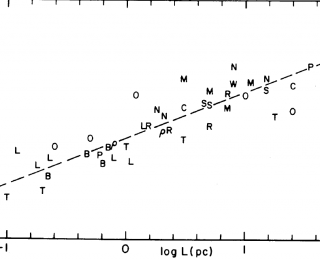
This paper presents three famous relations very important for understanding the inner workings of molecular clouds and star formation processes.
by Lucia Morganti | Nov 16, 2012 | Daily Paper Summaries
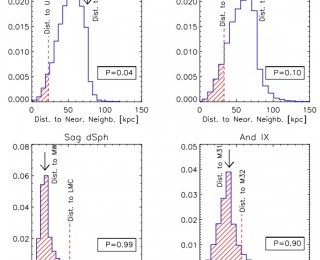
Pairs of dwarf galaxies in the Local Group are much more common than what expected from N-body/semi-analytic models of galaxy formation.
by Sukrit Ranjan | Nov 14, 2012 | Daily Paper Summaries
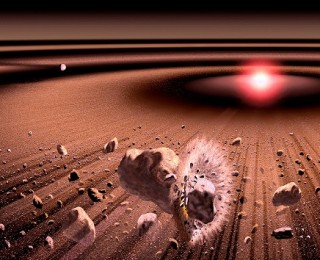
Paper Title: Comet-Like Mineralogy of Olivine Crystals in an Extrasolar Proto-Kuiper Belt (arxiv: 1211.2626) Authors: B. L. de Vries et al First Author’s Affiliation: K. U. Leuven, Flanders, Belgium Journal: Nature OverviewThis paper describes observations of the mineral olivine in the famous debris disk surrounding the star Beta Pictoris. Olivine is very important as it is one of the primary building blocks of rocky planets. They find its composition and temperature to match what we find in our outer solar system, hinting that we are spying on a proto-Kuiper belt. The similarity between solar systems suggests similar processes may be operating in other systems as happened here around Sol.More DetailIn the past decade, we’ve made huge advances in remote characterization of planetary bodies. From the atmospheres of exoplanets to the surfaces of asteroids, astronomers have conducted some pretty extraordinary measurements (for example, the discovery of Alpha Centauri Bb, which entailed measuring the motion of Alpha Cen to 51 cm/s — a slow walk!). However, most of these measurements have been surface measurements. It’s much harder to study the interiors of objects, because we don’t receive photons from them.There are exceptions, though. Consider a young planetary system with plenty of asteroids. These asteroids will run into each other, shattering apart and generating dust. Light passing through these dust clouds will then have their spectral signature imprinted on them, letting us study their interior composition!Astronomers have discovered several such systems, allowing us for the first time to characterize the interior composition of rocky bodies remotely. This paper presents the results of the latest such study, on the system Beta Pictoris. Beta...
by Maria Drout | Nov 12, 2012 | Daily Paper Summaries
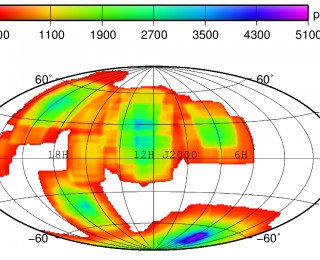
Astronomers at Harvard are working to digitize over 500,000 historic photographic plates obtained between 1985 and 1993. With about ~8% of the plates scanned they are already offering us a unique glimpse into the variability of the universe on a 100 year time scale.
by Shannon Hall | Nov 11, 2012 | Daily Paper Summaries
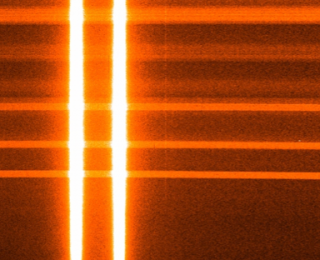
The field of exoplanet research is rapidly expanding. Presented here are the results from a recent ground-based study of an exoplanet’s atmosphere. We have characterized the atmospheres of less than ten exoplanets. By opening up the frontier for ground-based telescopes to do such ground-breaking research we will be able to characterize the atmospheres of hundreds of exoplanets.
by Lauren Weiss | Nov 10, 2012 | Daily Paper Summaries
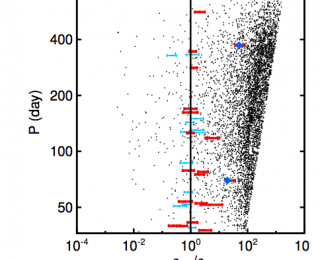
Title: A Paucity of Proto-Hot Jupiters on Super-Eccentric Orbits Authors: Rebekah I. Dawson, Ruth A. Murray-Clay, John Asher Johnson First Author’s Institution: Harvard-Smithsonian Center for Astrophysics Note: This post is based in part on a talk by Rebekah Dawson at the UC Berkeley Planet and Star Formation Seminar on Nov. 7, 2012.IntroductionHow do planets form, and after formation, how do they change their orbits (or “migrate”) to come to their present orbits? The increasing catalog of confirmed exoplanets (planets around other stars), in tandem with the also increasing list of exoplanet candidates discovered by the Kepler Mission, is making it possible to answer these questions through statistical tests of the exoplanet population.The authors investigate the formation history of a particular population of exoplanets called hot Jupiters, Jupiter-size planets in short orbits (in this study, 3-10 days) around their stars. The consensus among most scientists is that hot Jupiters are too big to have formed in their present location; they more likely formed oustide the “ice line,” or the radius at which water can freeze. This is because frozen water molecules can clump into tiny ice crystals, which could then aggregate into larger snowballs to form giant planets. Very few proposed mechanisms (such as core collapse, in which a clump of gas spontaneously collapses to form a planet) could form Jupiters inside the ice line, and these mechanisms are disfavored based on the current body of observations. Thus, theory says that hot Jupiters should have formed beyond the ice line and then migrated inward to their current, super-hot abodes. But how did they get there?There are two popular theories that could bring...
