by Alice Olmstead | Sep 25, 2012 | Daily Paper Summaries
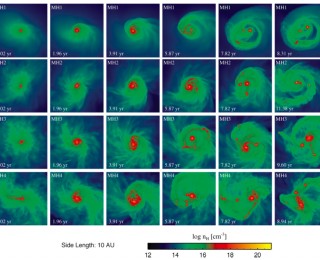
In a recent paper, Stacy et al. reveal the detailed internal structure of the seeds of four of the first stars, and demonstrate for the first time that they are rapidly spinning throughout. Their results bring us one step closer to a coherent story of the lives and deaths of Population III stars.
by Caroline Morley | Sep 21, 2012 | Daily Paper Summaries
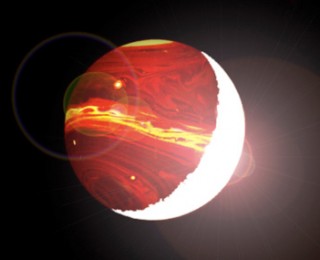
Astronomers have started trying to understand how to organize classes of exoplanets based on their physical characteristics. As it has turned out over the last ten years, exoplanets are considerably more complicated to classify than stars. The evolution of star is based (almost) exclusively on how massive it is at birth. Instead, this paper classifies hot exoplanets by their level of irradiation from their host star and their chemical composition.
by Maria Drout | Sep 17, 2012 | Daily Paper Summaries
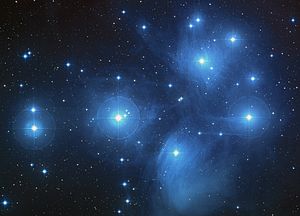
Several months ago NASA put out a request for information to astronomers asking what the main scientific goals of the next generation of Ultra-Violet space missions should be. These authors submitted a white paper arguing the case for massive star science.
by Justin Vasel | Sep 17, 2012 | Daily Paper Summaries
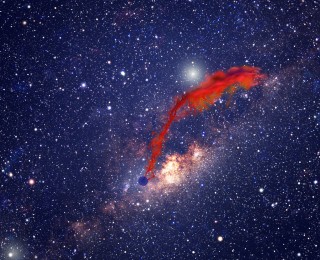
Paper Title: Disruption of a Proto-Planetary Disk by the Black Hole at the Milky Way Centre Authors: Murray-Clay, R. A. and Loeb, A. Institution: Harvard-Smithsonian Center for Astrophysics (CfA)If our solar system lives in suburbia, the center of our galaxy is a sprawling metropolis shining bright for all to see. The center of our Milky Way Galaxy is a crowded, bustling and hectic place. Stars race around like cars on a freeway. Densely-packed hot stars and supernova explosions flood the region with deadly radiation. The supermassive black hole at the center destroys anything that dares to wander too close and test its strength. The galactic center is different than what we’re used to. It’s exciting. It’s dangerous. It’s the kind of place that’s fun to visit, but you wouldn’t want to raise your kids there. The traditional wisdom among astronomers is that stars feel the same way; There is just too much excitement going on in the galactic center for planets to form around stars…Or is there?Last year, a team of astronomers at the Very Large Telescope (VLT) in Chile discovered a cloud of gas falling towards the black hole at the center, Sagittarius-A* (SgrA*). The team hypothesized that the gas cloud was the result of a collision between two gas clouds streaming from nearby stars. New research from the CfA proposes the seemingly-unlikely explanation the gas cloud is a proto-planetary disk surrounding a star that is too faint to see. A proto-planetary disk is a cloud of gas and dust that orbits a star for millions of years while it slowly coalesces into planets and asteroids and comets; It is where...
by Shannon Hall | Sep 16, 2012 | Daily Paper Summaries
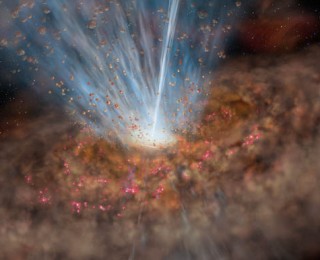
In the nearby Universe, massive galaxies contain very little interstellar gas and old stellar populations. But theoretical models predict that such galaxies should have much younger stellar populations. In order to solve this discrepancy models invoke quasar outflows in the early Universe. Such outflows would expel the gas from a galaxy and quench star formation. Presented here are the results from the first massive quasar outflow observer at z ~ 6.4189.

by Courtney Dressing | Sep 14, 2012 | Daily Paper Summaries
How well do stellar models match? Would astronomers using different stellar models and identical data determine consistent fits?
