by Evan Schneider | Oct 3, 2012 | Daily Paper Summaries
We know most galaxies host supermassive black holes at their centers, but how do they get so big? In this study, the authors investigate one of the smallest known supermassive black holes (weighing in at only 100,000 solar masses), to shed some light on what a young, accreting black hole might look like.
by Dan Gifford | Oct 2, 2012 | Daily Paper Summaries
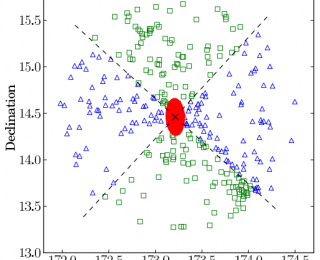
Title: Spatial Anisotropy of Galaxy Kinematics in Sloan Digital Sky Survey Galaxy ClustersFirst Author: Skielboe, A.Galaxy clusters are beautifully simple, but also fantastically complicated structures. For many years, astronomers have treated these systems as spherical cows, but simulations and observations have repeatedly shown that clusters exhibit triaxial rather than spherical shapes with nice relaxed dynamics (are virialized). Many cluster mass estimators assume spherically symmetric velocity fields (i.e. you measure the same velocities of cluster galaxies regardless of which side you observe from), but if the shape is anisotropic it’s probable the velocities are as well. This makes it crucial to measure the degree of triaxiality of clusters in observations to constrain its impact on mass estimates.The authors sought to show that velocity anisotropy exists by testing for an azimuthal (angle on the sky) dependence of the projected velocity dispersion. To do this, they used a stacked sample of galaxy clusters from the Sloan Digital Sky Survey (SDSS). Stacking is a common technique of taking many clusters with a similar property (in this case galaxy richness or number which is a proxy for mass) and adding them together to make a composite system with many hundreds more galaxies than any one system alone. This gives much better statistics and makes a result more robust.Because the authors are looking for azimuthal variations, they fit each cluster with an ellipse and stack them with their major axes aligned. They then estimate the projected velocity dispersion for galaxies closer to the stacked minor axis, and a separate velocity dispersion for galaxies closer to the major axis. Because they have a stacked sample with...
by Nathan Sanders | Oct 1, 2012 | Daily Paper Summaries
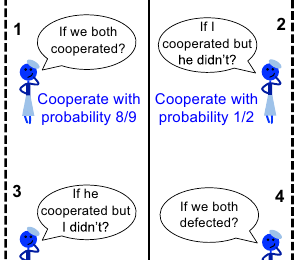
The Prisoner’s Dilemma is one of the classic problems in game theory, first posed in 1950 and studied exhaustively for generations. Remarkably, a new solution has been discovered that prompts us to re-examine long held principles.
by Sukrit Ranjan | Sep 28, 2012 | Daily Paper Summaries
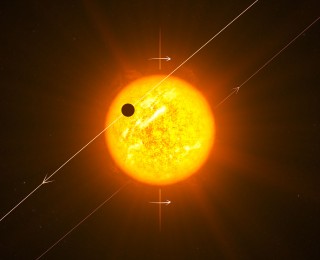
This work presents an interesting new idea to explain the apparent misalignment between the rotation of stars and the orbits of their planets.
by Courtney Dressing | Sep 27, 2012 | Daily Paper Summaries
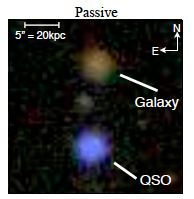
Astronomers often refer to elliptical galaxies as “red and dead” because they appear red in color and aren’t currently forming stars. In this paper, the authors present evidence that elliptical galaxies might not be as dead as we assume.
by Elisabeth Newton | Sep 26, 2012 | Daily Paper Summaries
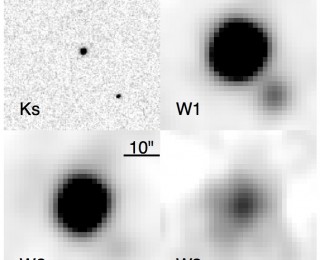
Astronomers like to find cool things. The first Earth-sized planet. The most distant galaxy yet. Two stars that merged while we watched. The coolness factor is certainly one reason why we keep at it – who wouldn’t want to be the first to find an Earth-sized planet, or the first human to see light from a galaxy that’s existed for billions of years? But there’s also a compelling scientific reason to search for these oddballs. This paper reports on the likely discovery of dust around a pair of binary stars.
