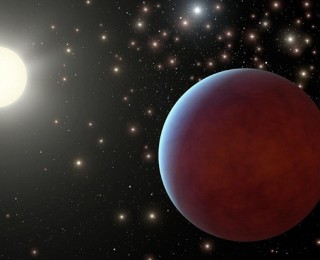
Planet Formation in Dense Environments
This paper looks at the role a young star’s environment plays in forming planets around it.

This paper looks at the role a young star’s environment plays in forming planets around it.
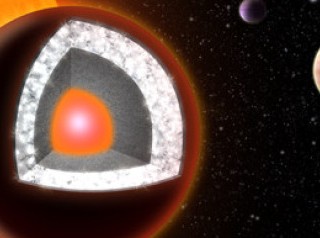
A team of astronomers and geologists have teamed up to study the composition of a rocky super-Earth which likely contains a layer of carbon in the form of diamond and graphite.
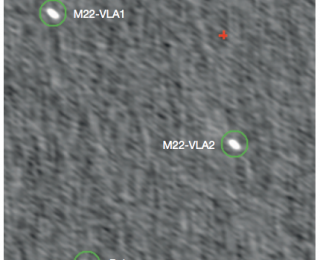
In this article, the authors report their serendipitous discovery of two stellar mass-black holes in the globular cluster M22, however theoretical work predicts that there should only be one stellar-mass black hole!
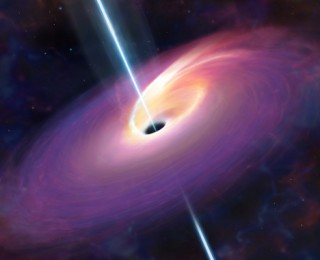
Do all tidal disruption events produce jets? This paper tests the hypothesis that they do!
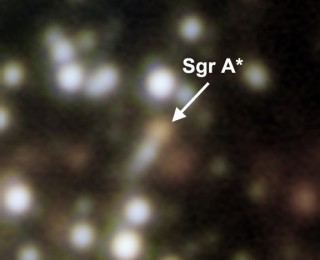
Witzel et. al examine the statistical properties of the photometric variability of our Galaxy’s central black hole.
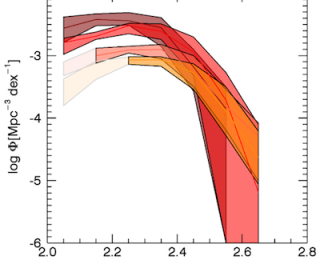
Astronomers at Yale investigate how the number of galaxies at fixed inferred velocity dispersion (a probe of the total gravitational potential) changes as a function of time. Their results support a picture where star-forming galaxies are somehow “quenched” and transition to the non-star-forming galaxy population, consistent with leading ideas of galaxy evolution.