by Ian Czekala | Jul 8, 2012 | Daily Paper Summaries
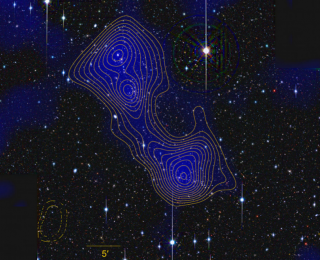
Throughout much of the 20th century, it was an open question in astronomy as to what the universe looked like on the largest observable scales. Were galaxies and galaxy clusters distributed uniformly throughout space, or was there a pattern? Thanks to galaxy surveys we know that, on large scales, the matter distribution of the universe is clumpy instead of smooth. Through these surveys we observe directly the distribution of luminous matter like stars, gas, and galaxies. However, luminous matter comprises only a small fraction of the matter in the universe (17%), the rest is dark matter which interacts via gravity but does not absorb and emit electromagnetic radiation like normal matter. Theoretical simulations of dark matter cosmologies firmly predict that there is a dark matter backbone to the cosmic web, with filaments of dark matter stretching between clusters of galaxies, though has not yet been a robust detection of a dark matter filament, until now.
by Nick Hand | Jul 8, 2012 | Daily Paper Summaries
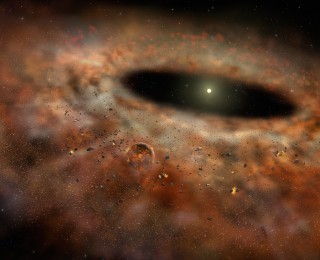
The authors report on a young, Sun-like star with a debris disk of dust and larger rocks that has had the dust particles mysteriously vanish from the disk in a span of less than two years.
by Courtney Dressing | Jul 5, 2012 | Daily Paper Summaries
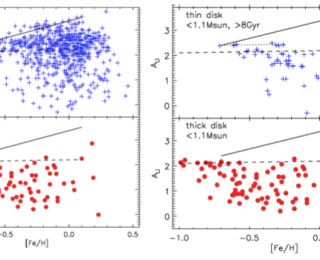
Is there a link between lithium abundance, galactic chemical evolution, and exoplanets? Ramirez et al. examine metallicities, lithium abundances, and stellar characteristics of 1381 Sun-like stars to find out.
by Alice Olmstead | Jul 4, 2012 | Daily Paper Summaries
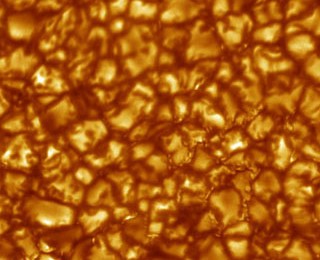
One prediction of General Relativity is that because of the way that gravity affects time, the frequency of electromagnetic radiation (light) emitted at the solar surface should decrease as it escapes the Sun’s gravitational potential well, i.e., the solar spectrum should appear gravitationally redshifted. Surprisingly, according to this recent paper by Takeda and Ueno, that prediction had yet to be definitively verified…until now.

by Elisabeth Newton | Jul 4, 2012 | Daily Paper Summaries
A patch of sky on the outskirts of Andromeda was observed for 7.5 hours with the Hubble space telescope, in which they found 630 RR Lyraes.
by Kim Phifer | Jul 2, 2012 | Daily Paper Summaries
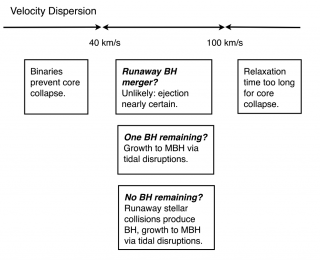
Miller & Davies investigate whether central black holes should exist in low mass stellar systems such as globular clusters.
