by Maria Drout | Oct 19, 2011 | Daily Paper Summaries
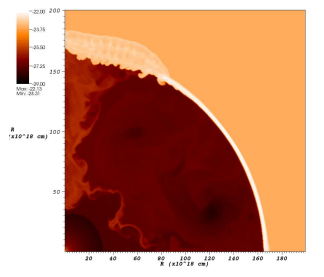
How can the medium immediately surrounding massive stars affect our observations of Gamma-Ray Bursts?

by Sukrit Ranjan | Oct 19, 2011 | Daily Paper Summaries
• Paper title: Modeling the Infrared Spectrum of the Earth-Moon System: Implications for the Detection and Characterization of Earthlike Extrasolar Planets and their Moonlike Companions (arXiv:1110.3744v1) • Authors: Tyler D. Robinson • First Author’s Affiliation: University of WashingtonIntroduction The holy grail of exoplanet scientists is the detection and characterization of a true Earth-analog, an “Earth-twin” orbiting another star. A number of great studies have been done towards this goal; see for example the EPOXI mission, which turned the sensors on Deep Impact back towards Earth to see what we could learn about its atmosphere from remote observation alone. Yet many of these studies consider the Earth in isolation. They ignore the fact that we have a very significant companion in the form of the Moon. Given how close the Earth and Moon orbit, it is unlikely that any exoplanet characterization mission we can envision will be able to resolve an Earth-Moon system analog (the Earth-Moon separation would be 5 milliarcseconds at just 5 parsecs). Therefore, any spectra we take of a terrestrial planet would likely include flux from unseen companions. Recent planet formation modelling suggests that impacts of the kind that formed the Moon may be common. What would be the effect of a lunar companion on measured atmospheric spectra, and how might we ascertain the existence of such a companion? This article explored these questions.MethodThis paper builds on previous work that looked for the effect of a lunar body on an Earth-analog in a bolometric (i.e. total luminosity) sense, which found that the orbiting body needed to be Mars-sized in order to be detectable through broadband photometry. In...
by Guest | Oct 17, 2011 | Daily Paper Summaries
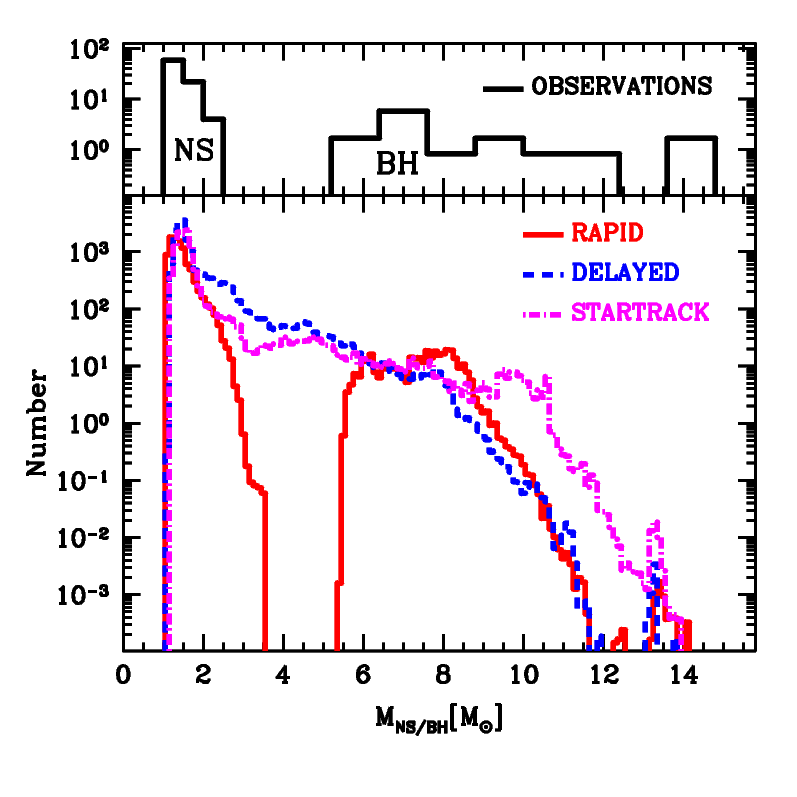
You might think that stars with an approximately continuous distribution of masses would lead to remnants with an approximately continuous distribution masses. But you’d be wrong.
by Adele Plunkett | Oct 14, 2011 | Daily Paper Summaries
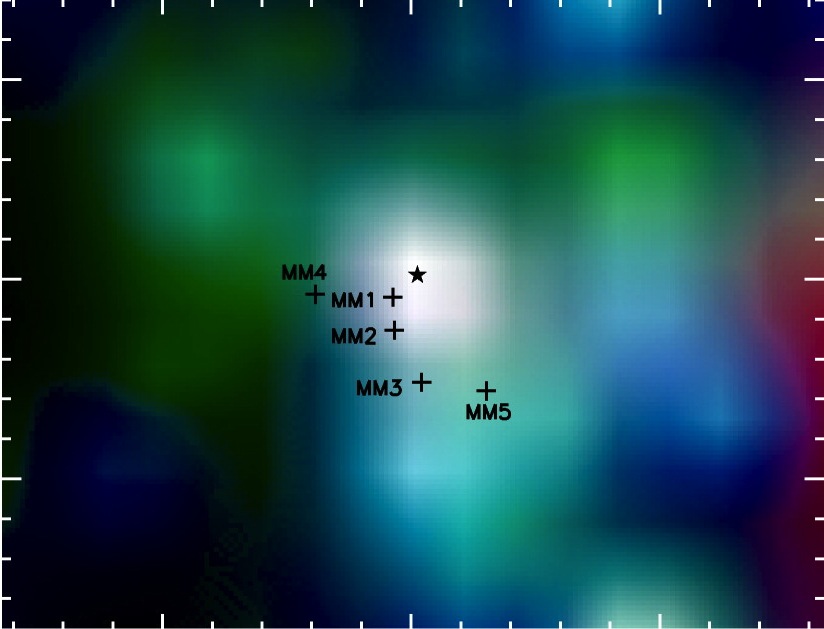
The common picture of star formation includes the gravitational collapse of cores within molecular clouds, with mass accreting either directly or via a disk. An important aspect of the model is that some component must lower the angular momentum of the accreting material. By observing infalling envelopes, especially at different stages of star formation, the mechanism for mass accretion can be studied.
by Elisabeth Newton | Oct 12, 2011 | Daily Paper Summaries
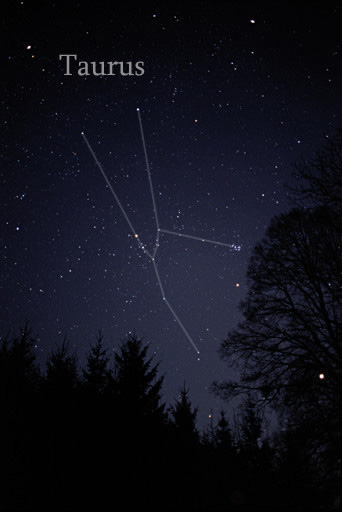
If you’re looking at the sky this evening, you can see the constellation of Taurus the Bull just above the horizon to the east. The bull’s face is outlined by a group of a stars that make up the Hyades cluster, a very near and well-known open cluster. This theory paper tries to understand the evolution of the Hyades cluster from formation to the present day using N-body simulations.
by Kirit Karkare | Oct 11, 2011 | Daily Paper Summaries
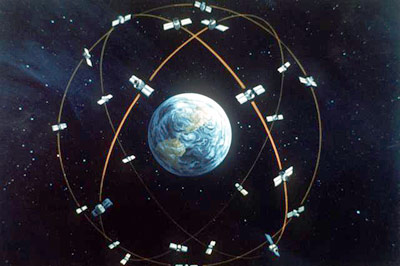
Water absorption in the atmosphere can be a big problem for Near-IR observations. This paper shows how to measure and correct for atmospheric water vapor using GPS satellites.
