
Featured Astrobites
Our latest posts
One is the Loneliest Number: Destroying Planet-Planet Binaries
JWST’s discovery of free-floating binary planetary-mass objects came as quite a surprise and tests theories of planet formation. Today’s paper investigates whether dynamical encounters in dense star-forming regions could destroy such binary systems.

An Exercise in Satellite Mission Design: Instrument Requirements
In today’s bite we are once again revisiting the mission design concept MAUVE to learn how science objectives drive instrument design requirements!

Using Large-scale structures and gravitational wave sources to measure the expansion rate
In today’s astrobite we explore a new approach that has been developed to measure the Universal expansion rate, involving gravitational waves from merging black holes and the large-scale structure of the Universe.
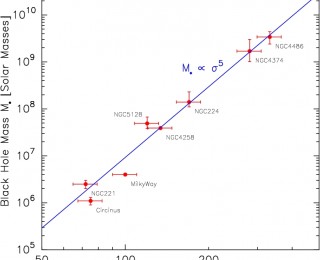
On the Straight and Narrow: How Black Hole Seeds Agree with Scaling Relations
How are the masses of growing black holes in the early universe are correlated with properties of their host galaxies? Read on to see what today’s authors found!
Following up on flares: Can we spot black hole mergers in AGN disks?
In today’s Astrobite, we revisit the possibility of binary black hole mergers in AGN disks creating flares, which could have interesting implications for multimessenger astronomy and cosmology.
Sharing is caring: how do binary stars actually transfer mass?
Mass transfer is a fundamental parameter for determining how binary stars evolve. A 3D hydrodynamic simulation enables real-time movies of how material moves from one star to another!
Beyond astro-ph
Astronomy beyond the research
No Results Found
The page you requested could not be found. Try refining your search, or use the navigation above to locate the post.
Navigating careers in astronomy
Career advice
Meet the AAS Keynote Speakers: Dr. Catherine Espaillat
How do the protoplanetary disks around young pre-main sequence stars evolve into planetary systems? Come attend Dr. Catherine Espaillat’s plenary talk “From Disks to Planets: Observing Planet Formation in Disks Around Young Stars” at #AAS233 to know more!
Meet the AAS Keynote Speakers: Dr. Julianne Dalcanton
The Milky Way’s nearest neighbor, the Andromeda galaxy, is a promising target for deep multi-wavelength observations. Come listen to Prof. Julianne Dalcanton talk about her work catching up with the neighbor at #AAS233!
Meet the AAS Keynote Speakers: Dr. Caitlin Casey
Some galaxies are easy to find—others, like dusty galaxies with extreme star formation, are a bit harder to track down. Come to Professor Caitlin Casey’s #AAS233 talk to learn how we can find these galaxies in the “obscured early universe”!