
by Tanmoy Laskar | May 21, 2011 | Daily Paper Summaries
Photons do not normally talk to each other – but put GeV gamma-rays into a high enough background radiation field, and eventually one will break the ice.
by Katherine Rosenfeld | May 13, 2011 | Daily Paper Summaries
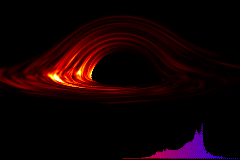
Einstein’s theory of General Relativity predicts all manner of strange astrophysical behaviors. Can we hope to observe these effects from supermassive black holes?
by Aaron Bray | May 12, 2011 | Daily Paper Summaries
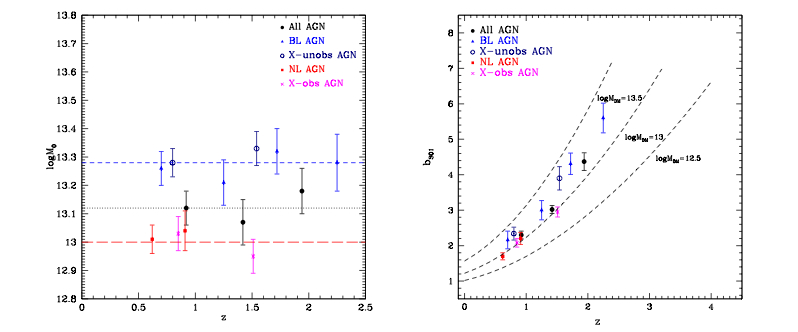
Using measurements of the projected correlation function, Allevato et al. study the evolution of X-ray selected, active galactic nuclei (AGN) in order to help understand how these massive, central black holes are triggered and where they fit in a larger cosmological framework.
by Susanna Kohler | Apr 22, 2011 | Daily Paper Summaries
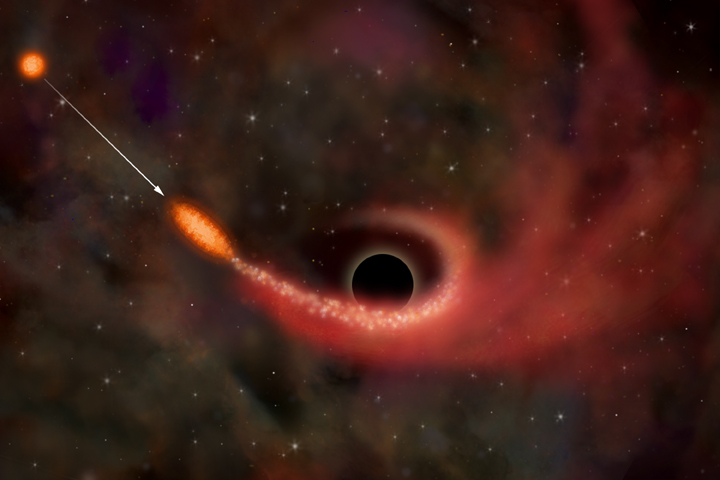
What happens when a normally-dormant black hole at the center of a galaxy tears apart a passing star and burps it back out again in the form of a jet? The authors of this paper think that the Swift satellite has recently witnessed exactly this!
by Evan Schneider | Apr 20, 2011 | Daily Paper Summaries
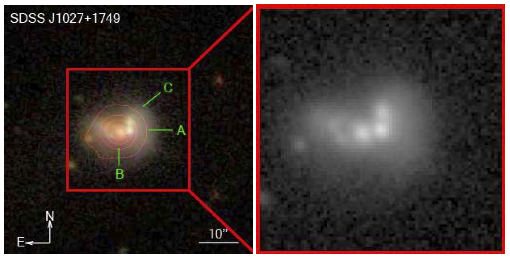
In this paper, the authors describe a system of three supermassive black holes interacting on kpc scales, and use their result to estimate the frequency of such interactions.
by Nathan Goldbaum | Apr 15, 2011 | Daily Paper Summaries
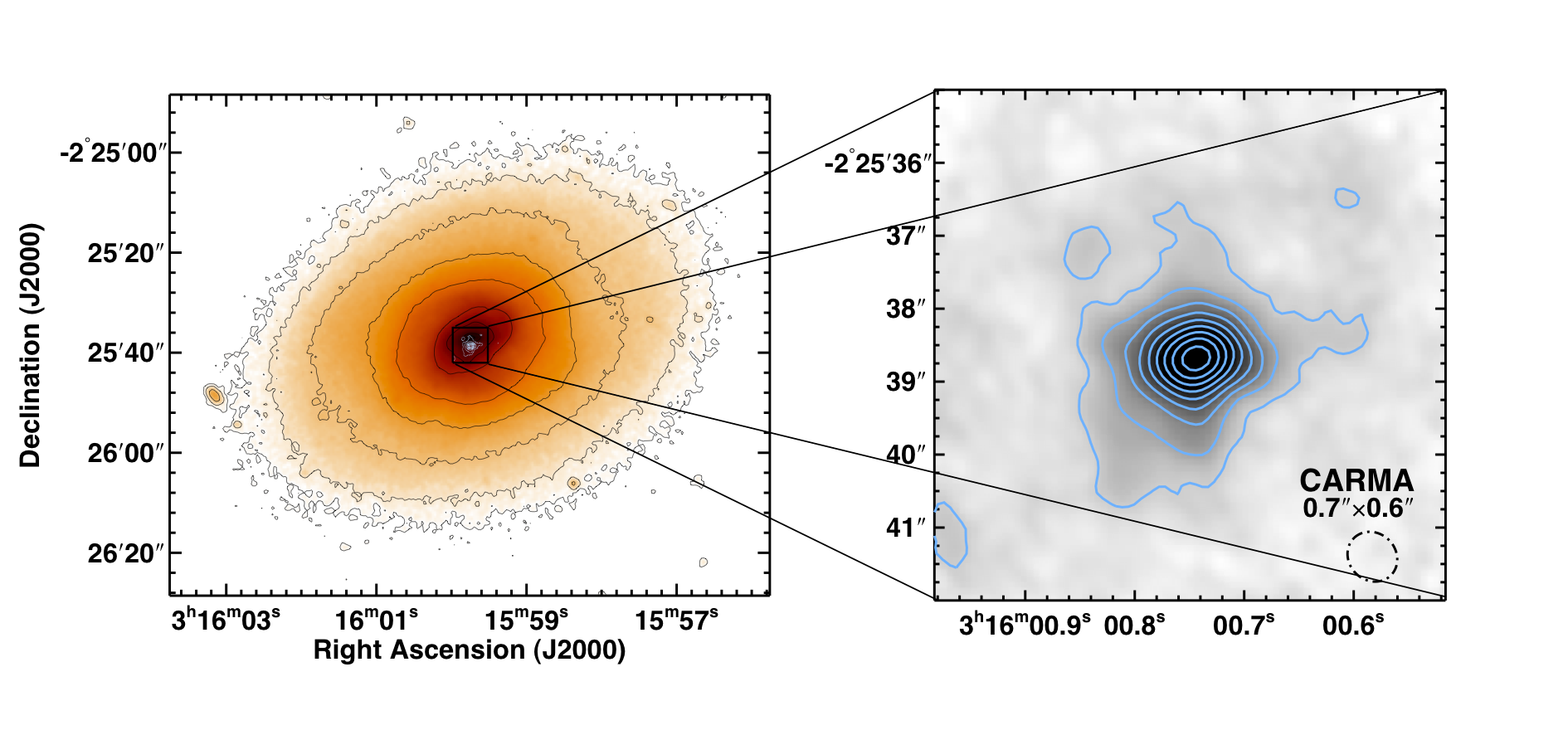
Title: Discovery of an AGN-Driven Molecular Outflow in the Local Early-Type Galaxy NGC 1266 Authors: Katherine Alatalo, Leo Blitz, Lisa M. Young, Timothy A. Davis, Martin Bureau, Laura A Lopez, Michele Cappellari, Nicholas Scott, Kristen L. Shapiro, Alison F. Crocker, Sergio Martin, Maxime Bois, et al. First author’s institution: University of California, Berkeley Today’s astrobite deals with an exciting but puzzling observation of a local galaxy, NGC 1266. These observations are exciting because they go against the standard lore of how galaxies form. This particular galaxy has been classified as an S0, a type of galaxy associated with little gas and an old stellar population. Most observers assume that S0 and elliptical galaxies are ‘red and dead’, that is, that they finished forming stars long ago and that the light we see mainly comes from older, low-mass stars that emit redder light than young, massive stars, which tend to dominate the light we see from star-forming galaxies.Recently, however, many studies have begun to find that S0s and ellipticals exhibit a low level of star formation and actually can host a significant amount of gas. This paper is part of the ATLAS3D project, which aims to infer the atomic and molecular gas content as well as the stellar kinematics of a sample of ‘red and dead’ elliptical and S0 galaxies. This particular paper makes use of multiwavelength data that span the electromagnetic spectrum from radio to x-rays. Perhaps most interesting are the submillimeter observations from the IRAM 30m telescope in southern Spain, the CARMA submillimeter array in Owens Valley California, and the SMA array on top of Mauna Kea on the Big Island of Hawaii. The submillimeter observations trace the molecular gas content...
